Webster Griffin Tarpley
TheAlexJonesChannel
February 16, 2011
Showing posts with label Egyptian Revolution. Show all posts
Showing posts with label Egyptian Revolution. Show all posts
Thursday, February 17, 2011


Wednesday, February 16, 2011
Israel Looks More and More Like a Fascist Regime
Egypt's Revolution and Israel: "Bad for the Jews"
By Ilan Pappe

Is Arab democracy bad for Israel? (Matthew Cassel)
February 15, 2011 "The Electronic Intifada" -- The view from Israel is that if they indeed succeed, the Tunisian and Egyptian revolutions are bad, very bad. Educated Arabs -- not all of them dressed as "Islamists," quite a few of them speaking perfect English whose wish for democracy is articulated without resorting to "anti-Western" rhetoric -- are bad for Israel.
Arab armies that do not shoot at these demonstrators are as bad as are many other images that moved and enthused so many people around the world, even in the West. This world reaction is also bad, very bad. It makes the Israeli occupation in the West Bank and Gaza Strip and its apartheid policies inside the state look like the acts of a typical "Arab" regime.
For a while you could not tell what official Israel thought. In his first ever commonsensical message to his colleagues, Prime Minister Benjamin Netanyahu asked his ministers, generals and politicians not to comment in public on the events in Egypt. For a brief moment one thought that Israel turned from the neighborhood's thug to what it always was: a visitor or permanent resident.
It seems Netanyahu was particularly embarrassed by the unfortunate remarks on the situation uttered publicly by General Aviv Kochavi, the head of Israeli military intelligence. This top Israeli expert on Arab affairs stated confidently two weeks ago in the Knesset that the Mubarak regime is as solid and resilient as ever. But Netanyahu could not keep his mouth shut for that long. And when the boss talked all the others followed. And when they all responded, their commentary made Fox News' commentators look like a bunch of peaceniks and free-loving hippies from the 1960s.
The gist of the Israeli narrative is simple: this is an Iranian-like revolution helped by Al Jazeera and stupidly allowed by US President Barack Obama, who is a new Jimmy Carter, and a stupefied world. Spearheading the Israeli interpretation are the former Israeli ambassadors to Egypt. All their frustration from being locked in an apartment in a Cairean high-rise is now erupting like an unstoppable volcano. Their tirade can be summarized in the words of one of them, Zvi Mazael who told Israeli television's Channel One on 28 January, "this is bad for the Jews; very bad."
In Israel of course when you say "bad for the Jews," you mean the Israelis -- but you also mean that whatever is bad for Israel is bad for the Jews all around the world (despite the evidence to the contrary since the foundation of the state).
But what is really bad for Israel is the comparison. Regardless of how all this would end, it exposes the fallacies and pretense of Israel like never before. Egypt is experiencing a peaceful Intifada with the deadly violence coming from the side of the regime. The army did not shoot at the demonstrators; and even before the departure of Mubarak, already seven days into the protests, the minister of interior who directed his thugs to violently crash the demonstrations had been sacked and will probably be brought to justice.
Yes, this was done in order to win time and try to persuade the demonstrators to go home. But even this scene, by now forgotten, can never happen in Israel. Israel is a place where all the generals who ordered the shootings of Palestinian and Jewish anti-occupation demonstrators now compete for the highest post of Chief of the General Staff.
One of them is Yair Naveh, who gave orders in 2008 to kill Palestinian suspects even if they could be peacefully arrested. He is not going to jail; but the young woman, Anat Kamm, who exposed these orders is now facing nine years in jail for leaking them to Israeli daily Haaretz. Not one Israeli general or politician has or is going to spend one day in jail for ordering the troops to shoot at unarmed demonstrators, innocent civilians, women, old men and children. The light radiating from Egypt and Tunisia is so strong that it also illuminates the darker spaces of the "only democracy in the Middle East."
Nonviolent, democratic (be they religious or not) Arabs are bad for Israel. But maybe these Arabs were there all along, not only in Egypt, but also in Palestine. The insistence of Israeli commentators that the most important issue at stake -- the Israeli peace treaty with Egypt -- is a diversion, and has very little relevance to the powerful impulse that is shaking the Arab world as a whole.
The peace treaties with Israel are the symptoms of moral corruption not the disease itself -- this is why Syrian President Bashar Asad, undoubtedly an anti-Israeli leader, is not immune from this wave of change. No, what is at stake here is the pretense that Israel is a stable, civilized, western island in a rough sea of Islamic barbarism and Arab fanaticism. The "danger" for Israel is that the cartography would be the same but the geography would change. It would still be an island but of barbarism and fanaticism in a sea of newly formed egalitarian and democratic states.
In the eyes of large sections of Western civil society the democratic image of Israel has long ago vanished; but it may now be dimmed and tarnished in the eyes of others who are in power and politics. How important is the old, positive image of Israel for maintaining its special relationship with the United States? Only time will tell.
But one way or another the cry rising from Cairo's Tahrir Square is a warning that fake mythologies of the "only democracy in the Middle East," hardcore Christian fundamentalism (far more sinister and corrupt than that of the Muslim Brotherhood), cynical military-industrial corporate profiteering, neo-conservatism and brutal lobbying will not guarantee the sustainability of the special relationship between Israel and the United States forever.
And even if the special relationship perseveres for a while, it is now based on even shakier foundations. The diametrically-opposed case studies of the so far resilient anti-American regional powers of Iran and Syria, and to some extent Turkey, on the one hand, and the fallen ultimate pro-American tyrants, on the other are indicative: even if it is sustained, American support may not be enough in future to maintain an ethnic and racist "Jewish state" in the heart of a changing Arab world. (Editor: one can only hope)
This could be good news for the Jews, even for the Jews in Israel in the long run. To be surrounded by peoples who cherish freedom, social justice and spirituality and navigating sometimes safely and sometimes roughly between tradition and modernity, nationalism and humanity, aggressive capitalist globalization and daily survival, is not going to be easy.
Yet it has a horizon, and it carries hope of triggering similar changes in Palestine. It can bring a closure to more than a century of Zionist colonization and dispossession, to be replaced by more equitable reconciliation between the Palestinian victims of these criminal policies wherever they are and the Jewish community. This reconciliation would be built on the basis of the Palestinian right of return and on all the other rights the people of Egypt so bravely fought for in the last twenty days.
But trust the Israelis not to miss an opportunity to miss peace. They would cry wolf. They would demand, and receive, more funds from the American taxpayer due to the new "developments." They would interfere clandestinely and destructively to undermine any transition to democracy (remember what force and viciousness characterized their reaction to democratization in Palestinian society?), and they would elevate the Islamophobic campaign to new and unprecedented heights.
But who knows, maybe the American taxpayer would not budge this time. And maybe the European politicians would follow the general sentiment of their public and allow not only Egypt to be dramatically transformed, but also welcome a similar change in Israel and Palestine. In such a scenario the Jews of Israel have a chance to become part of the real Middle East and not an alien and aggressive member of a Middle East which was the figment of the hallucinatory Zionist imagination. (Editor's bold emphasis throughout)
Ilan Pappe is Professor of History and Director of the European Centre for Palestine Studies at the University of Exeter. His most recent book is Out of the Frame: The Struggle for Academic Freedom in Israel (Pluto Press, 2010).
By Ilan Pappe
Is Arab democracy bad for Israel? (Matthew Cassel)
February 15, 2011 "The Electronic Intifada" -- The view from Israel is that if they indeed succeed, the Tunisian and Egyptian revolutions are bad, very bad. Educated Arabs -- not all of them dressed as "Islamists," quite a few of them speaking perfect English whose wish for democracy is articulated without resorting to "anti-Western" rhetoric -- are bad for Israel.
Arab armies that do not shoot at these demonstrators are as bad as are many other images that moved and enthused so many people around the world, even in the West. This world reaction is also bad, very bad. It makes the Israeli occupation in the West Bank and Gaza Strip and its apartheid policies inside the state look like the acts of a typical "Arab" regime.
For a while you could not tell what official Israel thought. In his first ever commonsensical message to his colleagues, Prime Minister Benjamin Netanyahu asked his ministers, generals and politicians not to comment in public on the events in Egypt. For a brief moment one thought that Israel turned from the neighborhood's thug to what it always was: a visitor or permanent resident.
It seems Netanyahu was particularly embarrassed by the unfortunate remarks on the situation uttered publicly by General Aviv Kochavi, the head of Israeli military intelligence. This top Israeli expert on Arab affairs stated confidently two weeks ago in the Knesset that the Mubarak regime is as solid and resilient as ever. But Netanyahu could not keep his mouth shut for that long. And when the boss talked all the others followed. And when they all responded, their commentary made Fox News' commentators look like a bunch of peaceniks and free-loving hippies from the 1960s.
The gist of the Israeli narrative is simple: this is an Iranian-like revolution helped by Al Jazeera and stupidly allowed by US President Barack Obama, who is a new Jimmy Carter, and a stupefied world. Spearheading the Israeli interpretation are the former Israeli ambassadors to Egypt. All their frustration from being locked in an apartment in a Cairean high-rise is now erupting like an unstoppable volcano. Their tirade can be summarized in the words of one of them, Zvi Mazael who told Israeli television's Channel One on 28 January, "this is bad for the Jews; very bad."
In Israel of course when you say "bad for the Jews," you mean the Israelis -- but you also mean that whatever is bad for Israel is bad for the Jews all around the world (despite the evidence to the contrary since the foundation of the state).
But what is really bad for Israel is the comparison. Regardless of how all this would end, it exposes the fallacies and pretense of Israel like never before. Egypt is experiencing a peaceful Intifada with the deadly violence coming from the side of the regime. The army did not shoot at the demonstrators; and even before the departure of Mubarak, already seven days into the protests, the minister of interior who directed his thugs to violently crash the demonstrations had been sacked and will probably be brought to justice.
Yes, this was done in order to win time and try to persuade the demonstrators to go home. But even this scene, by now forgotten, can never happen in Israel. Israel is a place where all the generals who ordered the shootings of Palestinian and Jewish anti-occupation demonstrators now compete for the highest post of Chief of the General Staff.
One of them is Yair Naveh, who gave orders in 2008 to kill Palestinian suspects even if they could be peacefully arrested. He is not going to jail; but the young woman, Anat Kamm, who exposed these orders is now facing nine years in jail for leaking them to Israeli daily Haaretz. Not one Israeli general or politician has or is going to spend one day in jail for ordering the troops to shoot at unarmed demonstrators, innocent civilians, women, old men and children. The light radiating from Egypt and Tunisia is so strong that it also illuminates the darker spaces of the "only democracy in the Middle East."
Nonviolent, democratic (be they religious or not) Arabs are bad for Israel. But maybe these Arabs were there all along, not only in Egypt, but also in Palestine. The insistence of Israeli commentators that the most important issue at stake -- the Israeli peace treaty with Egypt -- is a diversion, and has very little relevance to the powerful impulse that is shaking the Arab world as a whole.
The peace treaties with Israel are the symptoms of moral corruption not the disease itself -- this is why Syrian President Bashar Asad, undoubtedly an anti-Israeli leader, is not immune from this wave of change. No, what is at stake here is the pretense that Israel is a stable, civilized, western island in a rough sea of Islamic barbarism and Arab fanaticism. The "danger" for Israel is that the cartography would be the same but the geography would change. It would still be an island but of barbarism and fanaticism in a sea of newly formed egalitarian and democratic states.
In the eyes of large sections of Western civil society the democratic image of Israel has long ago vanished; but it may now be dimmed and tarnished in the eyes of others who are in power and politics. How important is the old, positive image of Israel for maintaining its special relationship with the United States? Only time will tell.
But one way or another the cry rising from Cairo's Tahrir Square is a warning that fake mythologies of the "only democracy in the Middle East," hardcore Christian fundamentalism (far more sinister and corrupt than that of the Muslim Brotherhood), cynical military-industrial corporate profiteering, neo-conservatism and brutal lobbying will not guarantee the sustainability of the special relationship between Israel and the United States forever.
And even if the special relationship perseveres for a while, it is now based on even shakier foundations. The diametrically-opposed case studies of the so far resilient anti-American regional powers of Iran and Syria, and to some extent Turkey, on the one hand, and the fallen ultimate pro-American tyrants, on the other are indicative: even if it is sustained, American support may not be enough in future to maintain an ethnic and racist "Jewish state" in the heart of a changing Arab world. (Editor: one can only hope)
This could be good news for the Jews, even for the Jews in Israel in the long run. To be surrounded by peoples who cherish freedom, social justice and spirituality and navigating sometimes safely and sometimes roughly between tradition and modernity, nationalism and humanity, aggressive capitalist globalization and daily survival, is not going to be easy.
Yet it has a horizon, and it carries hope of triggering similar changes in Palestine. It can bring a closure to more than a century of Zionist colonization and dispossession, to be replaced by more equitable reconciliation between the Palestinian victims of these criminal policies wherever they are and the Jewish community. This reconciliation would be built on the basis of the Palestinian right of return and on all the other rights the people of Egypt so bravely fought for in the last twenty days.
But trust the Israelis not to miss an opportunity to miss peace. They would cry wolf. They would demand, and receive, more funds from the American taxpayer due to the new "developments." They would interfere clandestinely and destructively to undermine any transition to democracy (remember what force and viciousness characterized their reaction to democratization in Palestinian society?), and they would elevate the Islamophobic campaign to new and unprecedented heights.
But who knows, maybe the American taxpayer would not budge this time. And maybe the European politicians would follow the general sentiment of their public and allow not only Egypt to be dramatically transformed, but also welcome a similar change in Israel and Palestine. In such a scenario the Jews of Israel have a chance to become part of the real Middle East and not an alien and aggressive member of a Middle East which was the figment of the hallucinatory Zionist imagination. (Editor's bold emphasis throughout)
Ilan Pappe is Professor of History and Director of the European Centre for Palestine Studies at the University of Exeter. His most recent book is Out of the Frame: The Struggle for Academic Freedom in Israel (Pluto Press, 2010).
Tuesday, February 15, 2011
Is The Army Tightening Its Grip On Egypt?
By Robert Fisk
February 14, 2011 "The Independent" - -Two days after millions of Egyptians won their revolution against the regime of Hosni Mubarak, the country's army – led by Mubarak's lifelong friend, General Mohamed el-Tantawi – further consolidated its power over Egypt yesterday, dissolving parliament and suspending the constitution. As they did so, the prime minister appointed by Mubarak, ex-General Ahmed Shafiq, told Egyptians that his first priorities were "peace and security" to prevent "chaos and disorder" – the very slogan uttered so often by the despised ex-president. Plus ça change?
In their desperation to honour the 'military council's' promise of Cairo-back-to-normal, hundreds of Egyptian troops – many unarmed – appeared in Tahrir Square to urge the remaining protesters to leave the encampment they had occupied for 20 days. At first the crowd greeted them as friends, offering them food and water. Military policemen in red berets, again without weapons, emerged to control traffic. But then a young officer began lashing demonstrators with a cane – old habits die hard in young men wearing uniforms – and for a moment there was a miniature replay of the fury visited upon the state security police here on 28 January.
It reflected a growing concern among those who overthrew Mubarak that the fruits of their victory may be gobbled up by an army largely composed of generals who achieved their power and privilege under Mubarak himself. No-one objects to the dissolution of parliament since Mubarak's assembly elections last year – and all other years -- were so transparently fraudulent. But the 'military council' gave no indication of the date for the free and fair elections which Egyptians believed they had been promised. The suspension of the constitution – a document which the millions of demonstrators anyway regarded as a laissez-passer for presidential dictatorship – left most Egyptians unmoved. And the army, having received the fulsome thanks of Israel for promising to honour the Egyptian-Israeli peace treaty, announced that it would hold power for only six months; no word, though, on whether they could renew their military rule after that date.
But a clear divergence is emerging between the demands of the young men and women who brought down the Mubarak regime and the concessions – if that is what they are – that the army appears willing to grant them. A small rally at the side of Tahrir Square yesterday held up a series of demands which included the suspension of Mubarak's old emergency law and freedom for political prisoners. The army has promised to drop the emergency legislation "at the right opportunity", but as long as it remains in force, it gives the military as much power to ban all protests and demonstrations as Mubarak possessed; which is one reason why those little battles broke out between the army and the people in the square yesterday.
As for the freeing of political prisoners, the military has remained suspiciously silent. Is this because there are prisoners who know too much about the army's involvement in the previous regime? Or because escaped and newly liberated prisoners are returning to Cairo and Alexandria from desert camps with terrible stories of torture and executions by – so they say – military personnel. An Egyptian army officer known to 'The Independent' insisted yesterday that the desert prisons were run by military intelligence units who worked for the interior ministry – not for the ministry of defence.
As for the top echelons of the state security police who ordered their men – and their faithful 'baltagi' plain-clothes thugs -- to attack peaceful demonstrators during the first week of the revolution, they appear to have taken the usual flight to freedom in the Arab Gulf. According to an officer in the Cairo police criminal investigation department whom I spoke to yesterday, all the officers responsible for the violence which left well over 300 Egyptians dead have fled Egypt with their families for the emirate of Abu Dhabi. The criminals who were paid by the cops to beat the protesters have gone to ground – who knows when their services might next be required? – while the middle-ranking police officers wait for justice to take its course against them. If indeed it does.
All this, of course, depends on the size of the archives left behind by the regime and the degree to which the authorities, currently the army, are prepared to make these papers available to a new and reformed judiciary. As for the city police, who hid in their police stations before they were burned down on 28th January, they turned up at the interior ministry in Cairo yesterday to demand better pay. That the police should now become protesters themselves – they are indeed to receive pay rises – was one of the more imperishable moments of post-revolutionary Egypt.
Now, of course, it is Egypt's turn to watch the effects of its own revolution on its neighbours. Scarcely a family in Egypt was unaware yesterday of the third day of protests against the president in Yemen and the police violence which accompanied them. And it is remarkable that just as Arab protesters mimic their successful counterparts in Egypt, the state security apparatus of each Arab regime faithfully follows the failed tactics of Mubarak's thugs (Editor's bold emphasis throughout).
Another irony has dawned on Egyptians. Those Arab dictators which claim to represent their people – Algeria comes to mind, and Libya, and Morocco – have signally failed to represent their people by not congratulating Egypt on its successful democratic revolution. To do so, needless to say, would be to saw off the legs of their own thrones.
Saturday, February 12, 2011
Hurriya is Arabic for Freedom: Just Listen to Egypt Roar
By Ramzy Baroud
Global Research
February 10, 2011
“Just listen to that roar,” urged a CNN correspondent in Egypt, as thousands of Egyptian protesters charged, fists pumped, against hundreds of armed Egyptian security forces. What a roar it was, indeed. The protests have shown the world that Arabs are capable of much more than merely being pitiable statistics of unemployment and illiteracy, or powerless subjects of ‘moderate’ but ‘strong’ leaders (an acronym for friendly dictators).
The times are changing, and British MP George Galloway’s comment about the Arab lion roaring again seems truer by the day. The Egyptians have revolted in style, and their revolution will go down in history books with such adjectives as “great”, “noble” and “historic”.
Truth be told, Arabs have had their fair share of conjured ‘revolutions’. Arab regimes have always been generous in how they ascribed the loaded term to their military coups or other stunts designed to impress or intimidate the masses. Any modern history of the Arab world will reveal an abundant use of the term ‘thawra’ – revolution. The label has been useful, for those who dared criticize a regime, or demanded basic rights (such as food) could then be dubbed enemies of whatever make-belief revolution the men in power championed. Innumerable Arab political prisoners were designated ‘a’da’ al-thawra’ – enemies of the revolution – and they paid a heavy price for their ‘crimes’. In Egypt alone, rough estimates put the current number of political prisoners (from different ideological backgrounds) at 20,000. The figure must be much larger now that the new enemies of the revolution – i.e. most of the Egyptian population – have dared demand freedoms, rights, democracy, and the biggest taboo of all: social justice.
If there is any revolution deserving of the name, it is this one. Thanks to Egypt, people the world over have been forced to re-think their previous idea of “Arabs”. Even many of us who insisted that the future of the Middle East could only be decided by the people themselves had eventually started to lose hope. We were told our words were redundant, sentimental, and, at best, an opportunity for poetic reflection, but not realpolitik. Now we know we have been right all along. Egypt is the clearest possible manifestation of the truth of people shaping their own history - not just in the Middle East, but anywhere.
The spontaneous popular revolution in Egypt was a most befitting uplift to the collective humiliation that Arabs have felt for so many years, but even more acutely since the US invasion and utter violation of Iraq .
“It became almost a burden being an Arab”, a caller told Al Jazeera. Looking “Middle Eastern” became sufficient grounds for suspicion in international airports. It was not considered entirely racist to ask such questions as “Are Arabs capable of achieving democracy?” In fact, heated media discussions emanated from the type of questions that pondered what Arabs were – or rather, were not capable of achieving. Every war against the Arabs was done in the name of “bringing” something to people who seemed impeded by their own collective failures. In one of my first political science classes at the University of Washington years ago, the professor told us that we would be “examining the Middle East, which consists of strong governments and weak peoples.” With the exception of Israel, of course.
The media has long repeated the mantra that Israel is the Middle East ’s only democracy. Combined with serious doubts regarding the Arabs’ readiness for democracy, the conclusion offered is: Israel carries similar values to the US, the West, the First World , the civilized hemisphere, and the Arabs epitomize all the ailments of the world. It matters little that Arab regimes were made ‘powerful’ by the backing of their western benefactors, or that oppression – in the name of fighting the enemies of peace and progress – was urged, financed and orchestrated with western interests in mind. The fact that the bullets and canister teargas that killed and wounded numerous Egyptians had the following words inscribed on it in Arabic: ‘suni’a fi al-wilayat al-mutahida al-amrikyia’ – Made in the United States – was also deemed entirely irrelevant to any discussion on how and why Egyptians were being suppressed or why the Arab Lion must never find its roar.
“The much-feted Mossad was taken by surprise,” wrote Uri Avnery. The CIA was too, although US lawmakers are trying to determine “whether the CIA and other spy agencies failed to give President Obama adequate warning of the unfolding crisis in Egypt” (as reported by Greg Miller in the Washington Post, February 4). Senator Dianne Feinstein who heads the Intelligence Committee, accused the intelligence community of ‘lacking” performance. The CIA should have monitored Facebook more closely, she suggested.
But there can be no telling when a nation revolts. Most of the chanting multitudes have no Facebook accounts. They don’t tweet either. In Tahrir Square , a man with a moustache, dark skin and handsome features carried a cardboard sign on which he had written, rather hurriedly: “I want to eat. My monthly salary is 267 (Egyptian) pounds – approx $45 – and I have four children.”
Others want to breathe the air of freedom. Others still want justice. Dignity. Equality. Democracy. Hope. How can such values be measured, or safeguarded against?
There is a very popular word in Egypt - al-Sabr. It means patience. But none could predict when the patience would run out. Arab and Egyptian intellectuals didn’t see it coming, and even the country’s opposition parties were caught by surprise. Everyone tried to catch up as millions -of long-oppressed Egyptians erupted in astounding unison: hurriya, hurriya, adalah igtimayyia – freedom, freedom, social justice.
Just when we were told that a religious strife was about to engulf Egypt and that the people were subdued to the point that there was no hope, millions of brave Egyptians declared a revolution that brought Muslims and Christians together. The courage and the bravery they displayed is enough to restore our faith in the world - in the human race, and in ourselves. Those who are still wondering if Arabs are capable of this or that need not ponder anymore. Just listen to them roar, and you will find the answer.
Ramzy Baroud (www.ramzybaroud.net) is an internationally-syndicated columnist and the editor of PalestineChronicle.com. His latest book is My Father Was a Freedom Fighter: Gaza 's Untold Story (Pluto Press, London ), available on Amazon.com.
Friday, February 11, 2011
Egyptians hold 'Farewell Friday': Mubarak Leaves Cairo
Pro-democracy campaigners march on state television and presidential palaces, as army calls for normal life to resume.
Aljazeera
11 Feb 2011 14:35 GMT

Pro-democracy protesters in Tahrir Square have vowed to take the protests to a 'last and final stage' [AFP]
Massive crowds have gathered across Egypt, including hundreds of thousands of protesters in and around Cairo's Tahrir [Liberation] Square, calling for Hosni Mubarak, the Egyptian president, to stand down.
Pro-democracy activists in the Egyptian capital marched on the presidential palace and state television buildings, while many also gathered at Liberation Square, on Friday, the 18th consecutive day of protests.
At the state television building, thousands have blocked people from entering or leaving, accusing the broadcaster of supporting the current government and of not truthfully reporting on protests.
"The military has stood aside and people are flooding through [a gap where barbed wire has been moved aside]," Al Jazeera's correspondent at the state television building reported.
He said it was not clear if they planned to storm the building, but said that "a lot of anger [was] generated" after Mubarak's speech last night, where he repeated his vow to complete his term as president.
"The activity isn't calm, but there are a lot of people here who are tired of not having their demands met," he said.
Outside the presidential palace in Heliopolis, where thousands of protesters had gathered in Cairo, our correspondent reported that there was a strong military presence, but that there was "no indication that the military wants to crack down on protesters".
She said that army officers had engaged in dialogue with protesters, and that remarks had been largely "friendly".
Tanks and military personnel had been deployed to bolster barricades around the palace.
Our correspondent said the crowd in Heliopolis was "gaining momentum by the moment", and that the crowd had gone into a frenzy when two helicopters were seen in the air around the palace grounds.
"By all accounts this is a highly civilised gathering. people are separated from the palace by merely a barbed wire ... but nobody has even attempted to cross that wire," she said.
Reports indicate, however, that Mubarak has left Cairo for the Red Sea resort of Sharm al-Shaikh, according to sources who spoke to Al Jazeera.
Egyptian state television announced on Friday evening that an "urgent" televised message from the presidential palace was due "shortly".
In Tahrir Square, meanwhile, hundreds of thousands of protesters gathered, chanting slogans against Mubarak and calling for the military to join them in their demands.
Our correspondent at the square said the "masses" of pro-democracy campaigners there appeared to have "clear resolution" and "bigger resolve" to achieve their goals than ever before.
He also said, however, that protesters were "confused by mixed messages" coming from the army, which has at times told them that their demands will be met, yet in communiques and other statements supported Mubarak's staying in power until at least September.
Army statement
In a statement read out on state television at midday, the military announced that it would lift a 30-year-old emergency law but only "as soon as the current circumstances end".
The military said it would also guarantee changes to the constitution as well as a free and fair election, and it called for normal business activity to resume.
Many protesters, hoping for Mubarak's resignation, had anticipated a much stronger statement.
Al Jazeera's correspondent in Tahrir Square said people there were hugely disappointed and vowed to take the protests to "a last and final stage".
Protesters outside the state television station accused it of being a mouthpiece for Mubarak's regime [AFP]
"They're frustrated, they're angry, and they say protests need to go beyond Liberation [Tahrir] Square, to the doorstep of political institutions," she said.
Protest organisers have called for 20 million people to come out on "Farewell Friday" in a final attempt to force Mubarak to step down.
'Anything can happen'
Hossam El Hamalawy, a pro-democracy organiser and member of the Socialist Studies Centre, said protesters were heading towards the presidential palace from multiple directions, calling on the army to side with them and remove Mubarak.
"People are extremely angry after yesterday's speech," he told Al Jazeera. "Anything can happen at the moment. There is self-restraint all over but at the same time I honestly can't tell you what the next step will be ... At this time, we don't trust them [the army commanders] at all."
An Al Jazeera reporter overlooking Tahrir said the side streets leading into the square were filling up with crowds.
"It's an incredible scene. From what I can judge, there are more people here today than yesterday night," she said.
"The military has not gone into the square except some top commanders, one asking people to go home ... I don't see any kind of tensions between the people and the army but all of this might change very soon if the army is seen as not being on the side of the people."
Hundreds of thousands were participating in Friday prayers outside a mosque in downtown Alexandria, Egypt's second biggest city.
Thousands of pro-democracy campaigners also gathered outside a presidential palace in Alexandria.
Egyptian television reported that large angry crowds were heading from Giza, adjacent to Cairo, towards Tahrir Square and some would march on the presidential palace.
Protests are also being held in the cities of Mahala, Tanta, Ismailia, and Suez, with thousands in attendance.
In a televised address to the nation on Thursday, Mubarak said he was handing "the functions of the president" to Vice-President Omar Suleiman. But the move means he retains his title of president.
"I have decided to stick... by my responsibility in protecting the constitution and the people's interests until the power and responsibility are handed over to whomever the voters chose next September, in free and fair elections," the president said.
Halfway through his much-awaited speech late at night, anticipation turned into anger among protesters camped in Tahrir Square who began taking off their shoes and waving them in the air.
'Go home'
Immediately after Mubarak's speech, Suleiman called on the protesters to "go home" and asked Egyptians to "unite and look to the future."
"Youth of Egypt, heroes of Egypt, go back to your homes and businesses. The country needs you so that we build, develop and create," Suleiman said.
"Do not listen to tendentious radios and satellite televisions which have no aim but ignite disorder, weaken Egypt and distort its image."
More than 1,000 protesters moved overnight towards the presidential palace in the upscale neighbourhood of Heliopolis in central Cairo.
Union workers have joined the protests over the past few days, effectively crippling transportation and several industries, and dealing a sharper blow to Mubarak’s embattled regime.
The US and EU said the announcement to transfer some powers to the vice-president was grossly insufficient and falls short of genuine reforms demanded by the people.
"The Egyptian people have been told that there was a transition of authority, but it is not yet clear that this transition is immediate, meaningful or sufficient," Barack Obama, the US president, said in a statement.
_______________________________________________
World sceptical of Mubarak's speech
US and EU say Egyptian leader's pledge to transfer some powers to his VP falls short of 'concrete path to democracy.'
Aljazeera
11 Feb 2011 00:46 GMT
The Egyptian president's defiant speech announcing that he would not resign but transfer some powers to his vice-president has failed to allay the concerns of the international community and pro-democracy Egyptians.
After meeting with his top national security team, Barack Obama, the US president, warned that the transfer of some powers from Hosni Mubarak to his deputy Omar Suleiman did not represent a credible and concrete change.
Obama added that Cairo "must spell out a clear path to democracy." "The Egyptian people have been told that there was a transition of authority, but it is not yet clear that this transition is immediate, meaningful or sufficient," he said in a statement.
Echoing Obama's position, the European Union foreign policy chief said Mubarak's remarks did not allay the concerns of the Egyptian people and the international community.
In a statement, Catherine Ashton said "the time for change [in Egypt] is now".
"President Mubarak has not yet opened the way to faster and deeper reforms," she said, adding that the EU would continue to "engage with the Egyptian authorities to convey the need for an orderly, meaningful and lasting democratic transition".
'Urgent transition'
Also speaking after Mubarak's speech, Nicolas Sarkozy, the French president, said the announcement was "unavoidable", and that he hoped Egypt would establish a healthy democracy rather than a "religious dictatorship" when Mubarak eventually leaves office
William Hague, the British foreign minister said his country was calling for "an urgent but orderly transition to a broadly-based government in Egypt".
He stressed that Britain did not seek to meddle in Egyptian affairs, and that "the solution to this has to be owned by the Egyptian people themselves."
Hague said it is not clear what powers Mubarak is handing over to his deputy Suleiman.
Guido Westerwelle, the German foreign minister, said Mubarak's speech "was not the hoped for step forward".
Ehud Barak, the Israeli defence minister, said it was not for foreign governments to decide what was best for Egypt.
We should not pretend that we are more important for the Egyptian people than their own interests. I don't think I have to respond on this. It's up to the Egyptian people to find a way and do it according to their own constitution, norms and practices," he said in comments delivered at the United Nations headquarters in New York.
Earlier in the day, Binyamin Netanyahu, the Israeli prime minister, responded to reports that Mubarak may resign by saying that he hoped whoever replaced him would uphold Egypt's peace treaty with Israel, according to an Israeli radio report.
Aljazeera
11 Feb 2011 14:35 GMT

Pro-democracy protesters in Tahrir Square have vowed to take the protests to a 'last and final stage' [AFP]
Massive crowds have gathered across Egypt, including hundreds of thousands of protesters in and around Cairo's Tahrir [Liberation] Square, calling for Hosni Mubarak, the Egyptian president, to stand down.
Pro-democracy activists in the Egyptian capital marched on the presidential palace and state television buildings, while many also gathered at Liberation Square, on Friday, the 18th consecutive day of protests.
At the state television building, thousands have blocked people from entering or leaving, accusing the broadcaster of supporting the current government and of not truthfully reporting on protests.
"The military has stood aside and people are flooding through [a gap where barbed wire has been moved aside]," Al Jazeera's correspondent at the state television building reported.
He said it was not clear if they planned to storm the building, but said that "a lot of anger [was] generated" after Mubarak's speech last night, where he repeated his vow to complete his term as president.
"The activity isn't calm, but there are a lot of people here who are tired of not having their demands met," he said.
Outside the presidential palace in Heliopolis, where thousands of protesters had gathered in Cairo, our correspondent reported that there was a strong military presence, but that there was "no indication that the military wants to crack down on protesters".
She said that army officers had engaged in dialogue with protesters, and that remarks had been largely "friendly".
Tanks and military personnel had been deployed to bolster barricades around the palace.
Our correspondent said the crowd in Heliopolis was "gaining momentum by the moment", and that the crowd had gone into a frenzy when two helicopters were seen in the air around the palace grounds.
"By all accounts this is a highly civilised gathering. people are separated from the palace by merely a barbed wire ... but nobody has even attempted to cross that wire," she said.
Reports indicate, however, that Mubarak has left Cairo for the Red Sea resort of Sharm al-Shaikh, according to sources who spoke to Al Jazeera.
Egyptian state television announced on Friday evening that an "urgent" televised message from the presidential palace was due "shortly".
In Tahrir Square, meanwhile, hundreds of thousands of protesters gathered, chanting slogans against Mubarak and calling for the military to join them in their demands.
Our correspondent at the square said the "masses" of pro-democracy campaigners there appeared to have "clear resolution" and "bigger resolve" to achieve their goals than ever before.
He also said, however, that protesters were "confused by mixed messages" coming from the army, which has at times told them that their demands will be met, yet in communiques and other statements supported Mubarak's staying in power until at least September.
Army statement
In a statement read out on state television at midday, the military announced that it would lift a 30-year-old emergency law but only "as soon as the current circumstances end".
The military said it would also guarantee changes to the constitution as well as a free and fair election, and it called for normal business activity to resume.
Many protesters, hoping for Mubarak's resignation, had anticipated a much stronger statement.
Al Jazeera's correspondent in Tahrir Square said people there were hugely disappointed and vowed to take the protests to "a last and final stage".
Protesters outside the state television station accused it of being a mouthpiece for Mubarak's regime [AFP]
"They're frustrated, they're angry, and they say protests need to go beyond Liberation [Tahrir] Square, to the doorstep of political institutions," she said.
Protest organisers have called for 20 million people to come out on "Farewell Friday" in a final attempt to force Mubarak to step down.
'Anything can happen'
Hossam El Hamalawy, a pro-democracy organiser and member of the Socialist Studies Centre, said protesters were heading towards the presidential palace from multiple directions, calling on the army to side with them and remove Mubarak.
"People are extremely angry after yesterday's speech," he told Al Jazeera. "Anything can happen at the moment. There is self-restraint all over but at the same time I honestly can't tell you what the next step will be ... At this time, we don't trust them [the army commanders] at all."
An Al Jazeera reporter overlooking Tahrir said the side streets leading into the square were filling up with crowds.
"It's an incredible scene. From what I can judge, there are more people here today than yesterday night," she said.
"The military has not gone into the square except some top commanders, one asking people to go home ... I don't see any kind of tensions between the people and the army but all of this might change very soon if the army is seen as not being on the side of the people."
Hundreds of thousands were participating in Friday prayers outside a mosque in downtown Alexandria, Egypt's second biggest city.
Thousands of pro-democracy campaigners also gathered outside a presidential palace in Alexandria.
Egyptian television reported that large angry crowds were heading from Giza, adjacent to Cairo, towards Tahrir Square and some would march on the presidential palace.
Protests are also being held in the cities of Mahala, Tanta, Ismailia, and Suez, with thousands in attendance.
In a televised address to the nation on Thursday, Mubarak said he was handing "the functions of the president" to Vice-President Omar Suleiman. But the move means he retains his title of president.
"I have decided to stick... by my responsibility in protecting the constitution and the people's interests until the power and responsibility are handed over to whomever the voters chose next September, in free and fair elections," the president said.
Halfway through his much-awaited speech late at night, anticipation turned into anger among protesters camped in Tahrir Square who began taking off their shoes and waving them in the air.
'Go home'
Immediately after Mubarak's speech, Suleiman called on the protesters to "go home" and asked Egyptians to "unite and look to the future."
"Youth of Egypt, heroes of Egypt, go back to your homes and businesses. The country needs you so that we build, develop and create," Suleiman said.
"Do not listen to tendentious radios and satellite televisions which have no aim but ignite disorder, weaken Egypt and distort its image."
More than 1,000 protesters moved overnight towards the presidential palace in the upscale neighbourhood of Heliopolis in central Cairo.
Union workers have joined the protests over the past few days, effectively crippling transportation and several industries, and dealing a sharper blow to Mubarak’s embattled regime.
The US and EU said the announcement to transfer some powers to the vice-president was grossly insufficient and falls short of genuine reforms demanded by the people.
"The Egyptian people have been told that there was a transition of authority, but it is not yet clear that this transition is immediate, meaningful or sufficient," Barack Obama, the US president, said in a statement.
_______________________________________________
World sceptical of Mubarak's speech
US and EU say Egyptian leader's pledge to transfer some powers to his VP falls short of 'concrete path to democracy.'
Aljazeera
11 Feb 2011 00:46 GMT
The Egyptian president's defiant speech announcing that he would not resign but transfer some powers to his vice-president has failed to allay the concerns of the international community and pro-democracy Egyptians.
After meeting with his top national security team, Barack Obama, the US president, warned that the transfer of some powers from Hosni Mubarak to his deputy Omar Suleiman did not represent a credible and concrete change.
Obama added that Cairo "must spell out a clear path to democracy." "The Egyptian people have been told that there was a transition of authority, but it is not yet clear that this transition is immediate, meaningful or sufficient," he said in a statement.
Echoing Obama's position, the European Union foreign policy chief said Mubarak's remarks did not allay the concerns of the Egyptian people and the international community.
In a statement, Catherine Ashton said "the time for change [in Egypt] is now".
"President Mubarak has not yet opened the way to faster and deeper reforms," she said, adding that the EU would continue to "engage with the Egyptian authorities to convey the need for an orderly, meaningful and lasting democratic transition".
'Urgent transition'
Also speaking after Mubarak's speech, Nicolas Sarkozy, the French president, said the announcement was "unavoidable", and that he hoped Egypt would establish a healthy democracy rather than a "religious dictatorship" when Mubarak eventually leaves office
William Hague, the British foreign minister said his country was calling for "an urgent but orderly transition to a broadly-based government in Egypt".
He stressed that Britain did not seek to meddle in Egyptian affairs, and that "the solution to this has to be owned by the Egyptian people themselves."
Hague said it is not clear what powers Mubarak is handing over to his deputy Suleiman.
Guido Westerwelle, the German foreign minister, said Mubarak's speech "was not the hoped for step forward".
Ehud Barak, the Israeli defence minister, said it was not for foreign governments to decide what was best for Egypt.
We should not pretend that we are more important for the Egyptian people than their own interests. I don't think I have to respond on this. It's up to the Egyptian people to find a way and do it according to their own constitution, norms and practices," he said in comments delivered at the United Nations headquarters in New York.
Earlier in the day, Binyamin Netanyahu, the Israeli prime minister, responded to reports that Mubarak may resign by saying that he hoped whoever replaced him would uphold Egypt's peace treaty with Israel, according to an Israeli radio report.
Saturday, February 5, 2011
Egypt and the Palestinian question
The Mubarak regime has been a tool with which Israel and the US have pressured Palestinians.
Abdullah Al-Arian
Aljazeera
Last Modified: 05 Feb 2011 13:50 GMT

There is a widespread view in Egypt that the Mubarak regime has served the interests of the West [GALLO/GETTY]
Along with the laundry list of domestic grievances expressed by Egyptian protesters calling for an end to the regime of Hosni Mubarak, the popular perception of Egypt's foreign policy has also been a focal point of the demonstrations.
Signs and chants have called on Mubarak to seek refuge in Tel Aviv, while his hastily appointed vice-president, Omar Suleiman, has been disparaged as a puppet of the US. Egypt's widely publicised sale of natural gas to Israel at rock bottom prices has featured in many refrains emanating from the crowds.
The widespread view among Egyptians that the regime has served the interests of the West has not been helped by Israel's call for world leaders to support Mubarak, or the apparent unwillingness by American officials to give the protests their full backing.
Plummeting status
In the shadow of the current cries to topple the Egyptian regime, the Mubarak government has had a tough time keeping its role in international affairs out of public view.
In the area where Egypt's foreign policy apparatus has served US interests most directly, Israel's security, the Mubarak regime's complicity in the failure to establish a Palestinian state has become widely publicised in recent years. Its role in placing the stranglehold on the people of Gaza, in conjunction with Israel, has seen Egypt's status in the region plummet to a level it has not reached in decades.
The Palestine Papers, the leaked internal documents of the Palestinian Authority (PA) that were recently exposed by Al Jazeera, provide further confirmation of Egypt's role in the impasse between Israeli and Palestinian negotiators.
While much of the coverage of the Palestine Papers has focused on the unprecedented concessions offered by Palestinian negotiators, and how swiftly they were spurned by Israeli and American representatives, Egypt's role as an instrument for added pressure stands out from the internal records.
As the peace process broke down over the past decade, Egypt was a party to many of the discussions and central to the security arrangements made between the PA and Israel.
Egyptian duplicity
Throughout the documents, Suleiman in particular is singled out as the point person whom Israeli and American officials could count on to execute their agenda of dividing the Palestinian factions or pressing the PA for greater concessions.
Barely a few months after the January 2006 Palestinian elections that resulted in a Hamas victory, PA leaders were already appealing for assistance in fending off their political opponents. At a meeting between leading Palestinian negotiator Saeb Erekat and US General Keith Dayton, the latter assured the Palestinians that the American administration is committed to reinforcing the PA's Presidential Guard to maintain Mahmoud Abbas' authority in the face of the newly elected Hamas government.
In support of his pledge, Dayton referred to discussions with Suleiman, who committed Egypt, along with Jordan, to providing training and equipment, "even at their own expense".
Later in the year, as the Palestinian factions were engaged in negotiations over the formation of a unity government, a European diplomat told Erekat that the American position on unifying the Palestinians was "prematurely negative". Erekat agreed, adding that Suleiman had also been discouraging of those efforts, saying that they would not work.
In early 2007, as the siege on Gaza had crippling consequences on the lives of Palestinians, negotiators complained that Egyptian leaders were duplicitous, speaking publicly in support of allowing goods into Gaza, but in reality, "it remains blocked on the ground .... This is a general problem with the Egyptians".
An internal report from April 2007 confirms these suspicions. The Agreement on Movement and Access states: "Although there has been political agreement by Omar Suleiman and President Mubarak on allowing exports through, this agreement has never been translated into operational reality."
Conditions in Gaza only worsened in the months ahead, thanks in large part to the stranglehold imposed by Israel and Egypt. As Hamas assumed sole control of Gaza by preventing a coup attempt by US-backed PA forces, Egypt determined to seal off the border.
In a February 2008 meeting between Ahmed Qurei, a high-ranking PA official, and Tzipi Livni, the then Israeli foreign minister, Qurei relayed the Egyptian position conveyed to him by their leader. "President Mubarak said they'll close down the borders after Sunday and whoever is caught on Egyptian territories will be considered illegal."
The situation came to a stalemate in the months leading up to Israel's December 2008 assault on Gaza that resulted in the deaths of 1,500 Palestinians, most of them civilians. As tensions were heightened, Erekat lamented to his Israeli counterpart that Suleiman was forced to cancel a meeting in the occupied territories. Amos Gilad, the director of Israeli military intelligence, speculated: "Regarding Omar Suleiman, maybe he delayed because he is afraid we will attack while he is here. It will hurt him. He will look like a collaborator."
A tool to pressure Palestinians
The image of Egyptian officials as tools to pressure the Palestinians also emerges out of conversations between US and Palestinian officials. In late 2009, George Mitchell, Barack Obama's envoy to the region, told Erekat that he had spoken with Suleiman and the two agreed that the PA could unilaterally declare new elections without any input from Hamas.
Furthermore, Mitchell and Suleiman agreed that any agreement would have to permanently eradicate any Hamas presence in the West Bank, while at the same time allowing the PA to resume control of Gaza, terms Hamas was sure to reject. But as Egypt was preparing a document on how the PA should proceed, Erekat assured Mitchell that: "Abu Mazen [Mahmoud Abbas] won't say no to whatever the Egyptians present to him".
Even when it appeared that the Egyptians were attempting to display some degree of autonomy, it became more evident in the documents that external pressure was never too far behind. Only a few weeks later, Erekat complained to US negotiators that Egypt's latest efforts to reconcile the Palestinian factions were straying from the official line. Daniel Rubenstein, the US consul general and chief of mission in Jerusalem, responded: "I can tell you, we did put pressure on the Egyptians. I read the document. It was a disaster."
As Erekat continued to grumble about the PA's weakened position and Egypt's lack of cooperation, General James Jones, the US special envoy for Middle East security, abruptly ended the meeting with his words: "It's insulting. We'll take care of this."
Jones appeared to have lived up to his promise. Only three months later, in January 2010, US negotiator David Hale assured Erekat that in recent talks with Suleiman: "The Egyptians brought ideas similar to our thinking."
In this instance, the US appeared to put pressure on the PA to accept the latest proposals by giving the impression that the US and its allies in the region were unified in their position. Hale further added of the Egyptians: "They talked with Netanyahu and think he is serious."
'Egypt's number two'
Given the critical role that Suleiman has played in advancing US and Israeli objectives, it was no surprise that Mubarak chose to appoint him as vice-president on January 29, a move rejected by protesters, but reassuring to Egypt's Western patrons. In the leaked documents, Israeli officials were already referring to Suleiman as "Egypt's Number Two" at a time when most observers believed that Mubarak was grooming his son to be succeed him.
Among Western policymakers, it seems Suleiman remains a popular choice to replace Mubarak, as the candidate uniquely suited to maintaining Egypt's current foreign policy, while also addressing domestic grievances expressed by protesters. That remains a distant prospect, given the unlikelihood that the Egyptian opposition would abandon its call to determine the nation's role in regional affairs. But it also demonstrates that, unlike Tunisia, Egypt is far too critical to US objectives in the Middle East to be left to its own devices.
Whatever the outcome in Egypt, it is clear that the recent revelations will have a dramatic impact on the settlement of the Palestinian question. Already weakened by the scandal of the Palestine Papers, Erekat may now have to do without the support of an Egyptian regime he termed, "our ally, our backbone".
Abdullah Al-Arian
Aljazeera
Last Modified: 05 Feb 2011 13:50 GMT
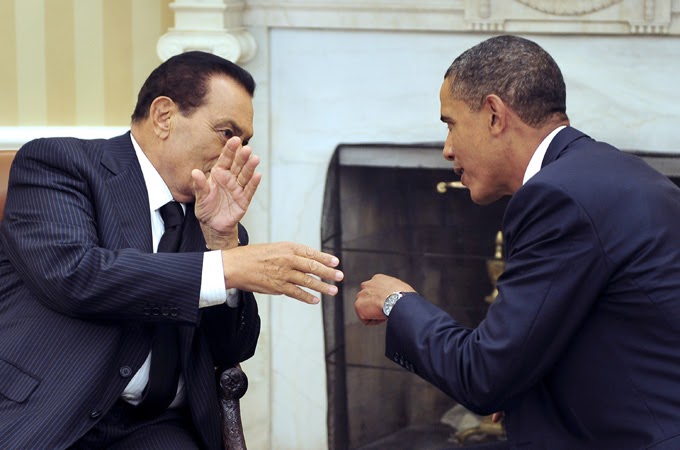
There is a widespread view in Egypt that the Mubarak regime has served the interests of the West [GALLO/GETTY]
Along with the laundry list of domestic grievances expressed by Egyptian protesters calling for an end to the regime of Hosni Mubarak, the popular perception of Egypt's foreign policy has also been a focal point of the demonstrations.
Signs and chants have called on Mubarak to seek refuge in Tel Aviv, while his hastily appointed vice-president, Omar Suleiman, has been disparaged as a puppet of the US. Egypt's widely publicised sale of natural gas to Israel at rock bottom prices has featured in many refrains emanating from the crowds.
The widespread view among Egyptians that the regime has served the interests of the West has not been helped by Israel's call for world leaders to support Mubarak, or the apparent unwillingness by American officials to give the protests their full backing.
Plummeting status
In the shadow of the current cries to topple the Egyptian regime, the Mubarak government has had a tough time keeping its role in international affairs out of public view.
In the area where Egypt's foreign policy apparatus has served US interests most directly, Israel's security, the Mubarak regime's complicity in the failure to establish a Palestinian state has become widely publicised in recent years. Its role in placing the stranglehold on the people of Gaza, in conjunction with Israel, has seen Egypt's status in the region plummet to a level it has not reached in decades.
The Palestine Papers, the leaked internal documents of the Palestinian Authority (PA) that were recently exposed by Al Jazeera, provide further confirmation of Egypt's role in the impasse between Israeli and Palestinian negotiators.
While much of the coverage of the Palestine Papers has focused on the unprecedented concessions offered by Palestinian negotiators, and how swiftly they were spurned by Israeli and American representatives, Egypt's role as an instrument for added pressure stands out from the internal records.
As the peace process broke down over the past decade, Egypt was a party to many of the discussions and central to the security arrangements made between the PA and Israel.
Egyptian duplicity
Throughout the documents, Suleiman in particular is singled out as the point person whom Israeli and American officials could count on to execute their agenda of dividing the Palestinian factions or pressing the PA for greater concessions.
Barely a few months after the January 2006 Palestinian elections that resulted in a Hamas victory, PA leaders were already appealing for assistance in fending off their political opponents. At a meeting between leading Palestinian negotiator Saeb Erekat and US General Keith Dayton, the latter assured the Palestinians that the American administration is committed to reinforcing the PA's Presidential Guard to maintain Mahmoud Abbas' authority in the face of the newly elected Hamas government.
In support of his pledge, Dayton referred to discussions with Suleiman, who committed Egypt, along with Jordan, to providing training and equipment, "even at their own expense".
Later in the year, as the Palestinian factions were engaged in negotiations over the formation of a unity government, a European diplomat told Erekat that the American position on unifying the Palestinians was "prematurely negative". Erekat agreed, adding that Suleiman had also been discouraging of those efforts, saying that they would not work.
In early 2007, as the siege on Gaza had crippling consequences on the lives of Palestinians, negotiators complained that Egyptian leaders were duplicitous, speaking publicly in support of allowing goods into Gaza, but in reality, "it remains blocked on the ground .... This is a general problem with the Egyptians".
An internal report from April 2007 confirms these suspicions. The Agreement on Movement and Access states: "Although there has been political agreement by Omar Suleiman and President Mubarak on allowing exports through, this agreement has never been translated into operational reality."
Conditions in Gaza only worsened in the months ahead, thanks in large part to the stranglehold imposed by Israel and Egypt. As Hamas assumed sole control of Gaza by preventing a coup attempt by US-backed PA forces, Egypt determined to seal off the border.
In a February 2008 meeting between Ahmed Qurei, a high-ranking PA official, and Tzipi Livni, the then Israeli foreign minister, Qurei relayed the Egyptian position conveyed to him by their leader. "President Mubarak said they'll close down the borders after Sunday and whoever is caught on Egyptian territories will be considered illegal."
The situation came to a stalemate in the months leading up to Israel's December 2008 assault on Gaza that resulted in the deaths of 1,500 Palestinians, most of them civilians. As tensions were heightened, Erekat lamented to his Israeli counterpart that Suleiman was forced to cancel a meeting in the occupied territories. Amos Gilad, the director of Israeli military intelligence, speculated: "Regarding Omar Suleiman, maybe he delayed because he is afraid we will attack while he is here. It will hurt him. He will look like a collaborator."
A tool to pressure Palestinians
The image of Egyptian officials as tools to pressure the Palestinians also emerges out of conversations between US and Palestinian officials. In late 2009, George Mitchell, Barack Obama's envoy to the region, told Erekat that he had spoken with Suleiman and the two agreed that the PA could unilaterally declare new elections without any input from Hamas.
Furthermore, Mitchell and Suleiman agreed that any agreement would have to permanently eradicate any Hamas presence in the West Bank, while at the same time allowing the PA to resume control of Gaza, terms Hamas was sure to reject. But as Egypt was preparing a document on how the PA should proceed, Erekat assured Mitchell that: "Abu Mazen [Mahmoud Abbas] won't say no to whatever the Egyptians present to him".
Even when it appeared that the Egyptians were attempting to display some degree of autonomy, it became more evident in the documents that external pressure was never too far behind. Only a few weeks later, Erekat complained to US negotiators that Egypt's latest efforts to reconcile the Palestinian factions were straying from the official line. Daniel Rubenstein, the US consul general and chief of mission in Jerusalem, responded: "I can tell you, we did put pressure on the Egyptians. I read the document. It was a disaster."
As Erekat continued to grumble about the PA's weakened position and Egypt's lack of cooperation, General James Jones, the US special envoy for Middle East security, abruptly ended the meeting with his words: "It's insulting. We'll take care of this."
Jones appeared to have lived up to his promise. Only three months later, in January 2010, US negotiator David Hale assured Erekat that in recent talks with Suleiman: "The Egyptians brought ideas similar to our thinking."
In this instance, the US appeared to put pressure on the PA to accept the latest proposals by giving the impression that the US and its allies in the region were unified in their position. Hale further added of the Egyptians: "They talked with Netanyahu and think he is serious."
'Egypt's number two'
Given the critical role that Suleiman has played in advancing US and Israeli objectives, it was no surprise that Mubarak chose to appoint him as vice-president on January 29, a move rejected by protesters, but reassuring to Egypt's Western patrons. In the leaked documents, Israeli officials were already referring to Suleiman as "Egypt's Number Two" at a time when most observers believed that Mubarak was grooming his son to be succeed him.
Among Western policymakers, it seems Suleiman remains a popular choice to replace Mubarak, as the candidate uniquely suited to maintaining Egypt's current foreign policy, while also addressing domestic grievances expressed by protesters. That remains a distant prospect, given the unlikelihood that the Egyptian opposition would abandon its call to determine the nation's role in regional affairs. But it also demonstrates that, unlike Tunisia, Egypt is far too critical to US objectives in the Middle East to be left to its own devices.
Whatever the outcome in Egypt, it is clear that the recent revelations will have a dramatic impact on the settlement of the Palestinian question. Already weakened by the scandal of the Palestine Papers, Erekat may now have to do without the support of an Egyptian regime he termed, "our ally, our backbone".
In his first interview as vice-president, Suleiman decried as "unacceptable" what he called "foreign interference" in Egypt's current turmoil. Coming from a regime whose ability to endure through the decades is owed largely to foreign interference, the irony of those words will not be lost on the Egyptian people.
Abdullah Al-Arian is a doctoral candidate in the department of history at Georgetown University.
The views expressed in this article are the author's own and do not necessarily reflect Al Jazeera's editorial policy.
The views expressed in this article are the author's own and do not necessarily reflect Al Jazeera's editorial policy.
Egypt protests 'to continue'
Former member of Egypt's parliament says parliamentary republic 'solution' to country's woes.
Last Modified: 05 Feb 2011 02:20 GMT
Aljazeera
Moustafa Elgindy, a member of the Egyptian Coalition for the Opposition and a former member of Egypt's parliament, said Egypt's pro-democracy protests will continue until president Hosni Mubarak leaves office.
Elgindy said the solution is a parliamentary republic with a strong army and a prime minister voted on by the people.
He spoke to Al Jazeera from Washington, DC.
Friday, February 4, 2011
What Corruption and Force Have Wrought in Egypt
By Chris Hedges
Truthdig
Jan 30, 2011
The uprising in Egypt, although united around the nearly universal desire to rid the country of the military dictator Hosni Mubarak, also presages the inevitable shift within the Arab world away from secular regimes toward an embrace of Islamic rule. Don’t be fooled by the glib sloganeering about democracy or the facile reporting by Western reporters—few of whom speak Arabic or have experience in the region. Egyptians are not Americans. They have their own culture, their own sets of grievances and their own history. And it is not ours. They want, as we do, to have a say in their own governance, but that say will include widespread support—especially among Egypt’s poor, who make up more than half the country and live on about two dollars a day—for the Muslim Brotherhood and Islamic parties. Any real opening of the political system in the Arab world’s most populated nation will see an empowering of these Islamic movements. And any attempt to close the system further—say a replacement of Mubarak with another military dictator—will ensure a deeper radicalization in Egypt and the wider Arab world.
The only way opposition to the U.S.-backed regime of Mubarak could be expressed for the past three decades was through Islamic movements, from the Muslim Brotherhood to more radical Islamic groups, some of which embrace violence. And any replacement of Mubarak (which now seems almost certain) while it may initially be dominated by moderate, secular leaders will, once elections are held and popular will is expressed, have an Islamic coloring. A new government, to maintain credibility with the Egyptian population, will have to more actively defy demands from Washington and be more openly antagonistic to Israel. What is happening in Egypt, like what happened in Tunisia, tightens the noose that will—unless Israel and Washington radically change their policies toward the Palestinians and the Muslim world—threaten to strangle the Jewish state as well as dramatically curtail American influence in the Middle East.
The failure of the United States to halt the slow-motion ethnic cleansing of Palestinians by Israel has consequences. The failure to acknowledge the collective humiliation and anger felt by most Arabs because of the presence of U.S. troops on Muslim soil, not only in Iraq and Afghanistan but in the staging bases set up in Kuwait and Saudi Arabia, has consequences. The failure to denounce the repression, including the widespread use of torture, censorship and rigged elections, wielded by our allies against their citizens in the Middle East has consequences. We are soaked with the stench of these regimes. Mubarak, who reportedly is suffering from cancer, is seen as our puppet, a man who betrayed his own people and the Palestinians for money and power.
The Muslim world does not see us as we see ourselves. Muslims are aware, while we are not, that we have murdered tens of thousands of Muslims in Iraq, Afghanistan and Pakistan. We have terrorized families, villages and nations. We enable and defend the Israeli war crimes carried out against Palestinians and the Lebanese—indeed we give the Israelis the weapons and military aid to carry out the slaughter. We dismiss the thousands of dead as “collateral damage.” And when those who are fighting against occupation kill us or Israelis we condemn them, regardless of context, as terrorists.
Our hypocrisy is recognized on the Arab street. Most Arabs see bloody and disturbing images every day from the wars in Iraq and Afghanistan, images that are censored on our television screens. They have grown sick of us. They have grown sick of the Arab regimes that pay lip service to the suffering of Palestinians but do nothing to intervene. They have grown sick of being ruled by tyrants who are funded and supported by Washington. Arabs understand that we, like the Israelis, primarily speak to the Muslim world in the crude language of power and violence. And because of our entrancement with our own power and ability to project force, we are woefully out of touch. Israeli and American intelligence services did not foresee the popular uprising in Tunisia or Egypt. Gen. Aviv Kochavi, Israel’s new intelligence chief, told Knesset members last Tuesday that “there is no concern at the moment about the stability of the Egyptian government.” Tuesday, it turned out, was the day hundreds of thousands of Egyptians poured into the streets to begin their nationwide protests.
What is happening in Egypt will damage and perhaps unravel the fragile peace treaty between Egypt and Jordan with Israel. It is likely to end Washington’s alliance with these Arab intelligence services, including the use of prisons to torture those we have disappeared into our vast network of black sites. The economic ties between Israel and these Arab countries will suffer. The current antagonism between Cairo and the Hamas government in Gaza will be replaced by more overt cooperation. The Egyptian government’s collaboration with Israel, which includes demolishing tunnels into Gaza, the sharing of intelligence and the passage of Israeli warship and submarines through the Suez Canal, will be in serious jeopardy. Any government—even a transition government that is headed by a pro-Western secularist such as Mohamed ElBaradei—will have to make these changes in the relationship with Israel and Washington if it wants to have any credibility and support. We are seeing the rise of a new Middle East, one that will not be as pliable to Washington or as cowed by Israel.
The secular Arab regimes, backed by the United States, are discredited and moribund. The lofty promise of a pan-Arab union, championed by the Egyptian leader Gamal Abd-al-Nasser and the original Baathists, has become a farce. Nasser’s defiance of Washington and the Western powers has been replaced by client states. The secular Arab regimes from Morocco to Yemen, for all their ties with the West, have not provided freedom, dignity, opportunity or prosperity for their people. They have failed as spectacularly as the secular Palestinian resistance movement led by Yasser Arafat. And Arabs, frustrated and enduring mounting poverty, are ready for something new.
Radical Islamist groups such as the Palestinian Hamas, the Shiite Hezbollah in Lebanon and the jihadists fighting in Iraq and Afghanistan are the new heroes, especially for the young who make up most of the Arab world. And many of those who admire these radicals are not observant Muslims. They support the Islamists because they fight back. Communism as an ideological force never took root in the Muslim world because it clashed with the tenets of Islam. The championing of the free market in countries such as Egypt has done nothing to ameliorate crushing poverty. Its only visible result has been to enrich the elite, including Mubarak’s son and designated heir, Gamal. Islamic revolutionary movements, because of these failures, are very attractive. And this is why Mubarak forbids the use of the slogan “Islam is the solution” and bans the Muslim Brotherhood. These secular Arab regimes hate and fear Hamas and the Islamic radicals as deeply as the Israelis do. And this hatred only adds to their luster.
The decision to withdraw the police from Egyptian cities and turn security over to the army means that Mubarak and his handlers in Washington face a grim choice. Either the army, as in Tunisia, refuses to interfere with the protests, meaning the removal of Mubarak, or it tries to quell the protests with force, a move that would leave hundreds if not thousands dead and wounded. The fraternization between the soldiers and the crowds, along with the presence of tanks adorned with graffiti such as “Mubarak will fall,” does not bode well for Washington, Israel and the Egyptian regime.
The army has not been immune to the creeping Islamization of Egypt—where bars, nightclubs and even belly dancing have been banished to the hotels catering to Western tourists. I attended a reception for middle-ranking army officers in Cairo in the 1990s when I was based there for The New York Times and every one of the officers’ wives had a head covering. Mubarak will soon become history. So, I expect, will neighboring secular Arab regimes. The rise of powerful Islamic parties appears inevitable. It appears inevitable not because of the Quran or a backward tradition, but because we and Israel believed we could bend the aspirations of the Arab world to our will through corruption and force. (Editor's bold emphasis throughout)
What is the US Really Doing in Egypt?
David Swanson's Blog
Let's Try Democracy
Decades in the Making: The U.S. Police State
By davidswanson - Posted on 01 February 2011
Lets Try Democracy
Andrew Kolin's new book "State Power and Democracy: Before and During the Presidency of George W. Bush" actually begins with the war for independence and continues into the Obama years. A 231-page monotone recounting of endless facts, it doesn't pick up with Bush the Lesser until page 137. Kolin chronicles a gradual slide into an imperial presidency that really got going after World War II. Along the way he chronicles the damage done to the forces of resistance, making a compelling case that our movements for peace and justice are weak in part because of the extreme repression of recent decades.
Kolin's second chapter takes us through the early twentieth century, chapter three from Truman to LBJ, chapter four Nixon to Bush the Older, chapter five Clinton and Chimpy, chapters six and seven all Dubya, and chapter eight Captain Peace Prize. Only without the cutesy names (that's me) and without much commentary, analysis, outline, or subheadings. "State Power and Democracy" is like an unrelenting stream-of-consciousness recounting of general trends and, in large part, specific detailed events of the past 60 years. It is thus an excellent reference book, as soon as you figure out where to find things.
Kolin's book is also an excellent corrective, that he himself seems to somewhat miss in his closing paragraphs, to the notion that partisan politics can reverse the movement toward a police state. Kolin says we've arrived at a police state but recognizes, I think, that we can still go further down this path. He recommends, however, that we try to work with the Democratic Party. More valuable perhaps than that bit of advice tacked onto the end of the book is the history Kolin tells of the two-steps-forward-and-a-half-a-step-back progress decade after decade, as Democratic and Republican presidents alike have seized ever greater police state powers. Had this happened under a single political party, the primary difference would probably not have been the increased speed in the fascist advance but the increased awareness and resistance among Americans.
When we get beyond the idea that George W. Bush ruined a perfect republic, and read a fuller account, like Kolin's, of what's gone wrong, it becomes evident that Bush could never have done what he did without Clinton's efforts to expand war and police powers, including the power of rendition. Similarly, Clinton could never have gone down that path without Reagan, or Reagan without Nixon, or Nixon without LBJ, or any of them without Truman, who would have been lost without the already huge accumulation of power in the White House and the abusive precedents of Abraham Lincoln and those who went before. It appears, as many of us warned in 2008, that what Kolin writes in this passage will determine our fate:
"The ultimate measure of whether or not the Obama administration will roll back the police state will depend on whether or not there are prosecutions of Bush administration officials. Past history says this isn't likely; whether it was enslavement of African Americans; ethnocidal policies against American Indians; or the consistent, sometimes violent repression of dissent, government has generally not been held accountable. While Nixon left office and a few of Watergate's perpetrators were punished, the institutional arrangements involving the FBI and CIA that made Watergate possible remained. The imperial presidency was slowed but not halted. When the Iran-Contra conspirators violated the Constitution, President Bush senior pardoned them."
The grammatical construction of the first sentence above should give us a bit of hope: "whether or not there are prosecutions" -- because there may be prosecutions of top Bush officials in Spain, and it will be up to us to communicate to the people and the courts of Spain our deep gratitude and our willingness to take the lesson to heart. Such reversals should, after all, come more easily in Washington if the people of Egypt are able, in the coming days, to remove and -- ideally -- prosecute the dictator of their country who has had the full support of the past seven presidents of ours.
Wednesday, February 2, 2011
Egyptian Uprising Must Address U.S Interference and the Role of Israel in the Region
By Ghada Chehade
Global Research
January 31, 2011
As an analyst and observer of the recent rebellions in the Middle East, specifically Egypt, I want to make three developing observations. First, the Egyptian people cannot confront local despots and “regime change” without addressing the patron of Mubarak’s regime--The United States. Second, because of the U.S’ influence and because Egypt is so strategically important to the U.S-Israel agenda for the Middle East, the U.S will attempt to control their investments and their interests by regaining control and maintaining patronage. In other words it will attempt (or may have already attempted) to co-opt the public uprising and manage it at some level and continue to do so. Last, in order to adequately address foreign meddlers within the context of the local region and its politics, one must also eventually address the role of Israel.
Local Revolution must Condemn Western Influence:
The images coming from the streets of Egypt bring a glimmer of hope to all in the Middle East as well as to anyone around the world who is serious about justice. Yet as I watch these images (as a Palestinian-Egyptian from the west) there is one thing that is alarmingly and frustratingly absent—cries of popular condemnation of and rebellion against the U.S’ influence and role in Egypt. There are denunciations of the puppet—Mubarak—but not of those who pull his strings. Any uprising against Mubarak that does not also confront foreign meddling is ultimately flawed and shortsighted. Revolutions against Arab despots must also address these dictators’ western over-lords and the latter’s ongoing colonial/imperial agenda for the region.
An Egyptian uprising that does not simultaneously confront imperialism and the heavy hands of the U.S and Israel is ultimately vulnerable to co-option and micro-management. Any new government (even if it succeeds in resolving the domestic issues of corruption, unemployment and food prices) that continues to receive 1.5 billion dollars in “aid” (i.e. bribery) will be a mere continuation of the Middle Eastern Banana Republic that Egypt is and has been for more than thirty years. It should be noted that the principal recipient of aid in Egypt is the Egyptian military and the vast internal security apparatus (with whom it shares the same branch of government). Consequently the role of the military and the security apparatus—whose patronage cannot allow them to be neutral and therefore genuinely stand with the people—is something that the protesters will inevitability have to contend with when addressing any reforms that may affect the issue of “security.”
U.S Attempting to Co-opt and Manage Egyptian Uprising
The lack of Egyptian condemnation of the U.S and its influence in Egypt may lead to speculations that the U.S is behind these uprisings. The United States has indeed been co-opting and courting Egyptian protest groups (especially youth dissidents) in an effort to work both sides within Egypt [1]. Chossudovsky aptly describes the U.S’ political double-speech as chatting with dictators while they mingle with dissidents [Ibid]. While I agree with much of the analysis I diverge on the issue of whether or not the current popular uprisings in Egypt are being directed by the U.S. Though the U.S has co-opted many opposition groups, what we are witnessing currently on the streets of Egypt is far-vaster in scale than a few meetings with Egyptian youth activists in Washington. I believe that even though the U.S administration has been attempting to appropriate certain opposition elements in Egypt (something it often does in client states), the current popular uprising took even them by surprise.
Moreover, Egypt’s neighbour and the US’ biggest ally and recipient of aid in the region, Israel, seems to be officially holding its tongue, clearly indicating that it is not pleased with this moment. In a recent Haaretz article Israeli media admits that Western and Israeli intelligence did not foresee a change of this scope. While Israeli and U.S intelligence did “predict” possible civil unrest and/or regime change in the Middle East (namely Egypt and Saudi Arabia), “a popular uprising like this was completely unexpected” [2]. In another Haaretz article it is maintained that the new IDF intelligence chief failed to predict the current popular uprising in Egypt [3]. If the Israelis (the eyes and ears of the U.S in the region) are admitting this then by extension, the U.S must also have failed to anticipate the scope of what is now developing into a full-fledged revolution. Gideon Levy, writing in Haaretz even applauds the Egyptian uprising:
“The masses of the Egyptian people- please note: on all levels- took their fate in their hands. There is something impressive and cheering in that.” [4]
While it may not have anticipated or orchestrated the current uprising, what the U.S is now attempting to do is to ultimately be able to control what is happening presently. As the “day of anger” spread into many days of wrath without any indication of dying down, the U.S has shifted its official stance on the uprisings and is increasingly and deceptively trying to present itself as a friend and ally of the protesters. Again, while they are not behind the uprising, there is a clear indication that the U.S seeks to appear supportive of the people in order to deflect criticism of its own role in the country and region and to position itself in order to co-opt and appropriate (typically meaning to threaten and/or bribe) any incoming or opposition government.
That the U.S is trying to cozy-up to the popular uprising and control it after the fact is evidenced in their repeated insistence on the restoration of social networking as a “right” after Mubarak disabled Internet capabilities [5]. Had a U.S- led campaign using online services like facebook and twitter been the catalyst for the uprising, then one might have expected the revolution to diminish as a result of Mubarak shutting down Internet and cell phone service; no such diminution occurred. Moreover, repeated cries from the highest levels of the U.S administration (including Hilary Clinton and Barack Obama) that in addition to the fundamental rights of democracy and free speech, Egyptians should have the “basic right to use social media” [6] (since when did Internet social networking become a basic human right?!), suggests that the U.S is eager to get ahead of the curve and control the uprising, using the Internet as one possible tool.
To demonstrate how much the U.S has depended on the Internet and social networking sites to co-opt opposition in Egypt, one should note that U.S officials have met in the past with dissidents from the April 6 Movement [7] (a youth opposition movement in Egypt that interesting exists mainly online through facebook). This notwithstanding, to reiterate my earlier point, the current uprisings are far vaster than anything the U.S may have been attempting to steer in the past, and have continued despite the shutdown of the Internet and the loss of social networking sites as an “organizing medium.”
In another, more obvious attempt at control, a “secret US file” relating to the aforementioned youth dissident group was leaked (most likely by the US administration). The document discloses U.S “support for Egypt protests” [8]. Clearly, in an effort to appear sympathetic to the authentic Egyptian uprising, the U.S is now shamelessly admitting that it has in the past attempted to co-opt youth dissidents, thus showing its hand at playing both sides in Egypt. In reality this self-leaked “secret document” does not show any authentic U.S support for Egyptian protesters and opposition as much as it proves that they have been infiltrating and co-opting social movements and activists in Egypt, specifically via Internet social networking sites.
In the most recent and brazen attempt to spin the U.S as the ally and anchor of the revolution, mainstream media in the west are openly declaring that the US has been secretly backing the leaders of the Egyptian uprising all along [9]. Such mainstream media framing serves to solidify the U.S as a supposed ally of the revolution while also deflecting much-needed criticism of U.S foreign policy and interference in Egypt and the Middle East. These narratives are intended more for western audiences and one hopes that Egyptians will not fall for this manipulative spin, damage control and blatant attempts at co-option.
Addressing the role of Israel in the Region
One cannot say enough about the special nature of the relationship (at all levels) between the State of Israel and the existing regime in Egypt. U.S aid and influence serve to ensure and solidify this warped relationship (after all the U.S funds the military budget of both nations). U.S aid to Egypt and control of the current regime is intended to support Israel and Israeli regional policy. U.S foreign policy in the region is contradictory at best. While the U.S claims to prefer secular regimes in the Middle East, it opposes or opposed the two main secular regimes of Syria and Iraq under Saddam Hussein [10]. And while it supposedly promotes democracy in the region, it is close friends and allies with Saudi Arabia and Egypt while shunning democratically elected Hamas [11], and the democratic process in Lebanon. As Gilad Atzmon succinctly and aptly explains,
“American policy seems to be a total mess -- unless one is willing to openly admit that there is a clear coherent thread running through American foreign policy: it simply serves Israel’s interests.” [12]
In this respect we cannot critically address the U.S without also addressing those whose interests it serves—Israel. And as a puppet of the U.S administration, the Egyptian state has played a “special” role in protecting Israeli interests. These include signing a peace treaty with Israel, maintaining an Israeli security perimeter on its borders, constant intelligence leading to the bombing of supply tunnels, and closing the borders to Gaza.
Yet it is obvious that the Egyptian people have never been happy with their government’s relationship with Israel. Israeli journalist Gideon Levy correctly points out that one thing all opposition groups in Egypt share is a disdain for Israel. Levy even seems to admit that such disdain is justified given Israel’s illegal actions against the Palestinian people:
“As long the masses in Egypt and in the entire Arab world continue seeing the images of tyranny and violence from the occupied territories, Israel will not be able to be accepted, even if it is acceptable to a few regimes” [13].
Clearly, necessary criticism of Israel already exists within the Egyptian opposition, and it seems that the Israeli media is well aware of these sentiments. Mainstream North American media, on the other hand, are reluctant to link anything happening in Egypt with foreign policy concerning Israel and Egyptian sentiment around it. But let us hope that as the Egyptian revolution continues the Egyptian people and opposition will loudly articulate an anti-Israeli stance and long-term agenda. There will be more to say about this as the situation develops.
Conclusion
Overall, it is apparent that the U.S is (unsuccessfully) attempting to control and manage the uprising in Egypt—especially among the youth. (Editor's bold emphasis throughout) Its schizophrenic shift in its official stance on the uprising (first condemning it, then supporting it, then going as far as to leak its own “secret” documents in an effort to suggest that it has been behind the uprising all along) suggests that they did not orchestrate the uprising but are currently scrambling to try and contain and control it in a manner that will allow them to once again pull the strings of whomever rules the country. Lets hope that the Egyptian people and their revolution are able to resist such brazen efforts. In order for them to do so they must extend their revolt to include a critical reassessment of their relationship with the U.S—and the Israeli interests it serves—and its foreign meddling in and control of Egypt and the region. This implicitly entails (finally) confronting the problem of the Zionist regime--Israel.
Predictions
I want to end by making a couple of predictions regarding what to look for in terms of the U.S’ response to the revolts and its relationship with Egypt [14]:
•The US will further attempt to manipulate the revolution and position itself to control/threaten/bribe the new government, mainly by gaining the trust of the people vis-a-vis the military (note that mainstream media have already begun to praise the military as a “friend of the revolution”)
•The US will protect Israel’s interests (directly or indirectly) by attempting to display a consistent bi-partisanship about Egypt within the US government. This bi-partisanship will have “security” as their main concern, employing double-speak in reference to “Egyptian security,” which is actually code for Israel’s security. Bi-partisan committees with a rainbow of representation will likely emerge in the coming days and weeks (look for AIPAC to instruct these committees as to how to proceed).
•Israel may (much further down the road) attempt to make a bid for the Sinai. Since the U.S patronage of Egypt has been in the service of Israel, the ways in which it will attempt to control and co-opt any new or resultant government will also surely be in the service of Israel. Part of this service may entail helping to try and create a situation or conflict (i.e. a security or “terrorist” crisis on Israel’s southern borders, probably relating to Gaza) that would allow or “force” Israel to re-occupy the Sinai. Look for this to take shape over a span of the next couple years. Israeli media is already discussing IDF reformulations for its southern border.
Notes
[1] Michel Chossudovsky, Global Research "The Protest Movement in Egypt: "Dictators" do not Dictate, They Obey Orders"
[2] Haaretz, "Egypt Riots are and Intelligence Chiefs Nightmare"
[3] Haaretz, "Intelligence Chief Failed to Predict Egypt Uprising"
[4] Haaretz, "The Egyptian Masses won't Play Ally to Israel"
[5] Antiwar.com "Protests Swell as Obama Mubarak Trade Lip-Service Platitudes"
[6] Ibid.
[7] Telegraph UK " Egypt Protests Americas Secret Backing for Rebel Leaders Behind Uprising"
[8Telegraph UK "Egypyt Protests Secret US Document Discloses Support for Protesters"
[9] Telegraph UK "Egypt Protests Americas Secret Backing for Rebel Leaders Behind Uprising"
[10] Telegraph UK "Liberating the American People"
[11] Ibid.
[12] Ibid.
[13] Haaretz "The Egyptian Masses Won't PLay Ally to Israel"
[14] Special thanks to Silvestre Lilly for helping me to flesh out these ideas.
Subscribe to:
Posts (Atom)