How the Petroleum Age Will End
By Michael T. Klare
March 04, 2011 --- Whatever the outcome of the protests, uprisings, and rebellions now sweeping the Middle East, one thing is guaranteed: the world of oil will be permanently transformed. Consider everything that’s now happening as just the first tremor of an oilquake that will shake our world to its core.
For a century stretching back to the discovery of oil in southwestern Persia before World War I, Western powers have repeatedly intervened in the Middle East to ensure the survival of authoritarian governments devoted to producing petroleum. Without such interventions, the expansion of Western economies after World War II and the current affluence of industrialized societies would be inconceivable.
Here, however, is the news that should be on the front pages of newspapers everywhere: That old oil order is dying, and with its demise we will see the end of cheap and readily accessible petroleum -- forever.
Ending the Petroleum Age
Let’s try to take the measure of what exactly is at risk in the current tumult. As a start, there is almost no way to give full justice to the critical role played by Middle Eastern oil in the world’s energy equation. Although cheap coal fueled the original Industrial Revolution, powering railroads, steamships, and factories, cheap oil has made possible the automobile, the aviation industry, suburbia, mechanized agriculture, and an explosion of economic globalization. And while a handful of major oil-producing areas launched the Petroleum Age -- the United States, Mexico, Venezuela, Romania, the area around Baku (in what was then the Czarist Russian empire), and the Dutch East Indies -- it’s been the Middle East that has quenched the world’s thirst for oil since World War II.
In 2009, the most recent year for which such data is available, BP reported that suppliers in the Middle East and North Africa jointly produced 29 million barrels per day, or 36% of the world’s total oil supply -- and even this doesn’t begin to suggest the region’s importance to the petroleum economy. More than any other area, the Middle East has funneled its production into export markets to satisfy the energy cravings of oil-importing powers like the United States, China, Japan, and the European Union (EU). We’re talking 20 million barrels funneled into export markets every day. Compare that to Russia, the world’s top individual producer, at seven million barrels in exportable oil, the continent of Africa at six million, and South America at a mere one million.
As it happens, Middle Eastern producers will be even more important in the years to come because they possess an estimated two-thirds of remaining untapped petroleum reserves. According to recent projections by the U.S. Department of Energy, the Middle East and North Africa will jointly provide approximately 43% of the world’s crude petroleum supply by 2035 (up from 37% in 2007), and will produce an even greater share of the world’s exportable oil.
To put the matter baldly: The world economy requires an increasing supply of affordable petroleum. The Middle East alone can provide that supply. That’s why Western governments have long supported “stable” authoritarian regimes throughout the region, regularly supplying and training their security forces. Now, this stultifying, petrified order, whose greatest success was producing oil for the world economy, is disintegrating. Don’t count on any new order (or disorder) to deliver enough cheap oil to preserve the Petroleum Age.
To appreciate why this will be so, a little history lesson is in order.
The Iranian Coup
After the Anglo-Persian Oil Company (APOC) discovered oil in Iran (then known as Persia) in 1908, the British government sought to exercise imperial control over the Persian state. A chief architect of this drive was First Lord of the Admiralty Winston Churchill. Having ordered the conversion of British warships from coal to oil before World War I and determined to put a significant source of oil under London’s control, Churchill orchestrated the nationalization of APOC in 1914. On the eve of World War II, then-Prime Minister Churchill oversaw the removal of Persia’s pro-German ruler, Shah Reza Pahlavi, and the ascendancy of his 21-year-old son, Mohammed Reza Pahlavi.
Though prone to extolling his (mythical) ties to past Persian empires, Mohammed Reza Pahlavi was a willing tool of the British. His subjects, however, proved ever less willing to tolerate subservience to imperial overlords in London. In 1951, democratically elected Prime Minister Mohammed Mossadeq won parliamentary support for the nationalization of APOC, by then renamed the Anglo-Iranian Oil Company (AIOC). The move was wildly popular in Iran but caused panic in London. In 1953, to save this great prize, British leaders infamously conspired with President Dwight Eisenhower‘s administration in Washington and the CIA to engineer a coup d’état that deposed Mossadeq and brought Shah Pahlavi back from exile in Rome, a story recently told with great panache by Stephen Kinzer in All the Shah’s Men.
Until he was overthrown in 1979, the Shah exercised ruthless and dictatorial control over Iranian society, thanks in part to lavish U.S. military and police assistance. First he crushed the secular left, the allies of Mossadeq, and then the religious opposition, headed from exile by the Ayatollah Ruhollah Khomeini. Given their brutal exposure to police and prison gear supplied by the United States, the shah’s opponents came to loathe his monarchy and Washington in equal measure. In 1979, of course, the Iranian people took to the streets, the Shah was overthrown, and Ayatollah Khomeini came to power.
Much can be learned from these events that led to the current impasse in U.S.-Iranian relations. The key point to grasp, however, is that Iranian oil production never recovered from the revolution of 1979-1980.
Between 1973 and 1979, Iran had achieved an output of nearly six million barrels of oil per day, one of the highest in the world. After the revolution, AIOC (rechristened British Petroleum, or later simply BP) was nationalized for a second time, and Iranian managers again took over the company’s operations. To punish Iran’s new leaders, Washington imposed tough trade sanctions, hindering the state oil company’s efforts to obtain foreign technology and assistance. Iranian output plunged to two million barrels per day and, even three decades later, has made it back to only slightly more than four million barrels per day, even though the country possesses the world’s second largest oil reserves after Saudi Arabia.
Dreams of the Invader
Iraq followed an eerily similar trajectory. Under Saddam Hussein, the state-owned Iraq Petroleum Company (IPC) produced up to 2.8 million barrels per day until 1991, when the First Gulf War with the United States and ensuing sanctions dropped output to half a million barrels daily. Though by 2001 production had again risen to almost 2.5 million barrels per day, it never reached earlier heights. As the Pentagon geared up for an invasion of Iraq in late 2002, however, Bush administration insiders and well-connected Iraqi expatriates spoke dreamily of a coming golden age in which foreign oil companies would be invited back into the country, the national oil company would be privatized, and production would reach never before seen levels.
Who can forget the effort the Bush administration and its officials in Baghdad put into making their dream come true? After all, the first American soldiers to reach the Iraqi capital secured the Oil Ministry building, even as they allowed Iraqi looters free rein in the rest of the city. L. Paul Bremer III, the proconsul later chosen by President Bush to oversee the establishment of a new Iraq, brought in a team of American oil executives to supervise the privatization of the country’s oil industry, while the U.S. Department of Energy confidently predicted in May 2003 that Iraqi production would rise to 3.4 million barrels per day in 2005, 4.1 million barrels by 2010, and 5.6 million by 2020.
None of this, of course, came to pass. For many ordinary Iraqis, the U.S. decision to immediately head for the Oil Ministry building was an instantaneous turning point that transformed possible support for the overthrow of a tyrant into anger and hostility. Bremer’s drive to privatize the state oil company similarly produced a fierce nationalist backlash among Iraqi oil engineers, who essentially scuttled the plan. Soon enough, a full-scale Sunni insurgency broke out. Oil output quickly fell, averaging only 2.0 million barrels daily between 2003 and 2009. By 2010, it had finally inched back up to the 2.5 million barrel mark -- a far cry from those dreamed of 4.1 million barrels.
One conclusion isn’t hard to draw: Efforts by outsiders to control the political order in the Middle East for the sake of higher oil output will inevitably generate countervailing pressures that result in diminished production. The United States and other powers watching the uprisings, rebellions, and protests blazing through the Middle East should be wary indeed: whatever their political or religious desires, local populations always turn out to harbor a fierce, passionate hostility to foreign domination and, in a crunch, will choose independence and the possibility of freedom over increased oil output.
The experiences of Iran and Iraq may not in the usual sense be comparable to those of Algeria, Bahrain, Egypt, Iraq, Jordan, Libya, Oman, Morocco, Saudi Arabia, Sudan, Tunisia, and Yemen. However, all of them (and other countries likely to get swept up into the tumult) exhibit some elements of the same authoritarian political mold and all are connected to the old oil order. Algeria, Egypt, Iraq, Libya, Oman, and Sudan are oil producers; Egypt and Jordan guard vital oil pipelines and, in Egypt’s case, a crucial canal for the transport of oil; Bahrain and Yemen as well as Oman occupy strategic points along major oil sealanes. All have received substantial U.S. military aid and/or housed important U.S. military bases. And, in all of these countries, the chant is the same: “The people want the regime to fall.”
Two of these regimes have already fallen, three are tottering, and others are at risk. The impact on global oil prices has been swift and merciless: on February 24th, the delivery price for North Brent crude, an industry benchmark, nearly reached $115 per barrel, the highest it’s been since the global economic meltdown of October 2008. West Texas Intermediate, another benchmark crude, briefly and ominously crossed the $100 threshold.
Why the Saudis are Key
So far, the most important Middle Eastern producer of all, Saudi Arabia, has not exhibited obvious signs of vulnerability, or prices would have soared even higher. However, the royal house of neighboring Bahrain is already in deep trouble; tens of thousands of protesters -- more than 20% of its half million people -- have repeatedly taken to the streets, despite the threat of live fire, in a movement for the abolition of the autocratic government of King Hamad ibn Isa al-Khalifa, and its replacement with genuine democratic rule.
These developments are especially worrisome to the Saudi leadership as the drive for change in Bahrain is being directed by that country’s long-abused Shiite population against an entrenched Sunni ruling elite. Saudi Arabia also contains a large, though not -- as in Bahrain -- a majority Shiite population that has also suffered discrimination from Sunni rulers. There is anxiety in Riyadh that the explosion in Bahrain could spill into the adjacent oil-rich Eastern Province of Saudi Arabia -- the one area of the kingdom where Shiites do form the majority -- producing a major challenge to the regime. Partly to forestall any youth rebellion, 87-year-old King Abdullah has just promised $10 billion in grants, part of a $36 billion package of changes, to help young Saudi citizens get married and obtain homes and apartments.
Even if rebellion doesn’t reach Saudi Arabia, the old Middle Eastern oil order cannot be reconstructed. The result is sure to be a long-term decline in the future availability of exportable petroleum.
Three-quarters of the 1.7 million barrels of oil Libya produces daily were quickly taken off the market as turmoil spread in that country. Much of it may remain off-line and out of the market for the indefinite future. Egypt and Tunisia can be expected to restore production, modest in both countries, to pre-rebellion levels soon, but are unlikely to embrace the sorts of major joint ventures with foreign firms that might boost production while diluting local control. Iraq, whose largest oil refinery was badly damaged by insurgents only last week, and Iran exhibit no signs of being able to boost production significantly in the years ahead.
The critical player is Saudi Arabia, which just increased production to compensate for Libyan losses on the global market. But don’t expect this pattern to hold forever. Assuming the royal family survives the current round of upheavals, it will undoubtedly have to divert more of its daily oil output to satisfy rising domestic consumption levels and fuel local petrochemical industries that could provide a fast-growing, restive population with better-paying jobs.
From 2005 to 2009, Saudis used about 2.3 million barrels daily, leaving about 8.3 million barrels for export. Only if Saudi Arabia continues to provide at least this much oil to international markets could the world even meet its anticipated low-end oil needs. This is not likely to occur. The Saudi royals have expressed reluctance to raise output much above 10 million barrels per day, fearing damage to their remaining fields and so a decline in future income for their many progeny. At the same time, rising domestic demand is expected to consume an ever-increasing share of Saudi Arabia’s net output. In April 2010, the chief executive officer of state-owned Saudi Aramco, Khalid al-Falih, predicted that domestic consumption could reach a staggering 8.3 million barrels per day by 2028, leaving only a few million barrels for export and ensuring that, if the world can’t switch to other energy sources, there will be petroleum starvation.
In other words, if one traces a reasonable trajectory from current developments in the Middle East, the handwriting is already on the wall. Since no other area is capable of replacing the Middle East as the world’s premier oil exporter, the oil economy will shrivel -- and with it, the global economy as a whole.
Consider the recent rise in the price of oil just a faint and early tremor heralding the oilquake to come. Oil won’t disappear from international markets, but in the coming decades it will never reach the volumes needed to satisfy projected world demand, which means that, sooner rather than later, scarcity will become the dominant market condition. (Editor's bold emphasis throughout) Only the rapid development of alternative sources of energy and a dramatic reduction in oil consumption might spare the world the most severe economic repercussions.
Showing posts with label Peak Oil. Show all posts
Showing posts with label Peak Oil. Show all posts
Saturday, March 5, 2011
Saturday, September 4, 2010
Military Study Warns of a Potentially Drastic Oil Crisis
Editor's NOTE:
This purported leak of a German military document is consistent with what our own military command has intimated with respect to the possible depletion of fossil fuels over the next 2-4 decades. The US military utilizes a tremendous amount of fuel each year and barring a marked reduction in the size of our forces will need to find new sources of energy according to US military sources. For more see THIS...
There are those however who reject the entire concept of "peak oil" arguing that hydrocarbons are being continually created deep within the earth in a process which is termed abiogenic production. Certain Russian experts have made this argument among others. I do not know whether abiogenic oil production is merely theoretical or proven. Perhaps someone with expertise could comment. For more background see THIS...
--Dr. J. P. Hubert
'Peak Oil' and the German Government
By Stefan Schultz
Spiegel Online International HERE...
9/01/10

Reuters
A study by a German military think tank has analyzed how "peak oil" might change the global economy. The internal draft document -- leaked on the Internet -- shows for the first time how carefully the German government has considered a potential energy crisis.
The term "peak oil" is used by energy experts to refer to a point in time when global oil reserves pass their zenith and production gradually begins to decline. This would result in a permanent supply crisis -- and fear of it can trigger turbulence in commodity markets and on stock exchanges.
The issue is so politically explosive that it's remarkable when an institution like the Bundeswehr, the German military, uses the term "peak oil" at all. But a military study currently circulating on the German blogosphere goes even further.
The study is a product of the Future Analysis department of the Bundeswehr Transformation Center, a think tank tasked with fixing a direction for the German military. The team of authors, led by Lieutenant Colonel Thomas Will, uses sometimes-dramatic language to depict the consequences of an irreversible depletion of raw materials. It warns of shifts in the global balance of power, of the formation of new relationships based on interdependency, of a decline in importance of the western industrial nations, of the "total collapse of the markets" and of serious political and economic crises.
The study, whose authenticity was confirmed to SPIEGEL ONLINE by sources in government circles, was not meant for publication. The document is said to be in draft stage and to consist solely of scientific opinion, which has not yet been edited by the Defense Ministry and other government bodies.
The lead author, Will, has declined to comment on the study. It remains doubtful that either the Bundeswehr or the German government would have consented to publish the document in its current form. But the study does show how intensively the German government has engaged with the question of peak oil.
Parallels to activities in the UK
The leak has parallels with recent reports from the UK. Only last week the Guardian newspaper reported that the British Department of Energy and Climate Change (DECC) is keeping documents secret which show the UK government is far more concerned about an impending supply crisis than it cares to admit.
According to the Guardian, the DECC, the Bank of England and the British Ministry of Defence are working alongside industry representatives to develop a crisis plan to deal with possible shortfalls in energy supply. Inquiries made by Britain's so-called peak oil workshops to energy experts have been seen by SPIEGEL ONLINE. A DECC spokeswoman sought to play down the process, telling the Guardian the enquiries were "routine" and had no political implications.
The Bundeswehr study may not have immediate political consequences, either, but it shows that the German government fears shortages could quickly arise.
Part 2: A Litany of Market Failures
According to the German report, there is "some probability that peak oil will occur around the year 2010 and that the impact on security is expected to be felt 15 to 30 years later." The Bundeswehr prediction is consistent with those of well-known scientists who assume global oil production has either already passed its peak or will do so this year.
Market Failures and International Chain Reactions
The political and economic impacts of peak oil on Germany have now been studied for the first time in depth. The crude oil expert Steffen Bukold has evaluated and summarized the findings of the Bundeswehr study. Here is an overview of the central points:
The scenarios outlined by the Bundeswehr Transformation Center are drastic. Even more explosive politically are recommendations to the government that the energy experts have put forward based on these scenarios. They argue that "states dependent on oil imports" will be forced to "show more pragmatism toward oil-producing states in their foreign policy." Political priorities will have to be somewhat subordinated, they claim, to the overriding concern of securing energy supplies.
For example: Germany would have to be more flexible in relation toward Russia's foreign policy objectives. It would also have to show more restraint in its foreign policy toward Israel, to avoid alienating Arab oil-producing nations. Unconditional support for Israel and its right to exist is currently a cornerstone of German foreign policy.
The relationship with Russia, in particular, is of fundamental importance for German access to oil and gas, the study says. "For Germany, this involves a balancing act between stable and privileged relations with Russia and the sensitivities of (Germany's) eastern neighbors." In other words, Germany, if it wants to guarantee its own energy security, should be accommodating in relation to Moscow's foreign policy objectives, even if it means risking damage to its relations with Poland and other Eastern European states.
Peak oil would also have profound consequences for Berlin's posture toward the Middle East, according to the study. "A readjustment of Germany's Middle East policy … in favor of more intensive relations with producer countries such as Iran and Saudi Arabia, which have the largest conventional oil reserves in the region, might put a strain on German-Israeli relations, depending on the intensity of the policy change," the authors write.
When contacted by SPIEGEL ONLINE, the Defense Ministry declined to comment on the study.
This purported leak of a German military document is consistent with what our own military command has intimated with respect to the possible depletion of fossil fuels over the next 2-4 decades. The US military utilizes a tremendous amount of fuel each year and barring a marked reduction in the size of our forces will need to find new sources of energy according to US military sources. For more see THIS...
There are those however who reject the entire concept of "peak oil" arguing that hydrocarbons are being continually created deep within the earth in a process which is termed abiogenic production. Certain Russian experts have made this argument among others. I do not know whether abiogenic oil production is merely theoretical or proven. Perhaps someone with expertise could comment. For more background see THIS...
--Dr. J. P. Hubert
'Peak Oil' and the German Government
By Stefan Schultz
Spiegel Online International HERE...
9/01/10
Reuters
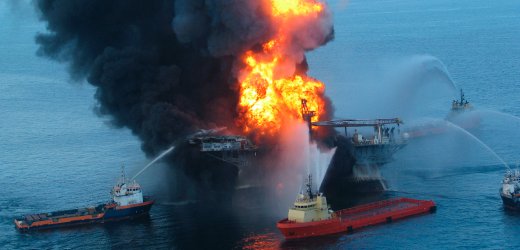
Suppose it runs out? Mishaps in oil and gas exploration are almost routine, and governments have now started to wonder about a future with dwindling fossil fuel.
A study by a German military think tank has analyzed how "peak oil" might change the global economy. The internal draft document -- leaked on the Internet -- shows for the first time how carefully the German government has considered a potential energy crisis.
The term "peak oil" is used by energy experts to refer to a point in time when global oil reserves pass their zenith and production gradually begins to decline. This would result in a permanent supply crisis -- and fear of it can trigger turbulence in commodity markets and on stock exchanges.
The issue is so politically explosive that it's remarkable when an institution like the Bundeswehr, the German military, uses the term "peak oil" at all. But a military study currently circulating on the German blogosphere goes even further.
The study is a product of the Future Analysis department of the Bundeswehr Transformation Center, a think tank tasked with fixing a direction for the German military. The team of authors, led by Lieutenant Colonel Thomas Will, uses sometimes-dramatic language to depict the consequences of an irreversible depletion of raw materials. It warns of shifts in the global balance of power, of the formation of new relationships based on interdependency, of a decline in importance of the western industrial nations, of the "total collapse of the markets" and of serious political and economic crises.
The study, whose authenticity was confirmed to SPIEGEL ONLINE by sources in government circles, was not meant for publication. The document is said to be in draft stage and to consist solely of scientific opinion, which has not yet been edited by the Defense Ministry and other government bodies.
The lead author, Will, has declined to comment on the study. It remains doubtful that either the Bundeswehr or the German government would have consented to publish the document in its current form. But the study does show how intensively the German government has engaged with the question of peak oil.
Parallels to activities in the UK
The leak has parallels with recent reports from the UK. Only last week the Guardian newspaper reported that the British Department of Energy and Climate Change (DECC) is keeping documents secret which show the UK government is far more concerned about an impending supply crisis than it cares to admit.
According to the Guardian, the DECC, the Bank of England and the British Ministry of Defence are working alongside industry representatives to develop a crisis plan to deal with possible shortfalls in energy supply. Inquiries made by Britain's so-called peak oil workshops to energy experts have been seen by SPIEGEL ONLINE. A DECC spokeswoman sought to play down the process, telling the Guardian the enquiries were "routine" and had no political implications.
The Bundeswehr study may not have immediate political consequences, either, but it shows that the German government fears shortages could quickly arise.
Part 2: A Litany of Market Failures
According to the German report, there is "some probability that peak oil will occur around the year 2010 and that the impact on security is expected to be felt 15 to 30 years later." The Bundeswehr prediction is consistent with those of well-known scientists who assume global oil production has either already passed its peak or will do so this year.
Market Failures and International Chain Reactions
The political and economic impacts of peak oil on Germany have now been studied for the first time in depth. The crude oil expert Steffen Bukold has evaluated and summarized the findings of the Bundeswehr study. Here is an overview of the central points:
- Oil will determine power: The Bundeswehr Transformation Center writes that oil will become one decisive factor in determining the new landscape of international relations: "The relative importance of the oil-producing nations in the international system is growing. These nations are using the advantages resulting from this to expand the scope of their domestic and foreign policies and establish themselves as a new or resurgent regional, or in some cases even global leading powers."
- Increasing importance of oil exporters: For importers of oil more competition for resources will mean an increase in the number of nations competing for favor with oil-producing nations. For the latter this opens up a window of opportunity which can be used to implement political, economic or ideological aims. As this window of time will only be open for a limited period, "this could result in a more aggressive assertion of national interests on the part of the oil-producing nations."
- Politics in place of the market: The Bundeswehr Transformation Center expects that a supply crisis would roll back the liberalization of the energy market. "The proportion of oil traded on the global, freely accessible oil market will diminish as more oil is traded through bi-national contracts," the study states. In the long run, the study goes on, the global oil market, will only be able to follow the laws of the free market in a restricted way. "Bilateral, conditioned supply agreements and privileged partnerships, such as those seen prior to the oil crises of the 1970s, will once again come to the fore."
- Market failures: The authors paint a bleak picture of the consequences resulting from a shortage of petroleum. As the transportation of goods depends on crude oil, international trade could be subject to colossal tax hikes. "Shortages in the supply of vital goods could arise" as a result, for example in food supplies. Oil is used directly or indirectly in the production of 95 percent of all industrial goods. Price shocks could therefore be seen in almost any industry and throughout all stages of the industrial supply chain. "In the medium term the global economic system and every market-oriented national economy would collapse."
- Relapse into planned economy: Since virtually all economic sectors rely heavily on oil, peak oil could lead to a "partial or complete failure of markets," says the study. "A conceivable alternative would be government rationing and the allocation of important goods or the setting of production schedules and other short-term coercive measures to replace market-based mechanisms in times of crisis."
- Global chain reaction: "A restructuring of oil supplies will not be equally possible in all regions before the onset of peak oil," says the study. "It is likely that a large number of states will not be in a position to make the necessary investments in time," or with "sufficient magnitude." If there were economic crashes in some regions of the world, Germany could be affected. Germany would not escape the crises of other countries, because it's so tightly integrated into the global economy.
- Crisis of political legitimacy: The Bundeswehr study also raises fears for the survival of democracy itself. Parts of the population could perceive the upheaval triggered by peak oil "as a general systemic crisis." This would create "room for ideological and extremist alternatives to existing forms of government." Fragmentation of the affected population is likely and could "in extreme cases lead to open conflict."
The scenarios outlined by the Bundeswehr Transformation Center are drastic. Even more explosive politically are recommendations to the government that the energy experts have put forward based on these scenarios. They argue that "states dependent on oil imports" will be forced to "show more pragmatism toward oil-producing states in their foreign policy." Political priorities will have to be somewhat subordinated, they claim, to the overriding concern of securing energy supplies.
For example: Germany would have to be more flexible in relation toward Russia's foreign policy objectives. It would also have to show more restraint in its foreign policy toward Israel, to avoid alienating Arab oil-producing nations. Unconditional support for Israel and its right to exist is currently a cornerstone of German foreign policy.
The relationship with Russia, in particular, is of fundamental importance for German access to oil and gas, the study says. "For Germany, this involves a balancing act between stable and privileged relations with Russia and the sensitivities of (Germany's) eastern neighbors." In other words, Germany, if it wants to guarantee its own energy security, should be accommodating in relation to Moscow's foreign policy objectives, even if it means risking damage to its relations with Poland and other Eastern European states.
Peak oil would also have profound consequences for Berlin's posture toward the Middle East, according to the study. "A readjustment of Germany's Middle East policy … in favor of more intensive relations with producer countries such as Iran and Saudi Arabia, which have the largest conventional oil reserves in the region, might put a strain on German-Israeli relations, depending on the intensity of the policy change," the authors write.
When contacted by SPIEGEL ONLINE, the Defense Ministry declined to comment on the study.
Thursday, April 29, 2010
The Imminent Crash Of The Oil Supply
What Is Going To Happen And Why Weren't We Forewarned?
By Nicholas C. Arguimbau
April 23, 2010 "Information Clearing House" -- Look at this graph and be afraid. It does not come from Earth First. It does not come from the Sierra Club. It was not drawn by Socialists or Nazis or Osama Bin Laden or anyone from Goldman-Sachs. If you are a Republican Tea-Partier, rest assured it does not come from a progressive Democrat. And vice versa. It was drawn by the United States Department of Energy, and the United States military's Joint Forces Command concurs with the overall picture.
What does it imply? The supply of the world's most essential energy source is going off a cliff. Not in the distant future, but in a year and a half. Production of all liquid fuels, including oil, will drop within 20 years to half what it is today. And the difference needs to be made up with "unidentified projects," which one of the world's leading petroleum geologists says is just a "euphemism for rank shortage," and the world's foremost oil industry banker says is "faith based."

This graph was prepared for a DOE meeting in spring, 2009. Take a good look at what it says, assuming it to be correct:
1. Conventional oil will be almost all gone in 20 years, and there is nothing known to replace it.
2. Production of petroleum from existing conventional sources has been dropping at a rate slightly over 4% per year for at least a year and will continue to do so for the indefinite future.
3. The graph implies that we are past the peak of production and that there are750 billion barrels of conventional oil left (the areas under the "conventional" portion of the graph, extrapolated to the right as an exponentional). Assuming that the remaining reserves were 900 billion or more at the halfway point, then we are at least 150 billion barrels, or 5 years, past the midpoint.
4. Total petroleum production from all presently known sources, conventional and unconventional, will remain "flat" at approximately 83 mbpd for the next two years and then will proceed to drop for the foreseeable future, at first slowly but by 4% per year after 2015.
5. Demand will begin to outstrip supply in 2012, and will already be 10 million barrels per day above supply in only five years. The United States Joint Forces Command concurs with these specific findings. http://www.jfcom.mil/newslink/storyarchive/2010/JOE_2010_o.pdf , at 31. 10 million bpd is equivalent to half the United States' entire consumption. To make up the difference, the world would have to find another Saudi Arabia and get it into full production in five years, an impossibility. See The Oil Drum, http://www.theoildrum.com/node/5154
5. The production from presently existing conventional sources will plummet from its present 81 mbpd to 30 mbpd by 2030, a 63% drop in a 20-year period.
6. Meeting demand requires discovering, developing, and bringing to full production 60mbpd (105-45) of "unidentified projects" in the 18-year period of 2012-2030 and approximately 25 mbpd of such projects by 2020, on the basis of a very conservative estimate of only 1% annual growth in demand. The independent Oxford Institute of Energy Studies has estimated a possible development of 6.5mbpd of such projects, including the Canadian tar sands, implying a deficit of 18-19 mbpd as compared to demand, and an approximate 14 mbpd drop in total liquid fuels production relative to 2012, a 16% drop in 8 years.
7. The curve is virtually identical to one produced by geologists Colin Campbell and Jean Laherrere and published in "The End of Cheap Oil," in Scientific American, March, 1998, twelve years ago. They projected that production of petroleum from conventional sources would drop from 74 mbpd in 2003 (as compared to 84 mbpd in 2008 in the DOE graph) and drop to 39 mbpd by 2030 (as compared to 39 mbpd by 2030 in the DOE graph!).http://www.jala.com/energy1.php . Campbell and Laherrere predicted a 2003 "peak," and the above graph implies a 'peak" (not necessarily the actual peak, but the midpoint of production of 2005 or before.
So here we are, if the graph is right, on the edge of a precipice, with no prior warning from either the industry, which knows what it possesses, or the collective governments, which ostensibly protect the public interest. As Colin Campbell, a research geologist who has worked for many large oil companies and studied oil depletion extensively (http://www.peakoil.net/about-aspo/dr-colin-campbell) says, "The warning signals have been flying for a long time. They have been plain to see, but the world turned a blind eye, and failed to read the message." http://www.greatchange.org/ov-campbell,outlook.html The world was completely transformed by oil for the duration of the twentieth century, but if the graph is right, within 20 years it will be virtually gone but our dependence upon it will not. Instead, we have
* zero time to plan how to replace cars in our lives
* zero time to plan how to manufacture and install millions of furnaces to replace home oil furnaces, and zero time to produce the infrastructure necessary to carry out that task
* zero time to retool suburbia so it can function without gasoline
* zero time to plan for replacement of the largest military establishment in history, almost completely dependent upon oil
* zero time to plan to support nine billion people without the "green revolution," a creation of the age of oil
* zero time to plan to replace oil as an essential fuel in electricity production
* zero time to plan for preserving millions of miles of roads without asphalt.
* zero time to plan for the replacement of oil in its essential role in EVERY industry.
* zero time to plan for replacement of oil in its exclusive role of transporting people, agricultural produce, manufactured goods. In a world without oil that appears only twenty years away, there will be no oil-burning ships transporting US grain to other countries, there will be no oil-burning airlines linking the world's major cities, there will be no oil-burning ships transporting Chinese manufactured goods to the billions now dependent on them.
* zero time to plan for the survival of the billions of new people expected by 2050 in the aftermath of ":peak everything."
* zero capital, because of failing banks and public and private debt, to address these issues.
Why zero time?
Because if we at any time use more oil than allowed by the graph, we will have even less later.
Because we are already committed to supporting 2.5 billion more people on what we have.
Because every day we continue upward in our oil consumption, even though we continue to have more people who need it and billions who deserve to rise from abject poverty, we are making the future supply shortage worse.
If you believe the graph, demand will outstrip supply starting at the end of 2011, and severely outstrip supply in five years. What are we going to do, and how are we going to do it? We have no time to decide.
IS THE GRAPH RIGHT?
It is very unlikely that things can be better than the graph indicates. Why?
* The great majority of authorities believe there is little more than 1 trillion barrels of conventional oil left. You can make a simple calculation from that: At the present rate of 30 billion barrels per year, 82 million barrels per day, it will all be gone in 33 years, and consumption has been rapidly increasing, not decreasing, so if anything it will all be gone sooner...
* A closer look at the graph reveals that it was drawn on the assumption that the world's existing conventional fields contain only 750,000 barrels at this time, enough to keep us going only 25 years.
* The graph assumes a decline rate of 4% per year. As long as the estimates of remaining reserves are right, that can't be far off. In fact, 4% is a relatively low decline rate compared to what has been observed in oil fields generally. Hold on, it's going to be a fast ride down!
* The major oil companies, which presumably know better than we do how much oil is in their possession, "conspicuously fail to invest in new refining capacity, which would surely be needed if production were set to rise.'" Campbell, http://www.greatchange.org/ov-campbell,outlook.html . The excess of refining capacity over demand remained close to 10 million bpd during the nineties, but dropped to almost nothing in the last decade as a result of failure to build new capacity. http://www.imf.org/external/pubs/ft/weo/2006/01/chp1pdf/fig1_21.pdf . The United States Joint Forces Command has also reported the failure of the oil industry to invest in the refining capacity necessary to permit expanded production, and that "Even were a concerted effort begun today to repair that shortage, it would be ten years before production could catch up with expected demand." "Joint Operating Environment 2010," at 26. http://www.jfcom.mil/newslink/storyarchive/2010/JOE_2010_o.pdf
* The most frequently discussed significant source of unexploited petroleum is the tar sands of Alberta, Canada. Because a high percentage of the energy value of the tar sands has to be expended in their extraction, the reported quantity of reserves is misleading, and two independent researchers have estimated respectively that production from the tar sands by 2020 may be expected of 3.3 million bpd and 4 million bpd. Consequently, the likelihood of the tar sands making a significant contribution to the world's petroleum demand in the foreseeable future is low.Phil Hart and Chris Skrebowski, "Peak oil: A detailed and transparent analysis," http://www.energybulletin.net/node/30537
* The shortfall, labeled "unidentified projects," that needs to be filled in 20 years is an unprecedented 60 million barrels per day, equivalent to 3/4 of today's total production. We have never in history done anything comparable to that. Although there are large deposits of "unconventional" oil such as the Canadian tar sands, most are making only slow progress at development and consume as much or more energy in their production as they can generate. The independent Oxford Institute of Energy Studies has estimated a possible development of 6.5mbpd of such projects, when we'll need more than that every two years just to keep our place. So the likelihood of anything at all making a significant dent in the shortfall is small. Indeed, the "unidentified projects" can be perceived as just a "euphemism for rank shortage" (Campbell http://www.greatchange.org/ov-campbell,outlook.html) The United States Joint Forces Command has come to the similar conclusion: that of all potential future energy sources, "None of these provide much reason for optimism," http://www.jfcom.mil/newslink/storyarchive/2010/JOE_2010_o.pdf Petroleum industry investment banker Matt Simmons calls them "faith-based." http://www.simmonsco-intl.com/files/Northern%20Trust%20Bank.pdf at 4
* The "Hubbert Peak" theory of oil field depreciation, which predicted the peak and subsequent demise of the US oil industry 15 years in advance and within 2 years of its occurrence http://www.hubbertpeak.com/hubbert/1956/1956.pdf , says that with normal production methods, a country reaches peak production in its oil fields when they are 50% depleted, with the production curve being bell-shaped. The peak can be postponed with innovative extraction techniques, but this only causes subsequent more rapid decline of the deposits and total extraction if anything decreasing. The world reached the midpoint of its reserves in the last decade, so the 2005 "peak" implied by the above graph is very close to what would be expected.
* Astonishingly, Dr. Hubbert in the same 1956 paper predicted, based upon records of only 90 billion barrels of oil having been recovered worldwide, that the peak of world petroleum production would be approximately the year 2000; this apparently quite accurate prediction by Hubbert has largely been forgotten. http://www.hubbertpeak.com/hubbert/1956/1956.pdf. One is tempted to ask why, if one man could predict the timing of the peak 44 years before it occurred, the United States Department of Energy is incapable of recognizing it after it occurred.
* There's a common feeling that just because we don't know where the oil is, doesn't mean the Mother Lode isn't right around the corner. But if you've looked everywhere, the chances are a lot slimmer. The lag time between discovery and bringing to full production of a field is 30-40 years, which means that even the virtually impossible discovery of another Saudi Arabia would barely change the graph above, of production between now and 2030. But no such discoveries are left to be made. The rate of discovery of new conventional oil has been steadily dropping now for FORTY years despite ever-more searching with ever-more-sophisticated technology. There have been two pivotal events: the peak of discovery around 1968, and the day in 1981` when discovery of new oil deposits no longer kept up with production. There is nothing complicated about this. As Campbell says, the warning sign there for anyone to see
"simply recognized two undeniable facts:
* You have to find oil before you can produce it
* Production has to mirror discovery after a time lag
"Discovery reached a peak in the 1960s - despite all the technology we hear so much about, and a worldwide search for the best prospects. It should surprise no one that the corresponding peak of production is now upon us." Indeed, Campbell's second point means that the inevitable peaking of oil production in the early 21st century, should have been clear for all to see since the peaking of discovery in the late sixties.
Campbell does not stand alone. As the US Joint Forces Command observes, "The discovery rate for new oil and gas fields over the last two decades (with the possible exception of Brazil) provides little reason for optimism that future efforts will find major new fields." "Joint Operating Environment 2010," at 31.
* Saudi Arabia's largest field, the Ghawar, is now in decline and it appears that the country has nothing to offset that decline. That has led many to conclude that "Peak Oil is a Done Deal." (Dave Cohen, ASPO/USA Energy Bulletin, July 16, 2008. http://www.energybulletin.net/node/45940 )
IF IT'S A "DONE DEAL," WHY DID IT TAKE UNTIL THE LAST MINUTE TO GET HERE?
"We can wish it, we can dream it, but it will never be, oil is not renewable, and therefore in time it must be realized that THERE WILL BE NO OIL." ENO Petroleum Corporation, "Peak Oil - The Global Oil Crisis," http://www.enopetroleum.com/opecoilreservers.html. It is hard to conceive of an act or omission causing more pain to more people and creatures than the failure of "those in charge" to announce with reasonable forewarning that the oil supply was going to crash. But it is upon us with no forewarning to the general public at all.
The government planning agencies charged with helping the public survive the end of oil could not have performed worse than by recognizing peak oil only after it has happened. Like anthropogenic global warming ("AGW"), "peak oil" has been the subject of decades of denial. Notwithstanding Hubbert's famous coup in pinpointing the peak of US oil production through the simple observation that production naturally peaks when the supply is half gone, few would listen that because the worldwide supply of conventional oil would reach the halfway point in the first decade of this century, trouble was right around the corner. The fact is, coming to that point meant we were in trouble regardless, because the early stages of development of an oil field (like the early stages of growth of virtually anything else) follow an exponential growth curve, and the world's growth addicts love exponential curves, but once you get beyond the halfway point, it is a mathematical certainty that the longer you attempt to conform the field to a pattern of exponential growth, the more the end is going to be precipitous. If you don't decelerate rapidly, that is precisely what has to happen - the decline after the halfway point can only be more rapid than the rise beforehand.
What Hubbert observed with respect to the US oil reserves has an intuitive sense to it - as the amount of oil in the field drops, its pressure drops, so the flow begins to slow down - the gusher goes down to a trickle. But if the owner of the field doesn't make full disclosure of what's there, outsiders can only make educated guesses from general geological principles and what the owner is selling, as to what the future holds. And as we all know, full disclosure is not the name of the game in the oil business.
If the field is just allowed to release its liquid gold at its natural rate, that's not too bad, because observations like the Hubbert Peak can be applied. But as technology improves and well pressure can be jacked up to compensate for declining reserves, (for instance by pumping water into the wells) the outside observer loses certainty.. There remains information about the company's reserves, but the accuracy of that information is seriously open to question. Within OPEC, which allows its members to market in accordance with the amount of their reserves. Hart, "Introduction to Peak Oil," www.philhart.com/content/introduction-peak-oil, there are great temptations to fudge. Outside observers can follow a country's reports on its reserves, but those reports are highly suspect. They will remain constant for years while the country is pumping great amounts of oil without reporting any new discoveries, and indeed they can take sudden leaps upward also without reports of new discoveries. Such "records" lead to the inevitable conclusion that many OPEC reserves reports are fictional. If you would like to see charts of OPEC oil reserves mysteriously contorting themselves, you are invited to take a look at Hart's essay. So if you thought the experts had it all in hand and would reliably warn us when trouble was a'brewin', think again. Not only do OPEC members have internal business reasons to exaggerate their reserves, but companies on the public stock market want to satisfy their stockholders of their long-term viability, and all oil producers want to make their customers confident that they can rely on oil for the long haul. By concealing their future from homeowners, oil companies have made trillions for the real estate business and the banks at the expense of those who chose urban sprawl over dense "near-in" housing, and the companies themselves will make trillions in the near future selling to consumers trapped into oil addiction, who might have sought alternatives more vigorously had they known how close the crash was.
Matt Simmons, the banker who has spent his post-Harvard-Business School career advising oil companies and saving as peak oil advisor to the last Presidential administration and specifically to President Bush, ought to know. And what he says is that Western oil companies like Exxon Mobil would be strongly opposed to the idea of transparent data because it would reveal “how crappy and old their fields really are.” Energy TechStocks.com, "Meeting the Challenge Matt Simmons: Force All Oil Producers to Give Transparent Data," According to EnergyStocks.com, Simmons has warned that "the failure of Saudi Arabia and other major oil producers to provide transparent production data has left the world in a lurch, unable to know whether it can maintain an adequate supply of oil in the face of burgeoning demand Such uncertainty has led to indecision about whether the world should invest the huge sums of money necessary to develop alternative transportation fuel sources."
Just how bad the published reserve figures for the major oil-producing nations are, has long been understood. We like to say that what goes up, must come down, but not OPEC member-nation oil reserves. Their allowed production quotas depend upon their reserves, so there is a built-in temptation to overstate reserves and never reflect in reduced reserve figures, what they have pumped out. In 1988, the OPEC oil reserves "magically and miraculously increased twofold," without any corresponding discovery of new fields. The officially reported reserves follow graphs that would be comical were it not for the fact that 6.8 billion people, and counting, depend upon the real numbers. See http://www.enopetroleum.com/opecoilreservers.html
Now we are facing the consequences of the major oil producers "leaving the world in a lurch": almost complete inability to cope with the severe difficulties we face in transporting, feeding, housing, and keeping warm the burgeoning billions of our numbers. It is hard to conceive of how any private entity could impose so much pain on so many. It didn't need to be that way. The US Government and its cohorts around the world could have imposed transparency on the oil companies as to their true reserves, and we would have had fair warning and the possibility of coping. Yes, and the moon could be made of green cheese.
Of course, as noted, it is possible to produce a graph roughly like the one above with nothing more than production data and reserves data. The former are public, and the latter are known to a limited extent. It has been the consensus of decision makers for many years that the world had a total (both produced and still in the ground) of approximately 2 trillion barrels of conventional oil, and as pointed out by Campbell, four decades of dwindling discoveries have left us with an absolute inability to increase available reserves in a timely manner to mitigate the looming shortfall. The two trillion barrel figure was absolutely critical for doing what planning could be done, but at the beginning of the last decade, the US broke ranks with the consensus of the rest of the world, declared through the historically-reliable US Geological Survey (USGS) that world reserves of conventional oil (both consumed and yet-to-be-consumed) were in fact in the neighborhood of three trillion barrels rather than two, a claim which if true immediately provided the world by sleight of hand with an extra thirty years' supply at present consumption rates. To be sure, USGS former employees disputed its estimates as relying "heavily on guesses to calculate new oil discoveries," and on doubling the usual 30 percent recovery rate from reserves "with no technology in mind capable of doing that." Gordon, "Worries Swelling Over Oil Shortage," Energy Bulletin March 20-, 2005. The concerns about overestimation of discoveries proved correct: they continued on their downward track. This alone created a discrepancy between the USGS projections and reality of approximately 900 billion barrels. At the same time, the production data appeared to peak in 2005, prominent Princeton University petroleum geologist Kenneth Deffeyes predicted that 2005 was the year, and Simmons suggested similar concerns. http://www.energybulletin.net/node/4835 and http://www.simmonsco-intl.com/files/Northern%20Trust%20Bank.pdf (p. 31). Nonetheless, based upon the USGS wishful thinking, during the Bush Administration, the Department of Energy was forecasting a "production peak somewhere between 2021 and the start of the next century, with 2037 the most likely date." http://www.energybulletin.net/node/4835 Not to worry.
With the peak imminent in reality, like the global warming "scientific skeptics," industry in 2006 came up with a "theory" published in a non-peer-reviewed report, that "peak oil" was in its totality a false concept, and that the true behavior of an oil field or conglomeration thereof was a peak followed by an "undulating plateau" and then a gentle decline by around 2% per year, years, perhaps decades later. According to Cambridge Energy Research Associates (CERA), "“It is likely that the situation will unfold in slow motion and that there are a number of decades to prepare for the start of the undulating plateau. This means that there is time to consider the best way to develop viable energy alternatives that would eventually provide the bulk of our transport energy needs." www.cera.com/aspx/cda/public1/about/about.aspx Not to worry.
CERA faulted the "peak oil" proponents with failure to take into acount the facts that reserve estimates evolve with time and that so does the technology used in extracting oil. The criticism is disingenuous given that the industry refuses to disclose either the technology it is using at any one time or its true reserves, and the reserve estimates evolve with time more for political reasons than geological one.. The facts the proponents of "peak oil" fail to take into account are facts that the industry will not disclose. As Simmons has pointed out, "With solid global field-by-field production data, 'Peak Oil timing could be 'proved'." And, or course, if the "undulating plateau" theory is correct, all the industry has to do is to disclose their true facts to prove it, but they won't. Regardless, average decline rates of an oil supply are dictated by only two numbers: how fast we are now using the oil, and how much is left. Lower decline rates now mean higher decline rates later. Those are immutable facts even if the "undulating plateau" is correct. So to avoid a rapid decline in available oil, we must discover and bring to production staggeringly large new supplies, right now today. Nonetheless, the CERA "theory" has sufficiently intimidated the bureaucrats that DOE's official position at the moment, as expressed to Le Monde, notwithstanding the graph, is that we are "entering a plateau." petrole.blog.lemonde.fr:80/2010/03/25/washington-considers-a-decline-of-world-oil-production-as-of-2011/
At the same time all of this was happening, the UN, the US Congress, the Obama Administration and the oil industry were negotiating over goals for global warming legislation. Miraculously, although arguably coincidentally, the percentage-reduction goals agreed to fit quite precisely the percentage reductions in oil consumption that will be physically forced upon us all if you believe the above graph: an 18% drop from 2005 by 2020, and an 85% drop from 2005 by 2050. (It is possible to extrapolate the graph, which assumes exponentially dropping levels of existing reserves at a 4% per year rate.) This compares to reductions of CO2 emissions 17% from 2005 in 2020 and 80% from 2005 in 2050 in the bill. So it would appear that the legislative goals have been set, for whatever reason, so that the oil industry will have to do little if anything it won't have to do in any event because of dwindling reserves. http://ecoglobe.ch/energy/e/peak9423.htm . It is hard to see how the negotiators could have come up with such correspondence if they had not all been aware of the impending crash of production and the expected decline rate.. Coincidence? Maybe, but somehow it seems unlikely. Whether or not by intent, the goals fit the needs of the oil companies rather than the needs calculated by the scientists.
In short, with all the evidence available, it is hard to see how the industry and the Department of Energy could have failed to see this coming. Their failure to warn the public, given the consequences, verges on the criminal. And if somehow they can claim innocence, then we still have to ask why they did not heed the warning of Matt Simmons, advisor on peak oil to the Bush administration, as to the importance of transparency. But they did not, and here we are.
CONCLUSIONS
We are on our own. We are rapidly going to have to deal with less and less oil, since there has been no forewarning and no planning. It is a time for communities to prepare for community energy independence, because only that way will be safe. This means relying on the sun and wind and water that have always been with us. It means cooperation with each other to get through seriously difficult times. It means finding alternatives to oil throughout our lives as quickly as possible - the oil that runs our cars, the oil that heats our houses, the oil that runs generators for our electricity, the oil from which chemical fertilizers and insecticides and plastics and polyester are made, the oil that brings countless manufactured goods to us from overseas, the oil on which farmers depend for irrigation pumps, for transporting produce to market, for working the soil to bring us food. If you believe the graph, it will almost all be gone in 20 years. And the progressives and Tea-Partyers must remember that the people who brought this calamity to us are not our friends but are people we trusted and they trusted, so we must work together to cope with the mess that is upon us, and "to throw the rascals out.".
By Nicholas C. Arguimbau
April 23, 2010 "Information Clearing House" -- Look at this graph and be afraid. It does not come from Earth First. It does not come from the Sierra Club. It was not drawn by Socialists or Nazis or Osama Bin Laden or anyone from Goldman-Sachs. If you are a Republican Tea-Partier, rest assured it does not come from a progressive Democrat. And vice versa. It was drawn by the United States Department of Energy, and the United States military's Joint Forces Command concurs with the overall picture.
What does it imply? The supply of the world's most essential energy source is going off a cliff. Not in the distant future, but in a year and a half. Production of all liquid fuels, including oil, will drop within 20 years to half what it is today. And the difference needs to be made up with "unidentified projects," which one of the world's leading petroleum geologists says is just a "euphemism for rank shortage," and the world's foremost oil industry banker says is "faith based."

This graph was prepared for a DOE meeting in spring, 2009. Take a good look at what it says, assuming it to be correct:
1. Conventional oil will be almost all gone in 20 years, and there is nothing known to replace it.
2. Production of petroleum from existing conventional sources has been dropping at a rate slightly over 4% per year for at least a year and will continue to do so for the indefinite future.
3. The graph implies that we are past the peak of production and that there are750 billion barrels of conventional oil left (the areas under the "conventional" portion of the graph, extrapolated to the right as an exponentional). Assuming that the remaining reserves were 900 billion or more at the halfway point, then we are at least 150 billion barrels, or 5 years, past the midpoint.
4. Total petroleum production from all presently known sources, conventional and unconventional, will remain "flat" at approximately 83 mbpd for the next two years and then will proceed to drop for the foreseeable future, at first slowly but by 4% per year after 2015.
5. Demand will begin to outstrip supply in 2012, and will already be 10 million barrels per day above supply in only five years. The United States Joint Forces Command concurs with these specific findings. http://www.jfcom.mil/newslink/storyarchive/2010/JOE_2010_o.pdf , at 31. 10 million bpd is equivalent to half the United States' entire consumption. To make up the difference, the world would have to find another Saudi Arabia and get it into full production in five years, an impossibility. See The Oil Drum, http://www.theoildrum.com/node/5154
5. The production from presently existing conventional sources will plummet from its present 81 mbpd to 30 mbpd by 2030, a 63% drop in a 20-year period.
6. Meeting demand requires discovering, developing, and bringing to full production 60mbpd (105-45) of "unidentified projects" in the 18-year period of 2012-2030 and approximately 25 mbpd of such projects by 2020, on the basis of a very conservative estimate of only 1% annual growth in demand. The independent Oxford Institute of Energy Studies has estimated a possible development of 6.5mbpd of such projects, including the Canadian tar sands, implying a deficit of 18-19 mbpd as compared to demand, and an approximate 14 mbpd drop in total liquid fuels production relative to 2012, a 16% drop in 8 years.
7. The curve is virtually identical to one produced by geologists Colin Campbell and Jean Laherrere and published in "The End of Cheap Oil," in Scientific American, March, 1998, twelve years ago. They projected that production of petroleum from conventional sources would drop from 74 mbpd in 2003 (as compared to 84 mbpd in 2008 in the DOE graph) and drop to 39 mbpd by 2030 (as compared to 39 mbpd by 2030 in the DOE graph!).http://www.jala.com/energy1.php . Campbell and Laherrere predicted a 2003 "peak," and the above graph implies a 'peak" (not necessarily the actual peak, but the midpoint of production of 2005 or before.
So here we are, if the graph is right, on the edge of a precipice, with no prior warning from either the industry, which knows what it possesses, or the collective governments, which ostensibly protect the public interest. As Colin Campbell, a research geologist who has worked for many large oil companies and studied oil depletion extensively (http://www.peakoil.net/about-aspo/dr-colin-campbell) says, "The warning signals have been flying for a long time. They have been plain to see, but the world turned a blind eye, and failed to read the message." http://www.greatchange.org/ov-campbell,outlook.html The world was completely transformed by oil for the duration of the twentieth century, but if the graph is right, within 20 years it will be virtually gone but our dependence upon it will not. Instead, we have
* zero time to plan how to replace cars in our lives
* zero time to plan how to manufacture and install millions of furnaces to replace home oil furnaces, and zero time to produce the infrastructure necessary to carry out that task
* zero time to retool suburbia so it can function without gasoline
* zero time to plan for replacement of the largest military establishment in history, almost completely dependent upon oil
* zero time to plan to support nine billion people without the "green revolution," a creation of the age of oil
* zero time to plan to replace oil as an essential fuel in electricity production
* zero time to plan for preserving millions of miles of roads without asphalt.
* zero time to plan for the replacement of oil in its essential role in EVERY industry.
* zero time to plan for replacement of oil in its exclusive role of transporting people, agricultural produce, manufactured goods. In a world without oil that appears only twenty years away, there will be no oil-burning ships transporting US grain to other countries, there will be no oil-burning airlines linking the world's major cities, there will be no oil-burning ships transporting Chinese manufactured goods to the billions now dependent on them.
* zero time to plan for the survival of the billions of new people expected by 2050 in the aftermath of ":peak everything."
* zero capital, because of failing banks and public and private debt, to address these issues.
Why zero time?
Because if we at any time use more oil than allowed by the graph, we will have even less later.
Because we are already committed to supporting 2.5 billion more people on what we have.
Because every day we continue upward in our oil consumption, even though we continue to have more people who need it and billions who deserve to rise from abject poverty, we are making the future supply shortage worse.
If you believe the graph, demand will outstrip supply starting at the end of 2011, and severely outstrip supply in five years. What are we going to do, and how are we going to do it? We have no time to decide.
IS THE GRAPH RIGHT?
It is very unlikely that things can be better than the graph indicates. Why?
* The great majority of authorities believe there is little more than 1 trillion barrels of conventional oil left. You can make a simple calculation from that: At the present rate of 30 billion barrels per year, 82 million barrels per day, it will all be gone in 33 years, and consumption has been rapidly increasing, not decreasing, so if anything it will all be gone sooner...
* A closer look at the graph reveals that it was drawn on the assumption that the world's existing conventional fields contain only 750,000 barrels at this time, enough to keep us going only 25 years.
* The graph assumes a decline rate of 4% per year. As long as the estimates of remaining reserves are right, that can't be far off. In fact, 4% is a relatively low decline rate compared to what has been observed in oil fields generally. Hold on, it's going to be a fast ride down!
* The major oil companies, which presumably know better than we do how much oil is in their possession, "conspicuously fail to invest in new refining capacity, which would surely be needed if production were set to rise.'" Campbell, http://www.greatchange.org/ov-campbell,outlook.html . The excess of refining capacity over demand remained close to 10 million bpd during the nineties, but dropped to almost nothing in the last decade as a result of failure to build new capacity. http://www.imf.org/external/pubs/ft/weo/2006/01/chp1pdf/fig1_21.pdf . The United States Joint Forces Command has also reported the failure of the oil industry to invest in the refining capacity necessary to permit expanded production, and that "Even were a concerted effort begun today to repair that shortage, it would be ten years before production could catch up with expected demand." "Joint Operating Environment 2010," at 26. http://www.jfcom.mil/newslink/storyarchive/2010/JOE_2010_o.pdf
* The most frequently discussed significant source of unexploited petroleum is the tar sands of Alberta, Canada. Because a high percentage of the energy value of the tar sands has to be expended in their extraction, the reported quantity of reserves is misleading, and two independent researchers have estimated respectively that production from the tar sands by 2020 may be expected of 3.3 million bpd and 4 million bpd. Consequently, the likelihood of the tar sands making a significant contribution to the world's petroleum demand in the foreseeable future is low.Phil Hart and Chris Skrebowski, "Peak oil: A detailed and transparent analysis," http://www.energybulletin.net/node/30537
* The shortfall, labeled "unidentified projects," that needs to be filled in 20 years is an unprecedented 60 million barrels per day, equivalent to 3/4 of today's total production. We have never in history done anything comparable to that. Although there are large deposits of "unconventional" oil such as the Canadian tar sands, most are making only slow progress at development and consume as much or more energy in their production as they can generate. The independent Oxford Institute of Energy Studies has estimated a possible development of 6.5mbpd of such projects, when we'll need more than that every two years just to keep our place. So the likelihood of anything at all making a significant dent in the shortfall is small. Indeed, the "unidentified projects" can be perceived as just a "euphemism for rank shortage" (Campbell http://www.greatchange.org/ov-campbell,outlook.html) The United States Joint Forces Command has come to the similar conclusion: that of all potential future energy sources, "None of these provide much reason for optimism," http://www.jfcom.mil/newslink/storyarchive/2010/JOE_2010_o.pdf Petroleum industry investment banker Matt Simmons calls them "faith-based." http://www.simmonsco-intl.com/files/Northern%20Trust%20Bank.pdf at 4
* The "Hubbert Peak" theory of oil field depreciation, which predicted the peak and subsequent demise of the US oil industry 15 years in advance and within 2 years of its occurrence http://www.hubbertpeak.com/hubbert/1956/1956.pdf , says that with normal production methods, a country reaches peak production in its oil fields when they are 50% depleted, with the production curve being bell-shaped. The peak can be postponed with innovative extraction techniques, but this only causes subsequent more rapid decline of the deposits and total extraction if anything decreasing. The world reached the midpoint of its reserves in the last decade, so the 2005 "peak" implied by the above graph is very close to what would be expected.
* Astonishingly, Dr. Hubbert in the same 1956 paper predicted, based upon records of only 90 billion barrels of oil having been recovered worldwide, that the peak of world petroleum production would be approximately the year 2000; this apparently quite accurate prediction by Hubbert has largely been forgotten. http://www.hubbertpeak.com/hubbert/1956/1956.pdf. One is tempted to ask why, if one man could predict the timing of the peak 44 years before it occurred, the United States Department of Energy is incapable of recognizing it after it occurred.
* There's a common feeling that just because we don't know where the oil is, doesn't mean the Mother Lode isn't right around the corner. But if you've looked everywhere, the chances are a lot slimmer. The lag time between discovery and bringing to full production of a field is 30-40 years, which means that even the virtually impossible discovery of another Saudi Arabia would barely change the graph above, of production between now and 2030. But no such discoveries are left to be made. The rate of discovery of new conventional oil has been steadily dropping now for FORTY years despite ever-more searching with ever-more-sophisticated technology. There have been two pivotal events: the peak of discovery around 1968, and the day in 1981` when discovery of new oil deposits no longer kept up with production. There is nothing complicated about this. As Campbell says, the warning sign there for anyone to see
"simply recognized two undeniable facts:
* You have to find oil before you can produce it
* Production has to mirror discovery after a time lag
"Discovery reached a peak in the 1960s - despite all the technology we hear so much about, and a worldwide search for the best prospects. It should surprise no one that the corresponding peak of production is now upon us." Indeed, Campbell's second point means that the inevitable peaking of oil production in the early 21st century, should have been clear for all to see since the peaking of discovery in the late sixties.
Campbell does not stand alone. As the US Joint Forces Command observes, "The discovery rate for new oil and gas fields over the last two decades (with the possible exception of Brazil) provides little reason for optimism that future efforts will find major new fields." "Joint Operating Environment 2010," at 31.
* Saudi Arabia's largest field, the Ghawar, is now in decline and it appears that the country has nothing to offset that decline. That has led many to conclude that "Peak Oil is a Done Deal." (Dave Cohen, ASPO/USA Energy Bulletin, July 16, 2008. http://www.energybulletin.net/node/45940 )
IF IT'S A "DONE DEAL," WHY DID IT TAKE UNTIL THE LAST MINUTE TO GET HERE?
"We can wish it, we can dream it, but it will never be, oil is not renewable, and therefore in time it must be realized that THERE WILL BE NO OIL." ENO Petroleum Corporation, "Peak Oil - The Global Oil Crisis," http://www.enopetroleum.com/opecoilreservers.html. It is hard to conceive of an act or omission causing more pain to more people and creatures than the failure of "those in charge" to announce with reasonable forewarning that the oil supply was going to crash. But it is upon us with no forewarning to the general public at all.
The government planning agencies charged with helping the public survive the end of oil could not have performed worse than by recognizing peak oil only after it has happened. Like anthropogenic global warming ("AGW"), "peak oil" has been the subject of decades of denial. Notwithstanding Hubbert's famous coup in pinpointing the peak of US oil production through the simple observation that production naturally peaks when the supply is half gone, few would listen that because the worldwide supply of conventional oil would reach the halfway point in the first decade of this century, trouble was right around the corner. The fact is, coming to that point meant we were in trouble regardless, because the early stages of development of an oil field (like the early stages of growth of virtually anything else) follow an exponential growth curve, and the world's growth addicts love exponential curves, but once you get beyond the halfway point, it is a mathematical certainty that the longer you attempt to conform the field to a pattern of exponential growth, the more the end is going to be precipitous. If you don't decelerate rapidly, that is precisely what has to happen - the decline after the halfway point can only be more rapid than the rise beforehand.
What Hubbert observed with respect to the US oil reserves has an intuitive sense to it - as the amount of oil in the field drops, its pressure drops, so the flow begins to slow down - the gusher goes down to a trickle. But if the owner of the field doesn't make full disclosure of what's there, outsiders can only make educated guesses from general geological principles and what the owner is selling, as to what the future holds. And as we all know, full disclosure is not the name of the game in the oil business.
If the field is just allowed to release its liquid gold at its natural rate, that's not too bad, because observations like the Hubbert Peak can be applied. But as technology improves and well pressure can be jacked up to compensate for declining reserves, (for instance by pumping water into the wells) the outside observer loses certainty.. There remains information about the company's reserves, but the accuracy of that information is seriously open to question. Within OPEC, which allows its members to market in accordance with the amount of their reserves. Hart, "Introduction to Peak Oil," www.philhart.com/content/introduction-peak-oil, there are great temptations to fudge. Outside observers can follow a country's reports on its reserves, but those reports are highly suspect. They will remain constant for years while the country is pumping great amounts of oil without reporting any new discoveries, and indeed they can take sudden leaps upward also without reports of new discoveries. Such "records" lead to the inevitable conclusion that many OPEC reserves reports are fictional. If you would like to see charts of OPEC oil reserves mysteriously contorting themselves, you are invited to take a look at Hart's essay. So if you thought the experts had it all in hand and would reliably warn us when trouble was a'brewin', think again. Not only do OPEC members have internal business reasons to exaggerate their reserves, but companies on the public stock market want to satisfy their stockholders of their long-term viability, and all oil producers want to make their customers confident that they can rely on oil for the long haul. By concealing their future from homeowners, oil companies have made trillions for the real estate business and the banks at the expense of those who chose urban sprawl over dense "near-in" housing, and the companies themselves will make trillions in the near future selling to consumers trapped into oil addiction, who might have sought alternatives more vigorously had they known how close the crash was.
Matt Simmons, the banker who has spent his post-Harvard-Business School career advising oil companies and saving as peak oil advisor to the last Presidential administration and specifically to President Bush, ought to know. And what he says is that Western oil companies like Exxon Mobil would be strongly opposed to the idea of transparent data because it would reveal “how crappy and old their fields really are.” Energy TechStocks.com, "Meeting the Challenge Matt Simmons: Force All Oil Producers to Give Transparent Data," According to EnergyStocks.com, Simmons has warned that "the failure of Saudi Arabia and other major oil producers to provide transparent production data has left the world in a lurch, unable to know whether it can maintain an adequate supply of oil in the face of burgeoning demand Such uncertainty has led to indecision about whether the world should invest the huge sums of money necessary to develop alternative transportation fuel sources."
Just how bad the published reserve figures for the major oil-producing nations are, has long been understood. We like to say that what goes up, must come down, but not OPEC member-nation oil reserves. Their allowed production quotas depend upon their reserves, so there is a built-in temptation to overstate reserves and never reflect in reduced reserve figures, what they have pumped out. In 1988, the OPEC oil reserves "magically and miraculously increased twofold," without any corresponding discovery of new fields. The officially reported reserves follow graphs that would be comical were it not for the fact that 6.8 billion people, and counting, depend upon the real numbers. See http://www.enopetroleum.com/opecoilreservers.html
Now we are facing the consequences of the major oil producers "leaving the world in a lurch": almost complete inability to cope with the severe difficulties we face in transporting, feeding, housing, and keeping warm the burgeoning billions of our numbers. It is hard to conceive of how any private entity could impose so much pain on so many. It didn't need to be that way. The US Government and its cohorts around the world could have imposed transparency on the oil companies as to their true reserves, and we would have had fair warning and the possibility of coping. Yes, and the moon could be made of green cheese.
Of course, as noted, it is possible to produce a graph roughly like the one above with nothing more than production data and reserves data. The former are public, and the latter are known to a limited extent. It has been the consensus of decision makers for many years that the world had a total (both produced and still in the ground) of approximately 2 trillion barrels of conventional oil, and as pointed out by Campbell, four decades of dwindling discoveries have left us with an absolute inability to increase available reserves in a timely manner to mitigate the looming shortfall. The two trillion barrel figure was absolutely critical for doing what planning could be done, but at the beginning of the last decade, the US broke ranks with the consensus of the rest of the world, declared through the historically-reliable US Geological Survey (USGS) that world reserves of conventional oil (both consumed and yet-to-be-consumed) were in fact in the neighborhood of three trillion barrels rather than two, a claim which if true immediately provided the world by sleight of hand with an extra thirty years' supply at present consumption rates. To be sure, USGS former employees disputed its estimates as relying "heavily on guesses to calculate new oil discoveries," and on doubling the usual 30 percent recovery rate from reserves "with no technology in mind capable of doing that." Gordon, "Worries Swelling Over Oil Shortage," Energy Bulletin March 20-, 2005. The concerns about overestimation of discoveries proved correct: they continued on their downward track. This alone created a discrepancy between the USGS projections and reality of approximately 900 billion barrels. At the same time, the production data appeared to peak in 2005, prominent Princeton University petroleum geologist Kenneth Deffeyes predicted that 2005 was the year, and Simmons suggested similar concerns. http://www.energybulletin.net/node/4835 and http://www.simmonsco-intl.com/files/Northern%20Trust%20Bank.pdf (p. 31). Nonetheless, based upon the USGS wishful thinking, during the Bush Administration, the Department of Energy was forecasting a "production peak somewhere between 2021 and the start of the next century, with 2037 the most likely date." http://www.energybulletin.net/node/4835 Not to worry.
With the peak imminent in reality, like the global warming "scientific skeptics," industry in 2006 came up with a "theory" published in a non-peer-reviewed report, that "peak oil" was in its totality a false concept, and that the true behavior of an oil field or conglomeration thereof was a peak followed by an "undulating plateau" and then a gentle decline by around 2% per year, years, perhaps decades later. According to Cambridge Energy Research Associates (CERA), "“It is likely that the situation will unfold in slow motion and that there are a number of decades to prepare for the start of the undulating plateau. This means that there is time to consider the best way to develop viable energy alternatives that would eventually provide the bulk of our transport energy needs." www.cera.com/aspx/cda/public1/about/about.aspx Not to worry.
CERA faulted the "peak oil" proponents with failure to take into acount the facts that reserve estimates evolve with time and that so does the technology used in extracting oil. The criticism is disingenuous given that the industry refuses to disclose either the technology it is using at any one time or its true reserves, and the reserve estimates evolve with time more for political reasons than geological one.. The facts the proponents of "peak oil" fail to take into account are facts that the industry will not disclose. As Simmons has pointed out, "With solid global field-by-field production data, 'Peak Oil timing could be 'proved'." And, or course, if the "undulating plateau" theory is correct, all the industry has to do is to disclose their true facts to prove it, but they won't. Regardless, average decline rates of an oil supply are dictated by only two numbers: how fast we are now using the oil, and how much is left. Lower decline rates now mean higher decline rates later. Those are immutable facts even if the "undulating plateau" is correct. So to avoid a rapid decline in available oil, we must discover and bring to production staggeringly large new supplies, right now today. Nonetheless, the CERA "theory" has sufficiently intimidated the bureaucrats that DOE's official position at the moment, as expressed to Le Monde, notwithstanding the graph, is that we are "entering a plateau." petrole.blog.lemonde.fr:80/2010/03/25/washington-considers-a-decline-of-world-oil-production-as-of-2011/
At the same time all of this was happening, the UN, the US Congress, the Obama Administration and the oil industry were negotiating over goals for global warming legislation. Miraculously, although arguably coincidentally, the percentage-reduction goals agreed to fit quite precisely the percentage reductions in oil consumption that will be physically forced upon us all if you believe the above graph: an 18% drop from 2005 by 2020, and an 85% drop from 2005 by 2050. (It is possible to extrapolate the graph, which assumes exponentially dropping levels of existing reserves at a 4% per year rate.) This compares to reductions of CO2 emissions 17% from 2005 in 2020 and 80% from 2005 in 2050 in the bill. So it would appear that the legislative goals have been set, for whatever reason, so that the oil industry will have to do little if anything it won't have to do in any event because of dwindling reserves. http://ecoglobe.ch/energy/e/peak9423.htm . It is hard to see how the negotiators could have come up with such correspondence if they had not all been aware of the impending crash of production and the expected decline rate.. Coincidence? Maybe, but somehow it seems unlikely. Whether or not by intent, the goals fit the needs of the oil companies rather than the needs calculated by the scientists.
In short, with all the evidence available, it is hard to see how the industry and the Department of Energy could have failed to see this coming. Their failure to warn the public, given the consequences, verges on the criminal. And if somehow they can claim innocence, then we still have to ask why they did not heed the warning of Matt Simmons, advisor on peak oil to the Bush administration, as to the importance of transparency. But they did not, and here we are.
CONCLUSIONS
We are on our own. We are rapidly going to have to deal with less and less oil, since there has been no forewarning and no planning. It is a time for communities to prepare for community energy independence, because only that way will be safe. This means relying on the sun and wind and water that have always been with us. It means cooperation with each other to get through seriously difficult times. It means finding alternatives to oil throughout our lives as quickly as possible - the oil that runs our cars, the oil that heats our houses, the oil that runs generators for our electricity, the oil from which chemical fertilizers and insecticides and plastics and polyester are made, the oil that brings countless manufactured goods to us from overseas, the oil on which farmers depend for irrigation pumps, for transporting produce to market, for working the soil to bring us food. If you believe the graph, it will almost all be gone in 20 years. And the progressives and Tea-Partyers must remember that the people who brought this calamity to us are not our friends but are people we trusted and they trusted, so we must work together to cope with the mess that is upon us, and "to throw the rascals out.".


Wednesday, April 14, 2010
After Peak Oil, Are We Heading Towards Social Collapse?
By Emily Spence
April 13, 2010 "Information Clearing House" -- Recently, Glen Sweetnam, director of the International, Economic and Greenhouse Gas division of the Energy Information Administration at the DoE, announced that worldwide oil availability had reached a “plateau”. However, his statement was not made known through a major U.S. mainstream media outlet. Instead, it was covered in France’s “Le Monde” as follows: article in Le Monde.
One could assume that the U.S. assessment of the oil decline was exposed through this particular publication perhaps due to some arrangement that Barack Obama made with Nicolas Sarkozy. (Maybe it is an indirect way to alert the French while keeping most Americans still in the dark on the topic so that the latter bunch can ignorantly carry onward as usual. After all, no unsettling prognosis should disturb their slow return into shopoholic ways that keep the economy, particularly China’s on which the U.S. federal government depends for loans, going strong.)
All considered, there was not, as far as I know, even a ten second blurb about Glen Sweetnam’s message issued via newscasts in New England where I live. At the time of his declaration, their reports primarily covered ad-nauseam the recent flood again … and again.
In a similar vein, no reporter discussing the deluge dared to raise the point that worsening extreme weather is on the way with climate change consequences in the mix, along with oil’s relationship to these outcomes. Moreover, imagine the effect on the Dow or NASDAQ if Glen Sweetnam’s estimation and a discussion of connected economic ramifications got splashed all across the U.S.A.
What exactly are the implications? In Life After Growth, Richard Heinberg, Senior Fellow-in-Residence at Post Carbon Institute, states, “In effect, we have to create a desirable ‘new normal’ that fits the constraints imposed by depleting natural resources. Maintaining the ‘old normal’ is not an option; if we do not find new goals for ourselves and plan our transition from a growth-based economy to a healthy equilibrium economy, we will by default create a much less desirable ‘new normal’ whose emergence we are already beginning to see in the forms of persistent high unemployment, a widening gap between rich and poor, and ever more frequent and worsening financial and environmental crises—all of which translate to profound distress for individuals, families, and communities.”
In other words, we collectively have to stop our delusions about perpetual economic growth and find another way to live from this point forward. We need to stop pretending that all is well because our myopic view of life shows no oil or other major shortfalls in the very near future. If we do not face up to the truth, the repercussions are clear.
Instead of an “ignorance is bliss” outlook, it’s markedly better to have long range vision and see the coming monster so that
meaningful preparations can be made. Scrutiny of the landscape behind and ahead followed by timely adaptation is required. A suitable response is preferable to someone or some group blindly sticking to the same old patterns that could have worked well in the past, but are no longer functionally viable. (Shortsighted government leaders trying to wring the last drops of oil out of the Earth to continue globalized commercial goals certainly provide a clear case in point.)
Certainly, reality does not conform to fanciful hopes and dreams regardless of the degree that they are compelling due to familiarity or any other reasons. A willful adherence to past choices and whimsies just won’t help under the circumstances. As John Adams suggested, “Facts are stubborn things; and whatever may be our wishes, our inclinations, or the dictates of our passions, they cannot alter the state of facts and evidence.”
At the same time, our current standard of living clearly is provided by our ability to burn through unimaginable amounts of fossil fuels, including an estimated 30 billion barrels of oil a year whilst roughly 40 percent of global energy consumption stems from petroleum. Conversely, people without access to such rich energy sources, whether in developed or developing nations, rightfully equate prosperity and access to material goods with fossil fuel use.
After all, no “green” substitute can even come close to the energy density obtained by their derivatives. As such, Robert Bryce, managing editor of “Energy Tribune” and author of the newly released Power Hungry: The Myths of “Green” Energy, and the Real Fuels of the Future, points out in Let’s Get Real About Renewable Energy at online WSJ: “We can double the output of solar and wind, and double it again. We’ll still depend on hydrocarbons.”
In his view, the reason is that we can never, in a reasonable amount of time, reach the colossal scale needed to supply sufficient energy by alternative means. Likewise, “[renewables] cannot provide the baseload power, i.e., the amount of electricity required to meet minimum demand, that Americans want.”
At the same time, access to fossil fuels will increasingly be a major driver of small and large conflicts around the world with the biggest contenders — most notably the U.S.A., China and Russia — using ever more forceful means to gain advantage over rivals. As such, the current Middle East and African wars are diminutive in scale compared to the contention that lies ahead.
In addition, the pending oil shortfall will cause products, services and food that rely on oil to skyrocket in cost. Moreover, petroleum derivatives serve as the foundation for fertilizers, pesticides, herbicides, transportation of goods to markets, the majority of the grocery packaging operations (i.e., the manufacture of containers in addition to the bottling and canning processes, etc.) and, of course, operational farm machinery.
All considered, imagine just farms alone being run without sufficient oil. Would they be capable to supply enough food for close to seven billion people without it? How will they provide for the nine to ten billion expected to be on the Earth in approximately forty years?
Henry Kissinger stated, “Who controls the food supply controls the people; who controls the energy can control whole continents; who controls money can control the world.” However, he perhaps neglected to consider that our food, practically all industry and finance are deeply tied to energy and that, in turn, is tied to fossil fuels.
According to a Greenpeace USA report released last month, “‘Nearly 71 percent of U.S. electricity comes from fossil fuels, including 53 percent from coal. Of the remainder, 21 percent is generated from nuclear power, 15 percent from natural gas, 7 percent from hydro, and less than 2 percent from other renewable sources.’ As a result of this energy mix, the U.S. emits more than 2,500 million metric tons of C02 (MMtC02) every year.”
In addition, coal and gases, that can be converted into power supplies, are not endlessly abundant. So in light of our energy dilemma, what can be expected in times ahead?
According to Thomas Wheeler in It’s the End of the World as We Know It, “The consensus is the suburbs will surely not survive the end of cheap oil and natural gas. In other words, the massive downscaling of America – voluntary or involuntary – will be the trend of the future. We are in for some profound changes in the 21st century. The imminent collapse of industrial civilization means we’ll have to organize human communities in a much different fashion from the completely unsustainable, highly-centralized, earth-destroying, globalized system we have now. There will need to be a move to much smaller, human-scale, localized and decentralized systems that can sustain themselves within their own landbase. Industrial civilization and suburban living relies on cheap sources of energy to continue to grow and expand. That era is coming to an end. One of the most important tasks right now is to prepare for a very different way of life.”
Nonetheless, Barack Obama and his cohorts have recklessly decided to try to extend our period of dependence on oil for “business as usual” instead of using a significant portion of it, along with a lavish amount of federal funds, to establish a firm foundation for alternative energy provision and the massive, societal changes that are on the way. In other words, they are still trapped in an all-out effort to support globalized industry (including its offshored job market and gargantuan transportation network) instead of their preparing the public for post-peak oil lifestyles in which human welfare and regionalized community development are emphasized.
Assuredly, facilitation of such a constructive switch would help America across the board. The reason is that the redirection of wealth away from horrific resource wars, macro-scale business and pernicious corporate bailouts towards the creation of robust decentralized economic bases would yield many benefits. The action could generate jobs, serve to protect the raw materials and the natural environments on which communities rely and curb fossil fuel use since many products would be created and used locally. It could, also, lead individuals and groups into gaining the necessary skills and understandings to create assorted merchandise, foster developments of co-ops and other innovative organizations like Simple Gifts Farm, as well as strengthen the U.S. economy at the grassroots level.
Moreover, their backing of transnational corporate agendas is plainly ruinous for environmental well-being and multitudinous societies across the globe. It, also, ensures that the most affluent class continues to make staggering financial gains at the expense of others. As such, many people face increasing deteriorating circumstances while, in tandem, their surrounding natural world falls apart due to resource plunder and environmental disasters.
As Bruce Sterling indicates, “No civilization can survive the physical destruction of its resource base.” Indeed, closed resource and energy systems have built-in limits to growth regardless of whether there are increases in population, resource consumption or energy demands.
The results of exceeding the constraints are undeniably clear. They include armed invasions and resource grabs from populations least capable to defend their assets and lands from aggressors, dwindling supplies of critical commodities as thresholds are reached and, ultimately, diminished economic gains, anyway.
All the same, any government employee who advocates for a cutback in energy use or globalized trade would be committing political suicide. He would, also, face a hostile public, including industrialists and farm owners, along with his being shunned by lobbyists and reelection campaign contributors alike.
Simultaneously, it is apparent that ‘revolving door‘ politics between corporate executives, politicians and bureaucrats with whom global-scale moguls sometimes collude do, in fact, exist and even lead, in some instances to regulatory capture. The overall outcome from such a pattern is unchecked corporate exploitation, deceit and power mongering during which time nations’ general populations become progressively destitute. Meanwhile, the über-class, without meaningful regulatory brakes on free market enterprise, obtain ever greater control over worldwide resources and the financial wherewithal to seize even more control over time.
Likewise, the overall arrangement leads to multinational business owners seeking ever cheaper labor wherever it exists and even if it involves young children or unsafe practices, ever new consumers and an endless supply of raw materials from developing regions with lax (if any) conservation regulations. They, also, abandon countries in which coveted materials, when not already commandeered, are protected by stiff environmental laws. Concurrently, jobs continue to drain from nations if their standard minimum wages are not the absolute lowest to be found or there are no new stores of resources to tap.
In relation, Jan Lundberg indicates, in The People Of The Brook Versus Supermarket Splendor, “Social relations are defined today by tolerance of tyranny: of harmful industrial profit schemes, unfair ownership of huge property holdings, and astronomical financial wealth. As soon as the post-peak oil house of cards topples, ‘new’ social structures will be (re)established. There’s a growing number of people already welcoming the end of false wealth’s tyranny and of civilized arrogance.”
Clearly, our choices in terms of the future that we want to create will in time be largely determined by limitations in oil and other resources. It stands to follow that we can either have a last man standing orientation in which only the most affluent and powerful people have lavish supplies of expensive energy and material goods or we can foster deglobalization, which leads into equitable sharing of resources, job creation, strengthening of community ties, assurance that local resource bases are not exceeded and creation of a social foundation that does not increasingly divide the world between the rich and the poor members of society.
The second option, also, protects against the sort of widespread financial collapse that occurs in the buoy model. In such an arrangement, a descending buoy, when additional buoys are hooked by a line to a sinking one, drags the others to some degree downward based on proximity wherein the ones having the closest connections are pulled down the most. Alternately put, guess about what happens next when one’s own economy, assets, social well being and so forth are precariously linked to declining partners. Is it a structurally safe arrangement?
All considered, it is easy to notice that some individuals and countries faring relatively well throughout the ongoing recession are ones whose economic foundations have been largely isolated from worldwide influences. Moreover, the nations mostly immune to the downturn tend to be oriented towards serving the needs of their own populations, have been largely regionalized in focus, and generally have smaller, comparatively simple, manageable economies, as the U.S. and other countries, in my opinion, should aim to duplicate as much as possible.
In the end, “Our country’s leaders have three main choices: Taking over someone else’s oil fields until they are depleted; carrying on until the lights go out and Americans are freezing in the dark; or changing our life style by energy conservation while heavily investing in alternative energy sources at higher costs,” according to Charles T. Maxwell. I would add to his perspective that our leaders and the rest of us must, in fairly short order, start creating self-reliant, ecologically healthy communities, ones that are durable and flexible so as to reasonably withstand difficult outside forces, such as lack of sufficient oil or, in the least, the crippling post-peak oil prices, that will come to pass. Only if we successfully do so can we avoid the most dire consequences from the severe deficits to come.
With the current peak-oil interval, we have a grace period when oil is still fairly inexpensive and abundant. At the same time, we cannot expect our government leaders to help society transition off of heavy oil dependence on account of their being controlled by “big business” interests. Therefore, it is up to average citizens to create the reforms that lead into localized economic and social development. If the enterprise is not actively taken in a timely fashion, the resultant chaos, as pointed out by Dmitry Orlov in "The Five Stages Of Collapse", will be unavoidable.
April 13, 2010 "Information Clearing House" -- Recently, Glen Sweetnam, director of the International, Economic and Greenhouse Gas division of the Energy Information Administration at the DoE, announced that worldwide oil availability had reached a “plateau”. However, his statement was not made known through a major U.S. mainstream media outlet. Instead, it was covered in France’s “Le Monde” as follows: article in Le Monde.
One could assume that the U.S. assessment of the oil decline was exposed through this particular publication perhaps due to some arrangement that Barack Obama made with Nicolas Sarkozy. (Maybe it is an indirect way to alert the French while keeping most Americans still in the dark on the topic so that the latter bunch can ignorantly carry onward as usual. After all, no unsettling prognosis should disturb their slow return into shopoholic ways that keep the economy, particularly China’s on which the U.S. federal government depends for loans, going strong.)
All considered, there was not, as far as I know, even a ten second blurb about Glen Sweetnam’s message issued via newscasts in New England where I live. At the time of his declaration, their reports primarily covered ad-nauseam the recent flood again … and again.
In a similar vein, no reporter discussing the deluge dared to raise the point that worsening extreme weather is on the way with climate change consequences in the mix, along with oil’s relationship to these outcomes. Moreover, imagine the effect on the Dow or NASDAQ if Glen Sweetnam’s estimation and a discussion of connected economic ramifications got splashed all across the U.S.A.
What exactly are the implications? In Life After Growth, Richard Heinberg, Senior Fellow-in-Residence at Post Carbon Institute, states, “In effect, we have to create a desirable ‘new normal’ that fits the constraints imposed by depleting natural resources. Maintaining the ‘old normal’ is not an option; if we do not find new goals for ourselves and plan our transition from a growth-based economy to a healthy equilibrium economy, we will by default create a much less desirable ‘new normal’ whose emergence we are already beginning to see in the forms of persistent high unemployment, a widening gap between rich and poor, and ever more frequent and worsening financial and environmental crises—all of which translate to profound distress for individuals, families, and communities.”
In other words, we collectively have to stop our delusions about perpetual economic growth and find another way to live from this point forward. We need to stop pretending that all is well because our myopic view of life shows no oil or other major shortfalls in the very near future. If we do not face up to the truth, the repercussions are clear.
Instead of an “ignorance is bliss” outlook, it’s markedly better to have long range vision and see the coming monster so that
meaningful preparations can be made. Scrutiny of the landscape behind and ahead followed by timely adaptation is required. A suitable response is preferable to someone or some group blindly sticking to the same old patterns that could have worked well in the past, but are no longer functionally viable. (Shortsighted government leaders trying to wring the last drops of oil out of the Earth to continue globalized commercial goals certainly provide a clear case in point.)
Certainly, reality does not conform to fanciful hopes and dreams regardless of the degree that they are compelling due to familiarity or any other reasons. A willful adherence to past choices and whimsies just won’t help under the circumstances. As John Adams suggested, “Facts are stubborn things; and whatever may be our wishes, our inclinations, or the dictates of our passions, they cannot alter the state of facts and evidence.”
At the same time, our current standard of living clearly is provided by our ability to burn through unimaginable amounts of fossil fuels, including an estimated 30 billion barrels of oil a year whilst roughly 40 percent of global energy consumption stems from petroleum. Conversely, people without access to such rich energy sources, whether in developed or developing nations, rightfully equate prosperity and access to material goods with fossil fuel use.
After all, no “green” substitute can even come close to the energy density obtained by their derivatives. As such, Robert Bryce, managing editor of “Energy Tribune” and author of the newly released Power Hungry: The Myths of “Green” Energy, and the Real Fuels of the Future, points out in Let’s Get Real About Renewable Energy at online WSJ: “We can double the output of solar and wind, and double it again. We’ll still depend on hydrocarbons.”
In his view, the reason is that we can never, in a reasonable amount of time, reach the colossal scale needed to supply sufficient energy by alternative means. Likewise, “[renewables] cannot provide the baseload power, i.e., the amount of electricity required to meet minimum demand, that Americans want.”
At the same time, access to fossil fuels will increasingly be a major driver of small and large conflicts around the world with the biggest contenders — most notably the U.S.A., China and Russia — using ever more forceful means to gain advantage over rivals. As such, the current Middle East and African wars are diminutive in scale compared to the contention that lies ahead.
In addition, the pending oil shortfall will cause products, services and food that rely on oil to skyrocket in cost. Moreover, petroleum derivatives serve as the foundation for fertilizers, pesticides, herbicides, transportation of goods to markets, the majority of the grocery packaging operations (i.e., the manufacture of containers in addition to the bottling and canning processes, etc.) and, of course, operational farm machinery.
All considered, imagine just farms alone being run without sufficient oil. Would they be capable to supply enough food for close to seven billion people without it? How will they provide for the nine to ten billion expected to be on the Earth in approximately forty years?
Henry Kissinger stated, “Who controls the food supply controls the people; who controls the energy can control whole continents; who controls money can control the world.” However, he perhaps neglected to consider that our food, practically all industry and finance are deeply tied to energy and that, in turn, is tied to fossil fuels.
According to a Greenpeace USA report released last month, “‘Nearly 71 percent of U.S. electricity comes from fossil fuels, including 53 percent from coal. Of the remainder, 21 percent is generated from nuclear power, 15 percent from natural gas, 7 percent from hydro, and less than 2 percent from other renewable sources.’ As a result of this energy mix, the U.S. emits more than 2,500 million metric tons of C02 (MMtC02) every year.”
In addition, coal and gases, that can be converted into power supplies, are not endlessly abundant. So in light of our energy dilemma, what can be expected in times ahead?
According to Thomas Wheeler in It’s the End of the World as We Know It, “The consensus is the suburbs will surely not survive the end of cheap oil and natural gas. In other words, the massive downscaling of America – voluntary or involuntary – will be the trend of the future. We are in for some profound changes in the 21st century. The imminent collapse of industrial civilization means we’ll have to organize human communities in a much different fashion from the completely unsustainable, highly-centralized, earth-destroying, globalized system we have now. There will need to be a move to much smaller, human-scale, localized and decentralized systems that can sustain themselves within their own landbase. Industrial civilization and suburban living relies on cheap sources of energy to continue to grow and expand. That era is coming to an end. One of the most important tasks right now is to prepare for a very different way of life.”
Nonetheless, Barack Obama and his cohorts have recklessly decided to try to extend our period of dependence on oil for “business as usual” instead of using a significant portion of it, along with a lavish amount of federal funds, to establish a firm foundation for alternative energy provision and the massive, societal changes that are on the way. In other words, they are still trapped in an all-out effort to support globalized industry (including its offshored job market and gargantuan transportation network) instead of their preparing the public for post-peak oil lifestyles in which human welfare and regionalized community development are emphasized.
Assuredly, facilitation of such a constructive switch would help America across the board. The reason is that the redirection of wealth away from horrific resource wars, macro-scale business and pernicious corporate bailouts towards the creation of robust decentralized economic bases would yield many benefits. The action could generate jobs, serve to protect the raw materials and the natural environments on which communities rely and curb fossil fuel use since many products would be created and used locally. It could, also, lead individuals and groups into gaining the necessary skills and understandings to create assorted merchandise, foster developments of co-ops and other innovative organizations like Simple Gifts Farm, as well as strengthen the U.S. economy at the grassroots level.
Moreover, their backing of transnational corporate agendas is plainly ruinous for environmental well-being and multitudinous societies across the globe. It, also, ensures that the most affluent class continues to make staggering financial gains at the expense of others. As such, many people face increasing deteriorating circumstances while, in tandem, their surrounding natural world falls apart due to resource plunder and environmental disasters.
As Bruce Sterling indicates, “No civilization can survive the physical destruction of its resource base.” Indeed, closed resource and energy systems have built-in limits to growth regardless of whether there are increases in population, resource consumption or energy demands.
The results of exceeding the constraints are undeniably clear. They include armed invasions and resource grabs from populations least capable to defend their assets and lands from aggressors, dwindling supplies of critical commodities as thresholds are reached and, ultimately, diminished economic gains, anyway.
All the same, any government employee who advocates for a cutback in energy use or globalized trade would be committing political suicide. He would, also, face a hostile public, including industrialists and farm owners, along with his being shunned by lobbyists and reelection campaign contributors alike.
Simultaneously, it is apparent that ‘revolving door‘ politics between corporate executives, politicians and bureaucrats with whom global-scale moguls sometimes collude do, in fact, exist and even lead, in some instances to regulatory capture. The overall outcome from such a pattern is unchecked corporate exploitation, deceit and power mongering during which time nations’ general populations become progressively destitute. Meanwhile, the über-class, without meaningful regulatory brakes on free market enterprise, obtain ever greater control over worldwide resources and the financial wherewithal to seize even more control over time.
Likewise, the overall arrangement leads to multinational business owners seeking ever cheaper labor wherever it exists and even if it involves young children or unsafe practices, ever new consumers and an endless supply of raw materials from developing regions with lax (if any) conservation regulations. They, also, abandon countries in which coveted materials, when not already commandeered, are protected by stiff environmental laws. Concurrently, jobs continue to drain from nations if their standard minimum wages are not the absolute lowest to be found or there are no new stores of resources to tap.
In relation, Jan Lundberg indicates, in The People Of The Brook Versus Supermarket Splendor, “Social relations are defined today by tolerance of tyranny: of harmful industrial profit schemes, unfair ownership of huge property holdings, and astronomical financial wealth. As soon as the post-peak oil house of cards topples, ‘new’ social structures will be (re)established. There’s a growing number of people already welcoming the end of false wealth’s tyranny and of civilized arrogance.”
Clearly, our choices in terms of the future that we want to create will in time be largely determined by limitations in oil and other resources. It stands to follow that we can either have a last man standing orientation in which only the most affluent and powerful people have lavish supplies of expensive energy and material goods or we can foster deglobalization, which leads into equitable sharing of resources, job creation, strengthening of community ties, assurance that local resource bases are not exceeded and creation of a social foundation that does not increasingly divide the world between the rich and the poor members of society.
The second option, also, protects against the sort of widespread financial collapse that occurs in the buoy model. In such an arrangement, a descending buoy, when additional buoys are hooked by a line to a sinking one, drags the others to some degree downward based on proximity wherein the ones having the closest connections are pulled down the most. Alternately put, guess about what happens next when one’s own economy, assets, social well being and so forth are precariously linked to declining partners. Is it a structurally safe arrangement?
All considered, it is easy to notice that some individuals and countries faring relatively well throughout the ongoing recession are ones whose economic foundations have been largely isolated from worldwide influences. Moreover, the nations mostly immune to the downturn tend to be oriented towards serving the needs of their own populations, have been largely regionalized in focus, and generally have smaller, comparatively simple, manageable economies, as the U.S. and other countries, in my opinion, should aim to duplicate as much as possible.
In the end, “Our country’s leaders have three main choices: Taking over someone else’s oil fields until they are depleted; carrying on until the lights go out and Americans are freezing in the dark; or changing our life style by energy conservation while heavily investing in alternative energy sources at higher costs,” according to Charles T. Maxwell. I would add to his perspective that our leaders and the rest of us must, in fairly short order, start creating self-reliant, ecologically healthy communities, ones that are durable and flexible so as to reasonably withstand difficult outside forces, such as lack of sufficient oil or, in the least, the crippling post-peak oil prices, that will come to pass. Only if we successfully do so can we avoid the most dire consequences from the severe deficits to come.
With the current peak-oil interval, we have a grace period when oil is still fairly inexpensive and abundant. At the same time, we cannot expect our government leaders to help society transition off of heavy oil dependence on account of their being controlled by “big business” interests. Therefore, it is up to average citizens to create the reforms that lead into localized economic and social development. If the enterprise is not actively taken in a timely fashion, the resultant chaos, as pointed out by Dmitry Orlov in "The Five Stages Of Collapse", will be unavoidable.
Washington considers a decline of world oil production as of 2011
By: Matthieu Auzanneau
LeMonde
25 march 2010
The U.S. Department of Energy admits that “a chance exists that we may experience a decline” of world liquid fuels production between 2011 and 2015 “if the investment is not there”, according to an exclusive interview with Glen Sweetnam, main official expert on oil market in the Obama administration.
This warning on oil output issued by Obama’s energy administration comes at a time when world demand for oil is on the rise again, and investments in many drilling projects have been frozen in the aftermath of the tumbling of crude prices and of the financial crisis.
Glen Sweetnam, director of the International, Economic and Greenhouse Gas division of the Energy Information Administration at the DoE, does not say that investments will not be “there”. Yet the answer to the issue of knowing when, where and in which quantities additional sources of oil should be put on-stream remains widely “unidentified” in the eyes of the most prominent official analyst on energy inside the Obama administration.
The DoE dismisses the “peak oil” theory, which assumes that world crude oil production should irreversibly decrease in a nearby future, in want of sufficient fresh oil reserves yet to be exploited. The Obama administration of Energy supports the alternative hypothesis of an “undulating plateau”. Lauren Mayne, responsible for liquid fuel prospects at the DoE, explains : “Once maximum world oil production is reached, that level will be approximately maintained for several years thereafter, creating an undulating plateau. After this plateau period, production will experience a decline.”
Glen Sweetnam, who heads the publication of DoE's annual International Energy Outlook, agrees that what he identifies as a possible decline of liquid fuels production between 2011 and 2015 could be the first stage of the “undulating plateau” pattern, which will start “once maximum world oil production is reached”.
M. Auzanneau - After 2011 and until 2015, do you acknowledge that if adequate investment is not there, a chance exists that we may experience a first stage of decline in the “undulating plateau” you describe ?
GLEN SWEETNAM - I agree, if the investment is not there, a chance exists that we may experience a decline. If we do, I would expect investment in new capacity to increase if there is still demand for oil.
Glen Sweetnam acknowledges the possibility of a close-by and unexpected fall of world liquid fuels production in an email interview, after several requests of details about a round-table of oil economists that Mr Sweetnam held on April 7, 2009 in Washington, DC.
The DoE April 2009 round-table, untitled “Meeting the Growing Demand for Liquid (fuels)“, was semi-public. Yet it remained unnoticed and unjustly, as it put forward forecasts that are far more pessimistic than any analysis the DoE has ever delivered.
Page 8 of the presentation document of the round-table, a graph shows that the DoE is expecting a decline of the total of all known sources of liquid fuels supplies after 2011.
The graph labels as “unidentified” the additional supply projects needed to fill in a gap that is expected to grow after 2011 between rising demand and decline of known sources of supply that the DoE supposes will start that year. The declining production foreseen by the DoE concerns the total of existing sources of liquid fuels plus the new production projects that are supposed to come on-stream before 2012.
The DoE predicts that the decline of identified sources of supply will be steady and sharp : - 2 percent a year, from 87 million barrels per day (Mbpd) in 2011 to just 80 Mbpd in 2015. At that time, the world demand for oil and other liquid fuels should have climbed up to 90 Mbpd, according to the presentation document.
“Unidentified” additional liquid fuels projects would therefore have to fill in a 10 Mbpd gap between supplies and demand within less than 5 years. 10 Mbpd is almost the equivalent of the oil production of Saudi Arabia, world top producer with 10.8 Mbpd.
After the oil demand went through an air pocket in 2009, it is to rise afresh this year, according to the International Energy Agency (IEA), which advises the OECD countries. Now set at 86.5 million barrels per day, the world consumption is slightly higher than in 2008, when the financial crisis stroke. All the growth of the demand is now coming from non-OECD countries. This growth should continue at a firm pace in developing economies over the next years, says the IEA.
According to the presentation and the transcript of DoE's April 2009 round-table, many oil producing regions should see their extractions diminish before 2015.
Non-OPEC conventional oil extractions (more than half of the world crude oil production today) should already be in decline, from 46.9 Mbpd in 2008 to 44.8 Mbpd in 2011, shows the graph page 8 of the DoE round-table presentation.
Total non-OPEC liquid fuel production has been stable since 2008, says the IEA in Paris. But the IEA does not provide figures dealing with just conventional crude oil extractions. In 2005, in the French newspaper Le Monde, the IEA chief economist Fatih Birol predicted that non-OPEC oil production would decline “soon after 2010″.
Till 2015, among the top 15 oil producing countries, only 6 will manage to significantly increase their liquid fuel production, shows the graph page 9 of the DoE round-table presentation.
7 of the 15 biggest producers are supposed to evolve towards substantial reductions of their outputs over a period starting in 2007 and ending in 2015 : Russia (- 0.15 Mbpd), China (- 0.2), Iran (- 0.4), Mexico (- 0.9), the United Arab Emirates (- 0.3), Venezuela (- 0.25) and Norway (- 0.7).
Iraq’s and Kuwait’s supplies should remain practically flat.
The U.S DoE expects that the largest increase of production will need to come from within the United States : a 1.8 Mbpd boost over 8 years (from 2007 to 2015) that would equal to more than a quarter of the present U.S oil production. Since the early 70’s, U.S oil production has been steadily plummeting.
This huge U.S liquid fuel production increase should be achieved through what Glen Sweetnam described as “the ethanol ramp-up” during the round-table, according to its
transcript.
This “ethanol ramp-up”, initiated during the Bush administration, may stand for even more than the 1.8 Mbpd increasing expected by the DoE, as U.S crude oil extractions have been decreasing for four decades, and because there are no fresh oil reserves of significant scale coming on-stream in Alaska or elsewhere in the ‘Lower 50s’.
One-quarter of all the grain crops grown in the United States already ends up as bio-fuel, according to an analysis of 2009 figures from the US Department of Agriculture published by the Earth Policy Institute, a Washington ecologist think-tank.
Will investments in new and “unidentified” oil projects be able to compensate for the decline of the existing sources of supply, in order to fill in within less than 5 years (between now and 2015) the 10 Mbpd gap between demand and identified supplies that the DoE foresees ?
It takes at least 7 years to get any new oil project running, acknowledges the DoE.
During the Spring 2009 conference, Glen Sweetnam said that the recent discoveries of ultra-deep oil off the shores of Brazil were “sort of the bright spot for now (…) till we get to the Arctic”.
OPEC Secretary General Abdalla Salem El-Badri warned in February 2009 that out of the 135 projects due to come on-stream in the next few years, OPEC members have put 35 projects on hold to after 2013, as the “current prices threaten the very sustainability of planned investment”.
By 2007, despite huge profits, the top 5 international oil companies were spending a mere 6 percent of their free cash on exploration, compared to 34 percent on share buybacks, according to a Rice University study cited by The New York Times. Back in 1994, those top oil companies were spending 15 percent of their free cash on exploration. Many experts assume that this shift in strategy is forced by a lack of access to new oil reserves, while the world keeps clamoring for more oil.
The prospects of the Washington Department of Energy on oil now sound far more pessimistic than the kind of analysis the DoE used to release not so long ago. In 2004, under the Bush administration, the DoE published a study in which oil production was supposed to be able to rise strongly at least until 2037.
In 2008, Glen Sweetnam published for the DoE a long term base case scenario in which the “undulating plateau” was not to be reached until 2030, and would last until 2090 before world oil production would enter its final fall.
But Mr Sweetnam’s 2008 study also presented a “more unfavorable above ground factors” scenario under which the undulating plateau occurs during the present decade.
Glen Sweetnam, who is supervising in Washington the preparation of the next annual International energy outlook, now seems to wonder whether his “more unfavorable” scenario isn’t the right one, when he contemplates, in his interview with me, a decline of world liquid fuels production starting in 2011.
Such a sense of uncertainty cast by the Department of Energy is unseen. The DoE usually stands among the most optimistic sources regarding the issue of depletion of world oil reserves.
Glen Sweetnam’s warning comes after a long set of warnings dealing with possible troubles ahead on the supply side of the world oil market. Those warnings have been emitted over the last years through a range of sound sources such as The Wall Street Journal, The Houston Chronicle (main daily newspaper of the world capital of crude oil trade), the CEO of Brazilian oil company Petrobras, a former n°2 of Saudi national oil company Aramco, an International Energy Agency ‘whistleblower’, the chief economist of the IEA himself, the UK Industry Taskforce on Peak Oil & Energy Security, or legendary-wildcatter-turned-renewable-tycoon T. Boone Pickens.
LeMonde
25 march 2010
The U.S. Department of Energy admits that “a chance exists that we may experience a decline” of world liquid fuels production between 2011 and 2015 “if the investment is not there”, according to an exclusive interview with Glen Sweetnam, main official expert on oil market in the Obama administration.
This warning on oil output issued by Obama’s energy administration comes at a time when world demand for oil is on the rise again, and investments in many drilling projects have been frozen in the aftermath of the tumbling of crude prices and of the financial crisis.
Glen Sweetnam, director of the International, Economic and Greenhouse Gas division of the Energy Information Administration at the DoE, does not say that investments will not be “there”. Yet the answer to the issue of knowing when, where and in which quantities additional sources of oil should be put on-stream remains widely “unidentified” in the eyes of the most prominent official analyst on energy inside the Obama administration.
The DoE dismisses the “peak oil” theory, which assumes that world crude oil production should irreversibly decrease in a nearby future, in want of sufficient fresh oil reserves yet to be exploited. The Obama administration of Energy supports the alternative hypothesis of an “undulating plateau”. Lauren Mayne, responsible for liquid fuel prospects at the DoE, explains : “Once maximum world oil production is reached, that level will be approximately maintained for several years thereafter, creating an undulating plateau. After this plateau period, production will experience a decline.”
Glen Sweetnam, who heads the publication of DoE's annual International Energy Outlook, agrees that what he identifies as a possible decline of liquid fuels production between 2011 and 2015 could be the first stage of the “undulating plateau” pattern, which will start “once maximum world oil production is reached”.
M. Auzanneau - After 2011 and until 2015, do you acknowledge that if adequate investment is not there, a chance exists that we may experience a first stage of decline in the “undulating plateau” you describe ?
GLEN SWEETNAM - I agree, if the investment is not there, a chance exists that we may experience a decline. If we do, I would expect investment in new capacity to increase if there is still demand for oil.
Glen Sweetnam acknowledges the possibility of a close-by and unexpected fall of world liquid fuels production in an email interview, after several requests of details about a round-table of oil economists that Mr Sweetnam held on April 7, 2009 in Washington, DC.
The DoE April 2009 round-table, untitled “Meeting the Growing Demand for Liquid (fuels)“, was semi-public. Yet it remained unnoticed and unjustly, as it put forward forecasts that are far more pessimistic than any analysis the DoE has ever delivered.
Page 8 of the presentation document of the round-table, a graph shows that the DoE is expecting a decline of the total of all known sources of liquid fuels supplies after 2011.
The graph labels as “unidentified” the additional supply projects needed to fill in a gap that is expected to grow after 2011 between rising demand and decline of known sources of supply that the DoE supposes will start that year. The declining production foreseen by the DoE concerns the total of existing sources of liquid fuels plus the new production projects that are supposed to come on-stream before 2012.
The DoE predicts that the decline of identified sources of supply will be steady and sharp : - 2 percent a year, from 87 million barrels per day (Mbpd) in 2011 to just 80 Mbpd in 2015. At that time, the world demand for oil and other liquid fuels should have climbed up to 90 Mbpd, according to the presentation document.
“Unidentified” additional liquid fuels projects would therefore have to fill in a 10 Mbpd gap between supplies and demand within less than 5 years. 10 Mbpd is almost the equivalent of the oil production of Saudi Arabia, world top producer with 10.8 Mbpd.
After the oil demand went through an air pocket in 2009, it is to rise afresh this year, according to the International Energy Agency (IEA), which advises the OECD countries. Now set at 86.5 million barrels per day, the world consumption is slightly higher than in 2008, when the financial crisis stroke. All the growth of the demand is now coming from non-OECD countries. This growth should continue at a firm pace in developing economies over the next years, says the IEA.
According to the presentation and the transcript of DoE's April 2009 round-table, many oil producing regions should see their extractions diminish before 2015.
Non-OPEC conventional oil extractions (more than half of the world crude oil production today) should already be in decline, from 46.9 Mbpd in 2008 to 44.8 Mbpd in 2011, shows the graph page 8 of the DoE round-table presentation.
Total non-OPEC liquid fuel production has been stable since 2008, says the IEA in Paris. But the IEA does not provide figures dealing with just conventional crude oil extractions. In 2005, in the French newspaper Le Monde, the IEA chief economist Fatih Birol predicted that non-OPEC oil production would decline “soon after 2010″.
Till 2015, among the top 15 oil producing countries, only 6 will manage to significantly increase their liquid fuel production, shows the graph page 9 of the DoE round-table presentation.
7 of the 15 biggest producers are supposed to evolve towards substantial reductions of their outputs over a period starting in 2007 and ending in 2015 : Russia (- 0.15 Mbpd), China (- 0.2), Iran (- 0.4), Mexico (- 0.9), the United Arab Emirates (- 0.3), Venezuela (- 0.25) and Norway (- 0.7).
Iraq’s and Kuwait’s supplies should remain practically flat.
The U.S DoE expects that the largest increase of production will need to come from within the United States : a 1.8 Mbpd boost over 8 years (from 2007 to 2015) that would equal to more than a quarter of the present U.S oil production. Since the early 70’s, U.S oil production has been steadily plummeting.
This huge U.S liquid fuel production increase should be achieved through what Glen Sweetnam described as “the ethanol ramp-up” during the round-table, according to its
transcript.
This “ethanol ramp-up”, initiated during the Bush administration, may stand for even more than the 1.8 Mbpd increasing expected by the DoE, as U.S crude oil extractions have been decreasing for four decades, and because there are no fresh oil reserves of significant scale coming on-stream in Alaska or elsewhere in the ‘Lower 50s’.
One-quarter of all the grain crops grown in the United States already ends up as bio-fuel, according to an analysis of 2009 figures from the US Department of Agriculture published by the Earth Policy Institute, a Washington ecologist think-tank.
Will investments in new and “unidentified” oil projects be able to compensate for the decline of the existing sources of supply, in order to fill in within less than 5 years (between now and 2015) the 10 Mbpd gap between demand and identified supplies that the DoE foresees ?
It takes at least 7 years to get any new oil project running, acknowledges the DoE.
During the Spring 2009 conference, Glen Sweetnam said that the recent discoveries of ultra-deep oil off the shores of Brazil were “sort of the bright spot for now (…) till we get to the Arctic”.
OPEC Secretary General Abdalla Salem El-Badri warned in February 2009 that out of the 135 projects due to come on-stream in the next few years, OPEC members have put 35 projects on hold to after 2013, as the “current prices threaten the very sustainability of planned investment”.
By 2007, despite huge profits, the top 5 international oil companies were spending a mere 6 percent of their free cash on exploration, compared to 34 percent on share buybacks, according to a Rice University study cited by The New York Times. Back in 1994, those top oil companies were spending 15 percent of their free cash on exploration. Many experts assume that this shift in strategy is forced by a lack of access to new oil reserves, while the world keeps clamoring for more oil.
The prospects of the Washington Department of Energy on oil now sound far more pessimistic than the kind of analysis the DoE used to release not so long ago. In 2004, under the Bush administration, the DoE published a study in which oil production was supposed to be able to rise strongly at least until 2037.
In 2008, Glen Sweetnam published for the DoE a long term base case scenario in which the “undulating plateau” was not to be reached until 2030, and would last until 2090 before world oil production would enter its final fall.
But Mr Sweetnam’s 2008 study also presented a “more unfavorable above ground factors” scenario under which the undulating plateau occurs during the present decade.
Glen Sweetnam, who is supervising in Washington the preparation of the next annual International energy outlook, now seems to wonder whether his “more unfavorable” scenario isn’t the right one, when he contemplates, in his interview with me, a decline of world liquid fuels production starting in 2011.
Such a sense of uncertainty cast by the Department of Energy is unseen. The DoE usually stands among the most optimistic sources regarding the issue of depletion of world oil reserves.
Glen Sweetnam’s warning comes after a long set of warnings dealing with possible troubles ahead on the supply side of the world oil market. Those warnings have been emitted over the last years through a range of sound sources such as The Wall Street Journal, The Houston Chronicle (main daily newspaper of the world capital of crude oil trade), the CEO of Brazilian oil company Petrobras, a former n°2 of Saudi national oil company Aramco, an International Energy Agency ‘whistleblower’, the chief economist of the IEA himself, the UK Industry Taskforce on Peak Oil & Energy Security, or legendary-wildcatter-turned-renewable-tycoon T. Boone Pickens.
Tuesday, April 13, 2010
US Military Warns Oil Output May Dip Causing Massive Shortages By 2015
By Terry Macalister
April 12, 2010 "The Guardian" -- The US military has warned that surplus oil production capacity could disappear within two years and there could be serious shortages by 2015 with a significant economic and political impact.
The energy crisis outlined in a Joint Operating Environment report from the US Joint Forces Command, comes as the price of petrol in Britain reaches record levels and the cost of crude is predicted to soon top $100 a barrel.
"By 2012, surplus oil production capacity could entirely disappear, and as early as 2015, the shortfall in output could reach nearly 10 million barrels per day," says the report, which has a foreword by a senior commander, General James N Mattis.
It adds: "While it is difficult to predict precisely what economic, political, and strategic effects such a shortfall might produce, it surely would reduce the prospects for growth in both the developing and developed worlds. Such an economic slowdown would exacerbate other unresolved tensions, push fragile and failing states further down the path toward collapse, and perhaps have serious economic impact on both China and India."
The US military says its views cannot be taken as US government policy but admits they are meant to provide the Joint Forces with "an intellectual foundation upon which we will construct the concept to guide out future force developments."
The warning is the latest in a series from around the world that has turned peak oil – the moment when demand exceeds supply – from a distant threat to a more immediate risk.
The Wicks Review on UK energy policy published last summer effectively dismissed fears but Lord Hunt, the British energy minister, met concerned industrialists two weeks ago in a sign that it is rapidly changing its mind on the seriousness of the issue.
The Paris-based International Energy Agency remains confident that there is no short-term risk of oil shortages but privately some senior officials have admitted there is considerable disagreement internally about this upbeat stance.
Future fuel supplies are of acute importance to the US army because it is believed to be the biggest single user of petrol in the world. BP chief executive, Tony Hayward, said recently that there was little chance of crude from the carbon-heavy Canadian tar sands being banned in America because the US military like to have local supplies rather than rely on the politically unstable Middle East.
But there are signs that the US Department of Energy might also be changing its stance on peak oil. In a recent interview with French newspaper, Le Monde, Glen Sweetnam, main oil adviser to the Obama administration, admitted that "a chance exists that we may experience a decline" of world liquid fuels production between 2011 and 2015 if the investment was not forthcoming.
Lionel Badal, a post-graduate student at Kings College, London, who has been researching peak oil theories, said the review by the American military moves the debate on.
"It's surprising to see that the US Army, unlike the US Department of Energy, publicly warns of major oil shortages in the near-term. Now it could be interesting to know on which study the information is based," he said.
"The Energy Information Administration (of the department of energy) has been saying for years that Peak Oil was "decades away". In light of the report from the US Joint Forces Command, is the EIA still confident of its previous highly optimistic conclusions?"
The Joint Operating Environment report paints a bleak picture of what can happen on occasions when there is serious economic upheaval. "One should not forget that the Great Depression spawned a number of totalitarian regimes that sought economic prosperity for their nations by ruthless conquest," it points out.
April 12, 2010 "The Guardian" -- The US military has warned that surplus oil production capacity could disappear within two years and there could be serious shortages by 2015 with a significant economic and political impact.
The energy crisis outlined in a Joint Operating Environment report from the US Joint Forces Command, comes as the price of petrol in Britain reaches record levels and the cost of crude is predicted to soon top $100 a barrel.
"By 2012, surplus oil production capacity could entirely disappear, and as early as 2015, the shortfall in output could reach nearly 10 million barrels per day," says the report, which has a foreword by a senior commander, General James N Mattis.
It adds: "While it is difficult to predict precisely what economic, political, and strategic effects such a shortfall might produce, it surely would reduce the prospects for growth in both the developing and developed worlds. Such an economic slowdown would exacerbate other unresolved tensions, push fragile and failing states further down the path toward collapse, and perhaps have serious economic impact on both China and India."
The US military says its views cannot be taken as US government policy but admits they are meant to provide the Joint Forces with "an intellectual foundation upon which we will construct the concept to guide out future force developments."
The warning is the latest in a series from around the world that has turned peak oil – the moment when demand exceeds supply – from a distant threat to a more immediate risk.
The Wicks Review on UK energy policy published last summer effectively dismissed fears but Lord Hunt, the British energy minister, met concerned industrialists two weeks ago in a sign that it is rapidly changing its mind on the seriousness of the issue.
The Paris-based International Energy Agency remains confident that there is no short-term risk of oil shortages but privately some senior officials have admitted there is considerable disagreement internally about this upbeat stance.
Future fuel supplies are of acute importance to the US army because it is believed to be the biggest single user of petrol in the world. BP chief executive, Tony Hayward, said recently that there was little chance of crude from the carbon-heavy Canadian tar sands being banned in America because the US military like to have local supplies rather than rely on the politically unstable Middle East.
But there are signs that the US Department of Energy might also be changing its stance on peak oil. In a recent interview with French newspaper, Le Monde, Glen Sweetnam, main oil adviser to the Obama administration, admitted that "a chance exists that we may experience a decline" of world liquid fuels production between 2011 and 2015 if the investment was not forthcoming.
Lionel Badal, a post-graduate student at Kings College, London, who has been researching peak oil theories, said the review by the American military moves the debate on.
"It's surprising to see that the US Army, unlike the US Department of Energy, publicly warns of major oil shortages in the near-term. Now it could be interesting to know on which study the information is based," he said.
"The Energy Information Administration (of the department of energy) has been saying for years that Peak Oil was "decades away". In light of the report from the US Joint Forces Command, is the EIA still confident of its previous highly optimistic conclusions?"
The Joint Operating Environment report paints a bleak picture of what can happen on occasions when there is serious economic upheaval. "One should not forget that the Great Depression spawned a number of totalitarian regimes that sought economic prosperity for their nations by ruthless conquest," it points out.
Friday, April 18, 2008
The Coming War with Iran: It's About the Oil, Stupid
By Joe Lauria
14/04/08 Huffington Post.com -- World civilization is based on oil. The world is running out of oil. The oil companies and governments are not telling the truth about how close we are to the end. Dick Cheney knew about peak oil back in 1999 when he spoke to the London Petroleum Institute as Halliburton CEO. He predicted it would come in 2010. After that it's just a matter of years before it runs out. Whoever controls the remaining oil determines who lives and who dies.
Sixty percent of this oil is under a triangular area of the Middle East the size of Kansas. In that speech Cheney said: "The Middle East with two thirds of the world's oil and the lowest cost, is still where the prize ultimately lies."
This small Middle East triangle encompasses the northeast of Saudi Arabia, all of Iraq and the southwestern part of Iran, along with Kuwait, Qatar and the Emirates. The US controls Iraq. It has friendly governments in the other states.
Iran is the exception. The US now surrounds Iran.
Controlling an area the size of Kansas shouldn't be a problem for the U.S. military, except that it is heavily populated and many people in the triangle don't want the Americans there and are willing to fight.
It's been known for at least thirty years that America needs alternative energy sources. But instead of an alternative energy plan we got the invasion of Iraq by oilmen wedded to a dying business, willing to kill hundreds of thousands to cling to the last drop. The US is never leaving the region or withdrawing from Iraq. McCain is right about staying, but 100 years is too long. The oil won't last that long.
Iran is next. Lieberman set up Petraeus to testify last week that Iranian-backed groups are murdering hundreds of American servicemen in Iraq. On Friday Gates called Iran's influence in Iraq "malign" and Bush said if Iran keeps meddling in Iraq "then we'll deal with them." They are building their case for war with resolutions in the Senate and at the UN. It's only western Iran, from the Iraq border to 150 miles inside the country that the U.S. will have to occupy. That's where Iran's oil is. But the U.S. will have a nasty battle on their hands in Iran even if they restore a Shah-like puppet in Tehran 30 years after the revolution.
The Saudis would not mind seeing the Iranian regime go. But the Saudis may also be on the list. The US may have to destabilize and control Saudi Arabia some day too. The Wall Street Journal a few years ago revealed that in the 1970s under Nixon, Kissinger had plans drawn up for the US invasion and occupation of the Saudi oil fields. Those plans can be dusted off.
The American oil wars are being launched out of weakness, not strength. The American economy is teetering and without control of the remaining oil it will collapse. There will be massive chaos in any case, when only enough oil remains for the American elite and whomever they choose to share it with.
That will leave an oil-starved China and India, both with nuclear weapons, with no alternative but to bow to America or go to war.
It's not about greed any more. It's about survival. Because the leadership of this country was initially too greedy to switch from oil to solar, wind, geothermal and other renewable alternatives, it may now be too late. Had the hundreds of billions of dollars poured into the invasion and occupation of Iraq been put into alternative energy the world might have had a fighting chance. Now that is far from certain.
What is certain is that these wars are not about democracy. They are not about WMD. The coming one will not even be about Iran's nuclear weapons project. It's about the oil, stupid.
NOTE:
I have for some time been writing that our presense in the Middle East has to do with only 2 basic issues; the problem of diminishing world oil reserves and the Zionist desire to create a greater Israel through aggressive land grabs. Lauria in my view is correct in large part about the reason for a likely war with Iran.
Not to be discounted however is the constant Zionist drumbeat in favor of a preventive attack on Iran aimed almost exclusively at the United States. Hillary Clinton's recent saber rattling vis a vis Iran only fortifies what was already apparent.
The most idiotic part about Israeli concerns with respect to an attack on the Jewish state by Iran is that Israel has both a superior conventional military force and of course several hundred nuclear weapons with which to "wipe Iran off the map" should she be attacked.
--Dr. J. P. Hubert
14/04/08 Huffington Post.com -- World civilization is based on oil. The world is running out of oil. The oil companies and governments are not telling the truth about how close we are to the end. Dick Cheney knew about peak oil back in 1999 when he spoke to the London Petroleum Institute as Halliburton CEO. He predicted it would come in 2010. After that it's just a matter of years before it runs out. Whoever controls the remaining oil determines who lives and who dies.
Sixty percent of this oil is under a triangular area of the Middle East the size of Kansas. In that speech Cheney said: "The Middle East with two thirds of the world's oil and the lowest cost, is still where the prize ultimately lies."
This small Middle East triangle encompasses the northeast of Saudi Arabia, all of Iraq and the southwestern part of Iran, along with Kuwait, Qatar and the Emirates. The US controls Iraq. It has friendly governments in the other states.
Iran is the exception. The US now surrounds Iran.
Controlling an area the size of Kansas shouldn't be a problem for the U.S. military, except that it is heavily populated and many people in the triangle don't want the Americans there and are willing to fight.
It's been known for at least thirty years that America needs alternative energy sources. But instead of an alternative energy plan we got the invasion of Iraq by oilmen wedded to a dying business, willing to kill hundreds of thousands to cling to the last drop. The US is never leaving the region or withdrawing from Iraq. McCain is right about staying, but 100 years is too long. The oil won't last that long.
Iran is next. Lieberman set up Petraeus to testify last week that Iranian-backed groups are murdering hundreds of American servicemen in Iraq. On Friday Gates called Iran's influence in Iraq "malign" and Bush said if Iran keeps meddling in Iraq "then we'll deal with them." They are building their case for war with resolutions in the Senate and at the UN. It's only western Iran, from the Iraq border to 150 miles inside the country that the U.S. will have to occupy. That's where Iran's oil is. But the U.S. will have a nasty battle on their hands in Iran even if they restore a Shah-like puppet in Tehran 30 years after the revolution.
The Saudis would not mind seeing the Iranian regime go. But the Saudis may also be on the list. The US may have to destabilize and control Saudi Arabia some day too. The Wall Street Journal a few years ago revealed that in the 1970s under Nixon, Kissinger had plans drawn up for the US invasion and occupation of the Saudi oil fields. Those plans can be dusted off.
The American oil wars are being launched out of weakness, not strength. The American economy is teetering and without control of the remaining oil it will collapse. There will be massive chaos in any case, when only enough oil remains for the American elite and whomever they choose to share it with.
That will leave an oil-starved China and India, both with nuclear weapons, with no alternative but to bow to America or go to war.
It's not about greed any more. It's about survival. Because the leadership of this country was initially too greedy to switch from oil to solar, wind, geothermal and other renewable alternatives, it may now be too late. Had the hundreds of billions of dollars poured into the invasion and occupation of Iraq been put into alternative energy the world might have had a fighting chance. Now that is far from certain.
What is certain is that these wars are not about democracy. They are not about WMD. The coming one will not even be about Iran's nuclear weapons project. It's about the oil, stupid.
NOTE:
I have for some time been writing that our presense in the Middle East has to do with only 2 basic issues; the problem of diminishing world oil reserves and the Zionist desire to create a greater Israel through aggressive land grabs. Lauria in my view is correct in large part about the reason for a likely war with Iran.
Not to be discounted however is the constant Zionist drumbeat in favor of a preventive attack on Iran aimed almost exclusively at the United States. Hillary Clinton's recent saber rattling vis a vis Iran only fortifies what was already apparent.
The most idiotic part about Israeli concerns with respect to an attack on the Jewish state by Iran is that Israel has both a superior conventional military force and of course several hundred nuclear weapons with which to "wipe Iran off the map" should she be attacked.
--Dr. J. P. Hubert
Friday, November 23, 2007
Preparing for Life After Oil
Michael Klare discusses the undeniable link between growing global energy demand/depletion of reserves and increasing US military committments worldwide to "protect" American energy (oil as national security) access. For more details see my: 21st Century Global Challenges here.
By Michael T. Klare
11/18/07 "The Nation" See here
--- - This past May, in an unheralded and almost unnoticed move, the Energy Department signaled a fundamental, near epochal shift in US and indeed world history: we are nearing the end of the Petroleum Age and have entered the Age of Insufficiency. The department stopped talking about "oil" in its projections of future petroleum availability and began speaking of "liquids." The global output of "liquids," the department indicated, would rise from 84 million barrels of oil equivalent (mboe) per day in 2005 to a projected 117.7 mboe in 2030 -- barely enough to satisfy anticipated world demand of 117.6 mboe. Aside from suggesting the degree to which oil companies have ceased being mere suppliers of petroleum and are now purveyors of a wide variety of liquid products -- including synthetic fuels derived from natural gas, corn, coal and other substances -- this change hints at something more fundamental: we have entered a new era of intensified energy competition and growing reliance on the use of force to protect overseas sources of petroleum.
To appreciate the nature of the change, it is useful to probe a bit deeper into the Energy Department's curious terminology. "Liquids," the department explains in its International Energy Outlook for 2007, encompasses "conventional" petroleum as well as "unconventional" liquids -- notably tar sands (bitumen), oil shale, biofuels, coal-to-liquids and gas-to-liquids. Once a relatively insignificant component of the energy business, these fuels have come to assume much greater importance as the output of conventional petroleum has faltered. Indeed, the Energy Department projects that unconventional liquids production will jump from a mere 2.4 mboe per day in 2005 to 10.5 in 2030, a fourfold increase. But the real story is not the impressive growth in unconventional fuels but the stagnation in conventional oil output. Looked at from this perspective, it is hard to escape the conclusion that the switch from "oil" to "liquids" in the department's terminology is a not so subtle attempt to disguise the fact that worldwide oil production is at or near its peak capacity and that we can soon expect a downturn in the global availability of conventional petroleum.
Petroleum is, of course, a finite substance, and geologists have long warned of its ultimate disappearance. The extraction of oil, like that of other nonrenewable resources, will follow a parabolic curve over time. Production rises quickly at first and then gradually slows until approximately half the original supply has been exhausted; at that point, a peak in sustainable output is attained and production begins an irreversible decline until it becomes too expensive to lift what little remains. Most oil geologists believe we have already reached the midway point in the depletion of the world's original petroleum inheritance and so are nearing a peak in global output; the only real debate is over how close we have come to that point, with some experts claiming we are at the peak now and others saying it is still a few years or maybe a decade away.
Until very recently, Energy Department analysts were firmly in the camp of those wild-eyed optimists who claimed that peak oil was so far in the future that we didn't really need to give it much thought. Putting aside the science of the matter, the promulgation of such a rose-colored view obviated any need to advocate improvements in automobile fuel efficiency or to accelerate progress on the development of alternative fuels. Given White House priorities, it is hardly surprising that this view prevailed in Washington.
In just the past six months, however, the signs of an imminent peak in conventional oil production have become impossible even for conservative industry analysts to ignore. These have come from the take-no-prisoners world of oil pricing and deal-making, on the one hand, and the analysis of international energy experts, on the other.
Most dramatic, perhaps, has been the spectacular rise in oil prices. The price of light, sweet crude crossed the longstanding psychological barrier of $80 per barrel on the New York Mercantile Exchange for the first time in September, and has since risen to as high as $90. Many reasons have been cited for the rise in crude prices, including unrest in Nigeria's oil-producing Delta region, pipeline sabotage in Mexico, increased hurricane activity in the Gulf of Mexico and fears of Turkish attacks on Kurdish guerrilla sanctuaries in Iraq. But the underlying reality is that most oil-producing countries are pumping at maximum capacity and finding it increasingly difficult to boost production in the face of rising international demand.
Even a decision by the Organization of the Petroleum Exporting Countries (OPEC) to boost production by 500,000 barrels per day failed to halt the upward momentum in prices. Concerned that an excessive rise in oil costs would trigger a worldwide recession and lower demand for their products, the OPEC countries agreed to increase their combined output at a meeting in Vienna on September 11. "We think that the market is a little bit high," explained Kuwait's acting oil minister, Mohammad al-Olaim. But the move did little to slow the rise in prices. Clearly, OPEC would have to undertake a much larger production increase to alter the market environment, and it is not at all clear that its members possess the capacity to do that -- now or in the future.
A warning sign of another sort was provided by Kazakhstan's August decision to suspend development of the giant Kashagan oil region in its sector of the Caspian Sea, first initiated by a consortium of Western firms in the late '90s. Kashagan was said to be the most promising oil project since the discovery of oil in Alaska's Prudhoe Bay in the late '60s. But the enterprise has encountered enormous technical problems and has yet to produce a barrel of oil. Frustrated by a failure to see any economic benefits from the project, the Kazakh government has cited environmental risks and cost overruns to justify suspending operations and demanding a greater say in the project.
Like the dramatic rise in oil prices, the Kashagan episode is an indication of the oil industry's growing difficulties in its efforts to boost production in the face of rising demand. "All the oil companies are struggling to grow production," Peter Hitchens of Teather & Greenwood brokerage told the Wall Street Journal in July. "It's becoming more and more difficult to bring projects in on time and on budget."
That this industry debilitation is not a temporary problem but symptomatic of a long-term trend was confirmed in two important studies published this past summer by conservative industry organizations.
The first of these was released July 9 by the International Energy Agency (IEA), an affiliate of the Organization for Economic Cooperation and Development, the club of major industrial powers. Titled Medium-Term Oil Market Report, it is a blunt assessment of the global supply-and-demand equation over the 2007-12 period. The news is not good.
Predicting that world economic activity will grow by an average of 4.5 percent per year during this period -- much of it driven by unbridled growth in China, India and the Middle East -- the report concludes that global oil demand will rise by 2.2 percent per year, pushing world oil consumption from approximately 86 million barrels per day in 2007 to 96 million in 2012. With luck and massive new investment, the oil industry will be able to increase output sufficiently to satisfy the higher level of demand anticipated for 2012 -- barely. Beyond that, however, there appears little likelihood that the industry will be able to sustain any increase in demand. "Oil look[s] extremely tight in five years' time," the agency declared.
Underlying the report's general conclusion are a number of specific concerns. Most notably, it points to a worrisome decline in the yield of older fields in non-OPEC countries and a corresponding need for increased output from the OPEC countries, most of which are located in conflict-prone areas of the Middle East and Africa. The numbers involved are staggering. At first blush, it would seem that the need for an extra 10 million barrels per day between now and 2012 would translate into an added 2million barrels per day in each of the next five years -- a conceivably attainable goal. But that doesn't take into account the decline of older fields. According to the report, the world actually needs an extra 5 million: 3 million to make up for the decline in older fields plus the 2 million in added requirements. This is a daunting and possibly insurmountable challenge, especially when one considers that almost all of the additional petroleum will have to come from Iran, Iraq, Kuwait, Saudi Arabia, Algeria, Angola, Libya, Nigeria, Sudan, Kazakhstan and Venezuela -- countries that do not inspire the sort of investor confidence that will be needed to pour hundreds of billions of dollars into new drilling rigs, pipelines and other essential infrastructure.
Similar causes for anxiety can be found in the second major study released last summer, Facing the Hard Truths About Energy, prepared by the National Petroleum Council, a major industry organization. Because it supposedly provided a "balanced" view of the nation's energy dilemma, the NPC report was widely praised on Capitol Hill and in the media; adding to its luster was the identity of its chief author, former ExxonMobil CEO Lee Raymond.
Like the IEA report, the NPC study starts with the claim that, with the right mix of policies and higher investment, the industry is capable of satisfying US and international oil and natural gas demand. "Fortunately, the world is not running out of energy resources," the report bravely asserts. But obstacles to the development and delivery of these resources abound, so prudent policies and practices are urgently required. Although "there is no single, easy solution to the multiple challenges we face," the authors conclude, they are "confident that the prompt adoption of these strategies" will allow the United States to satisfy its long-term energy needs.
Read further into the report, however, and serious doubts emerge. Here again, worries arise from the growing difficulties of extracting oil and gas from less-favorable locations and the geopolitical risks associated with increased reliance on unfriendly and unstable suppliers. According to the NPC (using data acquired from the IEA), an estimated $20 trillion in new infrastructure will be needed over the next twenty-five years to ensure that sufficient energy is available to satisfy anticipated worldwide demand.
The report then states the obvious: "A stable and attractive investment climate will be necessary to attract adequate capital for evolution and expansion of the energy infrastructure." This is where any astute observer should begin to get truly alarmed, for, as the study notes, no such climate can be expected. As the center of gravity of world oil production shifts decisively to OPEC suppliers and state-centric energy producers like Russia, geopolitical rather than market factors will come to dominate the marketplace.
"These shifts pose profound implications for U.S. interests, strategies, and policy-making," the NPC report states. "Many of the expected changes could heighten risks to U.S. energy security in a world where U.S. influence is likely to decline as economic power shifts to other nations. In years to come, security threats to the world's main sources of oil and natural gas may worsen."
The implications are obvious: major investors are not likely to cough up the trillions of dollars needed to substantially boost production in the years ahead, suggesting that the global output of conventional petroleum will not reach the elevated levels predicted by the Energy Department but will soon begin an irreversible decline.
This conclusion leads to two obvious strategic impulses: first, the government will seek to ease the qualms of major energy investors by promising to protect their overseas investments through the deployment of American military forces; and second, the industry will seek to hedge its bets by shifting an ever-increasing share of its investment funds into the development of nonpetroleum liquids.
The New 'Washington Consensus'
The need for a vigorous US military role in protecting energy assets abroad has been a major theme in American foreign policy since 1945, when President Roosevelt met with King Abdul Aziz of Saudi Arabia and promised to protect the kingdom in return for privileged access to Saudi oil.
In the most famous expression of this linkage, President Carter affirmed in January 1980 that the unimpeded flow of Persian Gulf oil is among this country's vital interests and that to protect this interest, the United States will employ "any means necessary, including military force." This principle was later cited by President Reagan as the rationale for "reflagging" Kuwaiti oil tankers with the American ensign during the Iran-Iraq War of 1980-88 and protecting them with US warships -- a stance that led to sporadic clashes with Iran. The same principle was subsequently invoked by George H.W. Bush as a justification for the Gulf War of 1991.
In considering these past events, it is important to recognize that the use of military force to protect the flow of imported petroleum has generally enjoyed broad bipartisan support in Washington. Initially, this bipartisan outlook was largely focused on the Persian Gulf area, but since 1990, it has been extended to other areas as well. President Clinton eagerly pursued close military ties with the Caspian Sea oil states of Azerbaijan and Kazakhstan after the breakup of the USSR in 1991, while George W. Bush has avidly sought an increased US military presence in Africa's oil-producing regions, going so far as to favor the establishment of a US Africa Command (Africom) in February.
One might imagine that the current debacle in Iraq would shake this consensus, but there is no evidence that this is so. In fact, the opposite appears to be the case: possibly fearful that the chaos in Iraq will spread to other countries in the Gulf region, senior figures in both parties are calling for a reinvigorated US military role in the protection of foreign energy deliveries.
Perhaps the most explicit expression of this elite consensus is an independent task force report, National Security Consequences of U.S. Oil Dependency, backed by many prominent Democrats and Republicans. It was released by the bipartisan Council on Foreign Relations (CFR), co-chaired by John Deutch, deputy secretary of defense in the Clinton Administration, and James Schlesinger, defense secretary in the Nixon and Ford administrations, in October 2006. The report warns of mounting perils to the safe flow of foreign oil. Concluding that the United States alone has the capacity to protect the global oil trade against the threat of violent obstruction, it argues the need for a strong US military presence in key producing areas and in the sea lanes that carry foreign oil to American shores.
An awareness of this new "Washington consensus" on the need to protect overseas oil supplies with American troops helps explain many recent developments in Washington. Most significant, it illuminates the strategic stance adopted by President Bush in justifying his determination to retain a potent US force in Iraq -- and why the Democrats have found it so difficult to contest that stance.
Consider Bush's September 13 prime-time speech on Iraq. "If we were to be driven out of Iraq," he prophesied, "extremists of all strains would be emboldened.... Iran would benefit from the chaos and would be encouraged in its efforts to gain nuclear weapons and dominate the region. Extremists could control a key part of the global energy supply." And then came the kicker: "Whatever political party you belong to, whatever your position on Iraq, we should be able to agree that America has a vital interest in preventing chaos and providing hope in the Middle East." In other words, Iraq is no longer about democracy or WMDs or terrorism but about maintaining regional stability to ensure the safe flow of petroleum and keep the American economy on an even keel (my emphasis added); it was almost as if he was speaking to the bipartisan crowd that backed the CFR report cited above.
It is very clear that the Democrats, or at least mainstream Democrats, are finding it exceedingly difficult to contest this argument head-on. In March, for example, Senator Hillary Clinton told the New York Times that Iraq is "right in the heart of the oil region" and so "it is directly in opposition to our interests" for it to become a failed state or a pawn of Iran. This means, she continued, that it will be necessary to keep some US troops in Iraq indefinitely, to provide logistical and training support to the Iraqi military. Senator Barack Obama has also spoken of the need to maintain a robust US military presence in Iraq and the surrounding area. Thus, while calling for the withdrawal of most US combat brigades from Iraq proper, he has championed an "over-the-horizon force that could prevent chaos in the wider region."
Given this perspective, it is very hard for mainstream Democrats to challenge Bush when he says that an "enduring" US military presence is needed in Iraq or to change the Administration's current policy, barring a major military setback or some other unforeseen event. By the same token, it will be hard for the Democrats to avert a US attack on Iran if this can be portrayed as a necessary move to prevent Tehran from threatening the long-term safety of Persian Gulf oil supplies.
Nor can we anticipate a dramatic change in US policy in the Gulf region from the next administration, whether Democratic or Republican. If anything, we should expect an increase in the use of military force to protect the overseas flow of oil, as the threat level rises along with the need for new investment to avert even further reductions in global supplies.
The Rush to Alternative Liquids
Although determined to keep expanding the supply of conventional petroleum for as long as possible, government and industry officials are aware that at some point these efforts will prove increasingly ineffective. They also know that public pressure to reduce carbon dioxide emissions -- thus slowing the accumulation of climate-changing greenhouse gases -- and to avoid exposure to conflict in the Middle East is sure to increase in the years ahead. Accordingly, they are placing greater emphasis on the development of oil alternatives that can be procured at home or in neighboring Canada.
The new emphasis was first given national attention in Bush's latest State of the Union address. Stressing energy independence and the need to modernize fuel economy standards, he announced an ambitious plan to increase domestic production of ethanol and other biofuels. The Administration appears to favor several types of petroleum alternatives: ethanol derived from corn stover, switch grass and other nonfood crops (cellulosic ethanol); diesel derived largely from soybeans (biodiesel); and liquids derived from coal (coal-to-liquids), natural gas (gas-to-liquids) and oil shale. All of these methods are being tested in university laboratories and small-scale facilities, and will be applied in larger, commercial-sized ventures in coming years with support from various government agencies.
In February, for example, the Energy Department announced grants totaling $385 million for the construction of six pilot plants to manufacture cellulosic ethanol; when completed in 2012, these "biorefineries" will produce more than 130 million gallons of cellulosic ethanol per year. (The United States already produces large quantities of ethanol by cooking and fermenting corn kernels, a process that consumes vast amounts of energy and squanders a valuable food crop while supplanting only a small share of our petroleum usage; the proposed cellulosic plants would use nonfood biomass as a feedstock and consume far less energy.)
Just as eager to develop petroleum alternatives are the large energy companies, all of which have set up laboratories or divisions to explore future energy options. BP has been especially aggressive; in 2005 it established BP Alternative Energy and set aside $8 billion for this purpose. This past February the new spinoff announced a $500 million grant -- possibly the largest of its kind in history -- to the University of California, Berkeley, the University of Illinois and Lawrence Berkeley National Laboratory to establish an Energy Biosciences Institute with the aim of developing biofuels. BP said the institute "is expected to explore the application of bioscience [to] the production of new and cleaner energy, principally fuels for road transport."
Just about every large oil company is placing a heavy bet on Canadian tar sands -- a gooey substance found in Canada's Alberta province that can be converted into synthetic petroleum -- but only with enormous effort and expense. According to the Energy Department, Canadian bitumen production will rise from 1.1 mboe in 2005 to 3.6mboe in 2030, an increase that is largely expected to be routed to the United States. Hoping to cash in on this bonanza, giant US corporations like Chevron are racing to buy up leases in the bitumen fields of northern Alberta.
But while attractive from a geopolitical perspective, extracting Canadian tar sands is environmentally destructive. It takes vast quantities of energy to recover the bitumen and convert it into a usable liquid, releasing three times as much greenhouse gases as conventional oil production; the resulting process leaves toxic water supplies and empty moonscapes in its wake. Although rarely covered in the US press, opposition in Canada to the environmental damage wreaked by these mammoth operations is growing.
Environmental factors loom large in yet another potential source of liquids being pursued by US energy firms, with strong government support: shale oil, or petroleum liquids pried from immature rock found in the Green River basin of western Colorado, eastern Utah and southern Wyoming. Government geologists claim that shale rock in the United States holds the equivalent of 2.1 trillion barrels of oil -- the same as the original world supply of conventional petroleum. However, the only way to recover this alleged treasure is to strip-mine a vast wilderness area and heat the rock to 500 degrees Celsius, creating mountains of waste material in the process. Here too, opposition is growing to this massively destructive assault on the environment. Nevertheless, Shell Oil has established a pilot plant in Rio Blanco County in western Colorado with strong support from the Bush Administration.
Life After the Peak
And so we have a portrait of the global energy situation after the peak of conventional petroleum, with troops being rushed from one oil-producing hot spot to another and a growing share of our transportation fuel being supplied by nonpetroleum liquids of one sort or another. Exactly what form this future energy equation will take cannot be foreseen with precision, but it is obvious that the arduous process will shape American policy debates, domestic and foreign, for a long time.
As this brief assessment suggests, the passing of peak oil will have profound and lasting consequences for this country, with no easy solutions. In facing this future, we must, above all, disavow any simple answers, such as energy "independence" based on the pillage of America's remaining wilderness areas or the false promise of corn-based ethanol (which can supply only a tiny fraction of our transportation requirements). It is clear, moreover, that many of the fuel alternatives proposed by the Bush Administration pose significant dangers of their own and so should be examined carefully before vast public sums are committed to their development. The safest and most morally defensible course is to repudiate any "consensus" calling for the use of force to protect overseas petroleum supplies and to strive to conserve what remains of the world's oil by using less of it, (my emphasis added).
--Dr. J. P. Hubert
By Michael T. Klare
11/18/07 "The Nation" See here
--- - This past May, in an unheralded and almost unnoticed move, the Energy Department signaled a fundamental, near epochal shift in US and indeed world history: we are nearing the end of the Petroleum Age and have entered the Age of Insufficiency. The department stopped talking about "oil" in its projections of future petroleum availability and began speaking of "liquids." The global output of "liquids," the department indicated, would rise from 84 million barrels of oil equivalent (mboe) per day in 2005 to a projected 117.7 mboe in 2030 -- barely enough to satisfy anticipated world demand of 117.6 mboe. Aside from suggesting the degree to which oil companies have ceased being mere suppliers of petroleum and are now purveyors of a wide variety of liquid products -- including synthetic fuels derived from natural gas, corn, coal and other substances -- this change hints at something more fundamental: we have entered a new era of intensified energy competition and growing reliance on the use of force to protect overseas sources of petroleum.
To appreciate the nature of the change, it is useful to probe a bit deeper into the Energy Department's curious terminology. "Liquids," the department explains in its International Energy Outlook for 2007, encompasses "conventional" petroleum as well as "unconventional" liquids -- notably tar sands (bitumen), oil shale, biofuels, coal-to-liquids and gas-to-liquids. Once a relatively insignificant component of the energy business, these fuels have come to assume much greater importance as the output of conventional petroleum has faltered. Indeed, the Energy Department projects that unconventional liquids production will jump from a mere 2.4 mboe per day in 2005 to 10.5 in 2030, a fourfold increase. But the real story is not the impressive growth in unconventional fuels but the stagnation in conventional oil output. Looked at from this perspective, it is hard to escape the conclusion that the switch from "oil" to "liquids" in the department's terminology is a not so subtle attempt to disguise the fact that worldwide oil production is at or near its peak capacity and that we can soon expect a downturn in the global availability of conventional petroleum.
Petroleum is, of course, a finite substance, and geologists have long warned of its ultimate disappearance. The extraction of oil, like that of other nonrenewable resources, will follow a parabolic curve over time. Production rises quickly at first and then gradually slows until approximately half the original supply has been exhausted; at that point, a peak in sustainable output is attained and production begins an irreversible decline until it becomes too expensive to lift what little remains. Most oil geologists believe we have already reached the midway point in the depletion of the world's original petroleum inheritance and so are nearing a peak in global output; the only real debate is over how close we have come to that point, with some experts claiming we are at the peak now and others saying it is still a few years or maybe a decade away.
Until very recently, Energy Department analysts were firmly in the camp of those wild-eyed optimists who claimed that peak oil was so far in the future that we didn't really need to give it much thought. Putting aside the science of the matter, the promulgation of such a rose-colored view obviated any need to advocate improvements in automobile fuel efficiency or to accelerate progress on the development of alternative fuels. Given White House priorities, it is hardly surprising that this view prevailed in Washington.
In just the past six months, however, the signs of an imminent peak in conventional oil production have become impossible even for conservative industry analysts to ignore. These have come from the take-no-prisoners world of oil pricing and deal-making, on the one hand, and the analysis of international energy experts, on the other.
Most dramatic, perhaps, has been the spectacular rise in oil prices. The price of light, sweet crude crossed the longstanding psychological barrier of $80 per barrel on the New York Mercantile Exchange for the first time in September, and has since risen to as high as $90. Many reasons have been cited for the rise in crude prices, including unrest in Nigeria's oil-producing Delta region, pipeline sabotage in Mexico, increased hurricane activity in the Gulf of Mexico and fears of Turkish attacks on Kurdish guerrilla sanctuaries in Iraq. But the underlying reality is that most oil-producing countries are pumping at maximum capacity and finding it increasingly difficult to boost production in the face of rising international demand.
Even a decision by the Organization of the Petroleum Exporting Countries (OPEC) to boost production by 500,000 barrels per day failed to halt the upward momentum in prices. Concerned that an excessive rise in oil costs would trigger a worldwide recession and lower demand for their products, the OPEC countries agreed to increase their combined output at a meeting in Vienna on September 11. "We think that the market is a little bit high," explained Kuwait's acting oil minister, Mohammad al-Olaim. But the move did little to slow the rise in prices. Clearly, OPEC would have to undertake a much larger production increase to alter the market environment, and it is not at all clear that its members possess the capacity to do that -- now or in the future.
A warning sign of another sort was provided by Kazakhstan's August decision to suspend development of the giant Kashagan oil region in its sector of the Caspian Sea, first initiated by a consortium of Western firms in the late '90s. Kashagan was said to be the most promising oil project since the discovery of oil in Alaska's Prudhoe Bay in the late '60s. But the enterprise has encountered enormous technical problems and has yet to produce a barrel of oil. Frustrated by a failure to see any economic benefits from the project, the Kazakh government has cited environmental risks and cost overruns to justify suspending operations and demanding a greater say in the project.
Like the dramatic rise in oil prices, the Kashagan episode is an indication of the oil industry's growing difficulties in its efforts to boost production in the face of rising demand. "All the oil companies are struggling to grow production," Peter Hitchens of Teather & Greenwood brokerage told the Wall Street Journal in July. "It's becoming more and more difficult to bring projects in on time and on budget."
That this industry debilitation is not a temporary problem but symptomatic of a long-term trend was confirmed in two important studies published this past summer by conservative industry organizations.
The first of these was released July 9 by the International Energy Agency (IEA), an affiliate of the Organization for Economic Cooperation and Development, the club of major industrial powers. Titled Medium-Term Oil Market Report, it is a blunt assessment of the global supply-and-demand equation over the 2007-12 period. The news is not good.
Predicting that world economic activity will grow by an average of 4.5 percent per year during this period -- much of it driven by unbridled growth in China, India and the Middle East -- the report concludes that global oil demand will rise by 2.2 percent per year, pushing world oil consumption from approximately 86 million barrels per day in 2007 to 96 million in 2012. With luck and massive new investment, the oil industry will be able to increase output sufficiently to satisfy the higher level of demand anticipated for 2012 -- barely. Beyond that, however, there appears little likelihood that the industry will be able to sustain any increase in demand. "Oil look[s] extremely tight in five years' time," the agency declared.
Underlying the report's general conclusion are a number of specific concerns. Most notably, it points to a worrisome decline in the yield of older fields in non-OPEC countries and a corresponding need for increased output from the OPEC countries, most of which are located in conflict-prone areas of the Middle East and Africa. The numbers involved are staggering. At first blush, it would seem that the need for an extra 10 million barrels per day between now and 2012 would translate into an added 2million barrels per day in each of the next five years -- a conceivably attainable goal. But that doesn't take into account the decline of older fields. According to the report, the world actually needs an extra 5 million: 3 million to make up for the decline in older fields plus the 2 million in added requirements. This is a daunting and possibly insurmountable challenge, especially when one considers that almost all of the additional petroleum will have to come from Iran, Iraq, Kuwait, Saudi Arabia, Algeria, Angola, Libya, Nigeria, Sudan, Kazakhstan and Venezuela -- countries that do not inspire the sort of investor confidence that will be needed to pour hundreds of billions of dollars into new drilling rigs, pipelines and other essential infrastructure.
Similar causes for anxiety can be found in the second major study released last summer, Facing the Hard Truths About Energy, prepared by the National Petroleum Council, a major industry organization. Because it supposedly provided a "balanced" view of the nation's energy dilemma, the NPC report was widely praised on Capitol Hill and in the media; adding to its luster was the identity of its chief author, former ExxonMobil CEO Lee Raymond.
Like the IEA report, the NPC study starts with the claim that, with the right mix of policies and higher investment, the industry is capable of satisfying US and international oil and natural gas demand. "Fortunately, the world is not running out of energy resources," the report bravely asserts. But obstacles to the development and delivery of these resources abound, so prudent policies and practices are urgently required. Although "there is no single, easy solution to the multiple challenges we face," the authors conclude, they are "confident that the prompt adoption of these strategies" will allow the United States to satisfy its long-term energy needs.
Read further into the report, however, and serious doubts emerge. Here again, worries arise from the growing difficulties of extracting oil and gas from less-favorable locations and the geopolitical risks associated with increased reliance on unfriendly and unstable suppliers. According to the NPC (using data acquired from the IEA), an estimated $20 trillion in new infrastructure will be needed over the next twenty-five years to ensure that sufficient energy is available to satisfy anticipated worldwide demand.
The report then states the obvious: "A stable and attractive investment climate will be necessary to attract adequate capital for evolution and expansion of the energy infrastructure." This is where any astute observer should begin to get truly alarmed, for, as the study notes, no such climate can be expected. As the center of gravity of world oil production shifts decisively to OPEC suppliers and state-centric energy producers like Russia, geopolitical rather than market factors will come to dominate the marketplace.
"These shifts pose profound implications for U.S. interests, strategies, and policy-making," the NPC report states. "Many of the expected changes could heighten risks to U.S. energy security in a world where U.S. influence is likely to decline as economic power shifts to other nations. In years to come, security threats to the world's main sources of oil and natural gas may worsen."
The implications are obvious: major investors are not likely to cough up the trillions of dollars needed to substantially boost production in the years ahead, suggesting that the global output of conventional petroleum will not reach the elevated levels predicted by the Energy Department but will soon begin an irreversible decline.
This conclusion leads to two obvious strategic impulses: first, the government will seek to ease the qualms of major energy investors by promising to protect their overseas investments through the deployment of American military forces; and second, the industry will seek to hedge its bets by shifting an ever-increasing share of its investment funds into the development of nonpetroleum liquids.
The New 'Washington Consensus'
The need for a vigorous US military role in protecting energy assets abroad has been a major theme in American foreign policy since 1945, when President Roosevelt met with King Abdul Aziz of Saudi Arabia and promised to protect the kingdom in return for privileged access to Saudi oil.
In the most famous expression of this linkage, President Carter affirmed in January 1980 that the unimpeded flow of Persian Gulf oil is among this country's vital interests and that to protect this interest, the United States will employ "any means necessary, including military force." This principle was later cited by President Reagan as the rationale for "reflagging" Kuwaiti oil tankers with the American ensign during the Iran-Iraq War of 1980-88 and protecting them with US warships -- a stance that led to sporadic clashes with Iran. The same principle was subsequently invoked by George H.W. Bush as a justification for the Gulf War of 1991.
In considering these past events, it is important to recognize that the use of military force to protect the flow of imported petroleum has generally enjoyed broad bipartisan support in Washington. Initially, this bipartisan outlook was largely focused on the Persian Gulf area, but since 1990, it has been extended to other areas as well. President Clinton eagerly pursued close military ties with the Caspian Sea oil states of Azerbaijan and Kazakhstan after the breakup of the USSR in 1991, while George W. Bush has avidly sought an increased US military presence in Africa's oil-producing regions, going so far as to favor the establishment of a US Africa Command (Africom) in February.
One might imagine that the current debacle in Iraq would shake this consensus, but there is no evidence that this is so. In fact, the opposite appears to be the case: possibly fearful that the chaos in Iraq will spread to other countries in the Gulf region, senior figures in both parties are calling for a reinvigorated US military role in the protection of foreign energy deliveries.
Perhaps the most explicit expression of this elite consensus is an independent task force report, National Security Consequences of U.S. Oil Dependency, backed by many prominent Democrats and Republicans. It was released by the bipartisan Council on Foreign Relations (CFR), co-chaired by John Deutch, deputy secretary of defense in the Clinton Administration, and James Schlesinger, defense secretary in the Nixon and Ford administrations, in October 2006. The report warns of mounting perils to the safe flow of foreign oil. Concluding that the United States alone has the capacity to protect the global oil trade against the threat of violent obstruction, it argues the need for a strong US military presence in key producing areas and in the sea lanes that carry foreign oil to American shores.
An awareness of this new "Washington consensus" on the need to protect overseas oil supplies with American troops helps explain many recent developments in Washington. Most significant, it illuminates the strategic stance adopted by President Bush in justifying his determination to retain a potent US force in Iraq -- and why the Democrats have found it so difficult to contest that stance.
Consider Bush's September 13 prime-time speech on Iraq. "If we were to be driven out of Iraq," he prophesied, "extremists of all strains would be emboldened.... Iran would benefit from the chaos and would be encouraged in its efforts to gain nuclear weapons and dominate the region. Extremists could control a key part of the global energy supply." And then came the kicker: "Whatever political party you belong to, whatever your position on Iraq, we should be able to agree that America has a vital interest in preventing chaos and providing hope in the Middle East." In other words, Iraq is no longer about democracy or WMDs or terrorism but about maintaining regional stability to ensure the safe flow of petroleum and keep the American economy on an even keel (my emphasis added); it was almost as if he was speaking to the bipartisan crowd that backed the CFR report cited above.
It is very clear that the Democrats, or at least mainstream Democrats, are finding it exceedingly difficult to contest this argument head-on. In March, for example, Senator Hillary Clinton told the New York Times that Iraq is "right in the heart of the oil region" and so "it is directly in opposition to our interests" for it to become a failed state or a pawn of Iran. This means, she continued, that it will be necessary to keep some US troops in Iraq indefinitely, to provide logistical and training support to the Iraqi military. Senator Barack Obama has also spoken of the need to maintain a robust US military presence in Iraq and the surrounding area. Thus, while calling for the withdrawal of most US combat brigades from Iraq proper, he has championed an "over-the-horizon force that could prevent chaos in the wider region."
Given this perspective, it is very hard for mainstream Democrats to challenge Bush when he says that an "enduring" US military presence is needed in Iraq or to change the Administration's current policy, barring a major military setback or some other unforeseen event. By the same token, it will be hard for the Democrats to avert a US attack on Iran if this can be portrayed as a necessary move to prevent Tehran from threatening the long-term safety of Persian Gulf oil supplies.
Nor can we anticipate a dramatic change in US policy in the Gulf region from the next administration, whether Democratic or Republican. If anything, we should expect an increase in the use of military force to protect the overseas flow of oil, as the threat level rises along with the need for new investment to avert even further reductions in global supplies.
The Rush to Alternative Liquids
Although determined to keep expanding the supply of conventional petroleum for as long as possible, government and industry officials are aware that at some point these efforts will prove increasingly ineffective. They also know that public pressure to reduce carbon dioxide emissions -- thus slowing the accumulation of climate-changing greenhouse gases -- and to avoid exposure to conflict in the Middle East is sure to increase in the years ahead. Accordingly, they are placing greater emphasis on the development of oil alternatives that can be procured at home or in neighboring Canada.
The new emphasis was first given national attention in Bush's latest State of the Union address. Stressing energy independence and the need to modernize fuel economy standards, he announced an ambitious plan to increase domestic production of ethanol and other biofuels. The Administration appears to favor several types of petroleum alternatives: ethanol derived from corn stover, switch grass and other nonfood crops (cellulosic ethanol); diesel derived largely from soybeans (biodiesel); and liquids derived from coal (coal-to-liquids), natural gas (gas-to-liquids) and oil shale. All of these methods are being tested in university laboratories and small-scale facilities, and will be applied in larger, commercial-sized ventures in coming years with support from various government agencies.
In February, for example, the Energy Department announced grants totaling $385 million for the construction of six pilot plants to manufacture cellulosic ethanol; when completed in 2012, these "biorefineries" will produce more than 130 million gallons of cellulosic ethanol per year. (The United States already produces large quantities of ethanol by cooking and fermenting corn kernels, a process that consumes vast amounts of energy and squanders a valuable food crop while supplanting only a small share of our petroleum usage; the proposed cellulosic plants would use nonfood biomass as a feedstock and consume far less energy.)
Just as eager to develop petroleum alternatives are the large energy companies, all of which have set up laboratories or divisions to explore future energy options. BP has been especially aggressive; in 2005 it established BP Alternative Energy and set aside $8 billion for this purpose. This past February the new spinoff announced a $500 million grant -- possibly the largest of its kind in history -- to the University of California, Berkeley, the University of Illinois and Lawrence Berkeley National Laboratory to establish an Energy Biosciences Institute with the aim of developing biofuels. BP said the institute "is expected to explore the application of bioscience [to] the production of new and cleaner energy, principally fuels for road transport."
Just about every large oil company is placing a heavy bet on Canadian tar sands -- a gooey substance found in Canada's Alberta province that can be converted into synthetic petroleum -- but only with enormous effort and expense. According to the Energy Department, Canadian bitumen production will rise from 1.1 mboe in 2005 to 3.6mboe in 2030, an increase that is largely expected to be routed to the United States. Hoping to cash in on this bonanza, giant US corporations like Chevron are racing to buy up leases in the bitumen fields of northern Alberta.
But while attractive from a geopolitical perspective, extracting Canadian tar sands is environmentally destructive. It takes vast quantities of energy to recover the bitumen and convert it into a usable liquid, releasing three times as much greenhouse gases as conventional oil production; the resulting process leaves toxic water supplies and empty moonscapes in its wake. Although rarely covered in the US press, opposition in Canada to the environmental damage wreaked by these mammoth operations is growing.
Environmental factors loom large in yet another potential source of liquids being pursued by US energy firms, with strong government support: shale oil, or petroleum liquids pried from immature rock found in the Green River basin of western Colorado, eastern Utah and southern Wyoming. Government geologists claim that shale rock in the United States holds the equivalent of 2.1 trillion barrels of oil -- the same as the original world supply of conventional petroleum. However, the only way to recover this alleged treasure is to strip-mine a vast wilderness area and heat the rock to 500 degrees Celsius, creating mountains of waste material in the process. Here too, opposition is growing to this massively destructive assault on the environment. Nevertheless, Shell Oil has established a pilot plant in Rio Blanco County in western Colorado with strong support from the Bush Administration.
Life After the Peak
And so we have a portrait of the global energy situation after the peak of conventional petroleum, with troops being rushed from one oil-producing hot spot to another and a growing share of our transportation fuel being supplied by nonpetroleum liquids of one sort or another. Exactly what form this future energy equation will take cannot be foreseen with precision, but it is obvious that the arduous process will shape American policy debates, domestic and foreign, for a long time.
As this brief assessment suggests, the passing of peak oil will have profound and lasting consequences for this country, with no easy solutions. In facing this future, we must, above all, disavow any simple answers, such as energy "independence" based on the pillage of America's remaining wilderness areas or the false promise of corn-based ethanol (which can supply only a tiny fraction of our transportation requirements). It is clear, moreover, that many of the fuel alternatives proposed by the Bush Administration pose significant dangers of their own and so should be examined carefully before vast public sums are committed to their development. The safest and most morally defensible course is to repudiate any "consensus" calling for the use of force to protect overseas petroleum supplies and to strive to conserve what remains of the world's oil by using less of it, (my emphasis added).
--Dr. J. P. Hubert
Subscribe to:
Comments (Atom)