NEWS ALERT:
BP Closed all 5 Cap Valves Thursday afternoon: No oil is currently leaking from the well bore and new Cap assembly located above the level of the sea-bed during the integrity testing.
It is not clear at this time whether the well casing might be leaking below the level of the sea-bed since BP has not disclosed whether the pressure inside the well-bore is being maintained in the range necessary to prove that no leak exists anywhere in the system. This should be obvious in the next 24 hours perhaps sooner.
Retired Adm. Thad Allen indicated yesterday that the acoustic (ultrasonic) testing from several days ago did not disclose any abnormal pockets or collection of oil or methane gas outside the well bore (below the sea-bed and above the oil reservoir) in the geological formation. If true that is very good news.
--Dr. J. P. Hubert
___________
NEWS BUlLETIN: BP Suspends Integrity Tests Wednesday PM after Obama Administration gave OK to proceed: Cap Assembly Has Leak
BP works to fix valve leak before choking oil flow
By COLLEEN LONG and HARRY R. WEBER
Associated Press Writers
Jul 15, 5:10 AM EDT
NEW ORLEANS (AP) -- BP engineers working to choke the flow of oil into the Gulf of Mexico found a leak on a line attached to the side of the new well cap and were trying to fix it Thursday before attempting to stop the crude.
BP said Wednesday evening it had isolated the leak and was repairing it before moving forward. It wasn't clear how it would affect the timing of the operation, or whether oil continued to be slowly closed off into the cap.
Work started earlier Wednesday after a day-long hiatus to allay government fears that the disaster could be made worse by going forward with the tests to determine whether the temporary cap can withstand the pressure and contain the oil. It was the best hope yet of stopping the crude from streaming into the water for the first time since the April 20 explosion on the Deepwater Horizon rig that killed 11 people.
The process began with BP shutting off pipes that were funneling some of the oil to ships on the surface so the full force of the gusher went up into the cap. Then deep-sea robots began slowly closing, one at a time, three openings in the cap that let oil pass through. Ultimately, the flow of crude will be blocked entirely.
All along, engineers were watching pressure readings to learn whether the well is intact. The first two valves shut off like a light switch, while the third works more like a dimmer and takes longer to close off.
The leak was found in the line attached to the dimmer switch, but live video footage showed that oil previously spewing from other sources on the cap remained closed off.
Retired Coast Guard Adm. Thad Allen, the Obama administration's point man on the disaster, said a committee of scientists and engineers will monitor the results and assess every six hours, and end the test after 48 hours to evaluate the findings.
"I was gung-ho for this test and I remain gung-ho for this test," he said Wednesday.
If the cap works, it will enable BP to stop the oil from gushing into the sea, either by holding all the oil inside the well machinery like a stopper or, if the pressure is too great, channeling some through lines to as many as four collection ships.
The cap - a 75-ton metal stack of lines and valves - was lowered onto the well on Monday in hopes of either bottling up the oil inside the well machinery, or capturing it and funneling it to the surface. But before BP could test the equipment, the government intervened because of concerns about whether the buildup of pressure from the gushing oil could rupture the walls of the well and make the leak worse.
"We sat long and hard about delaying the tests," Allen said. He said that the pause was necessary in the interest of the public, the environment and safety, until officials were convinced the test could go forward.
Allen said the testing will also offer insight into the other, more permanent solution to the fix: two relief wells intended to plug the gusher from deep underground. The mapping of the sea floor that was done to prepare for the well cap test and the pressure readings will also help them determine how much mud and cement will be needed to seal off the well.
Drill work was stopped on one relief well because it was not clear what effect the testing of the cap could have on it. Work on the other relief well had already been stopped according to plan. (Editor's bold emphasis throughout)
The government estimates 1.5 million to 2.5 million gallons are leaking every day.
The latest effort to control the gushing well follows a string of failed attempts by BP to contain the leak, including the use of a giant concrete-and-steel box that quickly became encased in ice-like crystals; a colossal siphon tube that trapped very little oil, and an effort to jam the well by pumping in mud and shredded rubber.
As of Wednesday, the 85th day of the disaster, between 92 million and 182 million gallons of oil had spewed into the Gulf since the rig leased by BP exploded.
____________
Scientist Denies He Ever Predicted BP Oil Spill Would Cause Extinction Of Mankind
Gus Lubin
Jul. 12, 2010, 1:48 PM
Businessinsider.com
Suddenly everyone's talking about the methane-driven oceanic eruption and mass extinction theories of Dr. Gregory Ryskin, claiming that elevated methane levels from the oil spill could cause the end of mankind.
Absent from this discussion has been Ryskin, who Northwestern University says is out of his office until September. The professor gave us the real story by email:
"I also want to emphasize that in my theory, methane hydrates (clathrates) do not play any role."
Methane hydrates are the volatile compounds that have been released in large quantities in the Gulf of Mexico. They may suffocate aquatic life or cause a pressure explosion. But they probably won't poison the atmosphere and destroy 96 percent of life on earth.
He was talking about "an extremely fast, explosive release of dissolved methane (and other dissolved gases...) that accumulated in the oceanic water masses." For more on Ryskin's methane theories, he said we should watch this video from 2007... For more See THIS... and THIS...
Thursday, July 15, 2010
Wednesday, July 14, 2010
Gulf Oil Update: Day 86
Gulf Gusher To Keep Flowing As Cap Test Delayed
by The Associated Press
July 14, 2010

Oil emerges from the damage wellhead Tuesday morning in the Gulf of Mexico.
A pivotal moment in the Gulf oil crisis hit an unexpected snag Tuesday evening when officials announced they needed more time before they could begin choking off the geyser of crude at the bottom of the sea.
BP and federal officials did not say what prompted the decision or when the testing would begin on a new, tighter-fitting cap it had just installed on the blown-out well. The oil giant had been scheduled to start slowly shutting off valves on the 75-ton cap, aiming to stop the flow of oil for the first time in three months.
It seemed BP was on track to start the test Tuesday afternoon. The cap, lowered over the blown-out well Monday night, is designed to be a temporary fix until the well is plugged underground.
A series of methodical, preliminary steps were completed before progress stalled. Engineers spent hours on a seismic survey, creating a map of the rock under the sea floor to spot potential dangers, like gas pockets. It also provides a baseline to compare with later surveys during and after the test to see if the pressure on the well is causing underground problems.
An unstable area around the wellbore could create bigger problems if the leak continued elsewhere in the well after the cap valves were shut, experts said.
"It's an incredibly big concern," said Don Van Nieuwenhuise, director of Professional Geoscience Programs at the University of Houston. "They need to get a scan of where things are, that way when they do pressure testing, they know to look out for ruptures or changes."
It was unclear whether there was something in the results of the mapping that prompted officials to delay. Earlier, BP Vice President Kent Wells said he hadn't heard what the results were, but he felt "comfortable that they were good."
National Incident Commander Thad Allen met with the federal energy secretary and the head of the U.S. Geological Survey as well as BP officials and other scientists after the mapping was done.
"As a result of these discussions, we decided that the process may benefit from additional analysis," Allen said in a statement. He didn't specify what type of analysis would be done, but said work would continue until Wednesday.
Assuming BP gets the green light to do the cap testing after the extra analysis is finished, engineers can finally begin to shut the openings in the 75-ton metal stack of pipes and valves gradually, one at a time, while watching pressure gauges to see if the cap holds or any new leaks erupt.
The operation could last anywhere from six to 48 hours.
If the cap works, it will enable BP to stop the oil from gushing into the sea, either by holding all the oil inside the well machinery like a stopper or, if the pressure is too great, channeling some through pipes to as many as four collection ships.
Along the Gulf Coast, where the spill has heavily damaged the region's vital tourism and fishing industries, people anxiously awaited the outcome of the painstakingly slow work.
"I don't know what's taking them so long. I just hope they take care of it," said Lanette Eder, a vacationing school nutritionist from Hoschton, Ga., who was walking on the white sand at Pensacola Beach, Fla.
"I can't say that I'm optimistic - It's been, what, 84 days now? - but I'm hopeful," said Nancy LaNasa, 56, who runs a yoga center in Pensacola.
The cap is just a stopgap measure. To end the leak for good, the well needs to be plugged at the source. BP is drilling two relief wells through the seafloor to reach the broken well, possibly by late July, and jam it permanently with heavy drilling mud and cement. After that, the Gulf Coast faces a long cleanup.
In Washington, White House spokesman Robert Gibbs said the effort to put the containment cap into operation "represents the best news that we've had in the preceding 85 days."
"We are approaching what we hope is the next phase in the Gulf - understanding that that next phase is likely to take many years," he added.
BP engineers planned to shut off pipes that are already funneling some oil to two ships, to see how the cap handles the pressure of the crude coming up from the ground. Then they planned to close, one by one, three valves that let oil pass through the cap.
Experts said stopping the oil too quickly could blow the cap off or further damage the well.
Scientists will be looking for high pressure readings of 8,000 to 9,000 pounds per square inch. Anything lower than 6,000 might indicate previously unidentified leaks in the well.
"What we can't tell is the current condition of the wellbore below the seafloor," Allen said. "That is the purpose of the well integrity test."
If the cap cannot handle the pressure, or leaks are found, BP will have to reopen the valves and let some of the oil out. In that case, BP is ready to collect the crude by piping it to as many as four vessels on the surface.
The leak began after the Deepwater Horizon offshore drilling platform exploded on April 20, killing 11 workers. As of Tuesday, the 84th day of the disaster, between 90.4 and 178.6 million gallons of oil had spewed into the Gulf.
____________
BP delays tests on Cap: No reason given
Critical NEWS Update: 11:39 am 7/14/10
The results of acoustic (ultrasonography) tests performed on the geological formation in and around the Macondo Well yesterday July 13, 2010 have not been disclosed. Within the past hour, BP has announced that it has ceased drlling both of the "relief wells." This is either very good or extremely bad news. It may be that they have discovered the presence of multiple leaking channels below the sea-bed eminating from defects in the well casing suggesting that the relief wells will be unable to seal/kill the well.
More optimistically, it may be that BP has discovered that it will be unnecesary to use either of the relief wells because it will be able to successfully seal the well utilizing the new cap. The latter option seems unlikely however.
In any case, it is extremely odd that BP would simply cease drilling on both of the relief wells while they are supposedly analyzing the data.
--Dr. J. P. Hubert
____________
This Can't Be Good: BP Delays Pressure Tests and Stops Drilling Relief Well
by Michael Graham Richard,
Ottawa, Canada on 07.14.10
treehugger.com a Discovery Company
Only Bad News on the Oil Spill Today
After some good news in the past couple of days, BP is going back to what it has accustomed us to over the past few months: bad news. The first of these is that despite the fact that the cap has been fitted over the oil leak, the pressure tests to determine if the leak can be completely captured by this new 'top hat' will have to wait for "further analysis" (this was decided after a meeting with Steven Chu and his team of advisers). The second piece of bad news has to do with the relief well, and when you put the two together, it's enough to worry...
Relief Well Drilling Stopped for "Up to 48 Hours"
BP said this morning that they were halting the drilling of the relief well - the second well that will connect with the leaking one deep underground and permanently plug the leak - for "up to 48 hours" and didn't explain this decision. Chances are it's simply to avoid contaminating seismic readings around the well, but it could also be a sign of bigger troubles. In any case, this delay means that whatever else happens in the meantime, the relief well will be completed later than it would have been otherwise.
What Could This Mean?
What's scary about this is the possibility that this suspension of operations for "further analysis" might mean that they found something really bad, and they're now making sure before going public with it. After all, the relief well is still a few weeks from being completed, so it's safe to assume that it isn't too close to the leaking well. If they're stopping drilling now, this could mean that they're afraid that the integrity of the well was severely compromised under the surface. Could this mean that the relief well won't be able to 'connect' with the leaking well as easily as first thought? Or at all? Or do they have to change their approach, causing further delays and allowing more oil to leak in the Gulf? These are scary possibilities.
Let's hope that these delays are in fact caused by minor problems and that the pressure tests will soon begin and succeed, and that the relief well will be able to plug the leak once and for all.
Meanwhile...
At this time, the oil is still gushing out of the leak, going into the Gulf of Mexico
Editor's NOTE:
Mr. John Hoffmeister, former CEO for Shell Oil was interviewed on "Hardball" with Chris Matthews this afternoon regarding the significance of the above developments. He confirmed that Secretary of Energy Steven Chu and a team of independent scientists/analysts had asked BP not to proceed with testing the new Cap by subjecting it to increasing amounts of pressure as BP had planned. Chu et al. are apparently concerned that not enough is known about whether the tests themselves might cause damage in the sub-sea surface of the well casing.
Hoffmeister again repeated his previous comment that many experts in the petroleum industry fear that the well-casing is badly damaged below the level of the sea bed which would complicate the attempt to seal/kill the Mocondo well utilizing the relief well(s) perhaps rendering it impossible. He agrees with the current plan to evaluate the situation more fully before proceeding. In addition, he recommended not testing the pressure until at least one of the relief wells is finished.
--Dr. J. P. Hubert
by The Associated Press
July 14, 2010

Oil emerges from the damage wellhead Tuesday morning in the Gulf of Mexico.
A pivotal moment in the Gulf oil crisis hit an unexpected snag Tuesday evening when officials announced they needed more time before they could begin choking off the geyser of crude at the bottom of the sea.
BP and federal officials did not say what prompted the decision or when the testing would begin on a new, tighter-fitting cap it had just installed on the blown-out well. The oil giant had been scheduled to start slowly shutting off valves on the 75-ton cap, aiming to stop the flow of oil for the first time in three months.
It seemed BP was on track to start the test Tuesday afternoon. The cap, lowered over the blown-out well Monday night, is designed to be a temporary fix until the well is plugged underground.
A series of methodical, preliminary steps were completed before progress stalled. Engineers spent hours on a seismic survey, creating a map of the rock under the sea floor to spot potential dangers, like gas pockets. It also provides a baseline to compare with later surveys during and after the test to see if the pressure on the well is causing underground problems.
An unstable area around the wellbore could create bigger problems if the leak continued elsewhere in the well after the cap valves were shut, experts said.
"It's an incredibly big concern," said Don Van Nieuwenhuise, director of Professional Geoscience Programs at the University of Houston. "They need to get a scan of where things are, that way when they do pressure testing, they know to look out for ruptures or changes."
It was unclear whether there was something in the results of the mapping that prompted officials to delay. Earlier, BP Vice President Kent Wells said he hadn't heard what the results were, but he felt "comfortable that they were good."
National Incident Commander Thad Allen met with the federal energy secretary and the head of the U.S. Geological Survey as well as BP officials and other scientists after the mapping was done.
"As a result of these discussions, we decided that the process may benefit from additional analysis," Allen said in a statement. He didn't specify what type of analysis would be done, but said work would continue until Wednesday.
Assuming BP gets the green light to do the cap testing after the extra analysis is finished, engineers can finally begin to shut the openings in the 75-ton metal stack of pipes and valves gradually, one at a time, while watching pressure gauges to see if the cap holds or any new leaks erupt.
The operation could last anywhere from six to 48 hours.
If the cap works, it will enable BP to stop the oil from gushing into the sea, either by holding all the oil inside the well machinery like a stopper or, if the pressure is too great, channeling some through pipes to as many as four collection ships.
Along the Gulf Coast, where the spill has heavily damaged the region's vital tourism and fishing industries, people anxiously awaited the outcome of the painstakingly slow work.
"I don't know what's taking them so long. I just hope they take care of it," said Lanette Eder, a vacationing school nutritionist from Hoschton, Ga., who was walking on the white sand at Pensacola Beach, Fla.
"I can't say that I'm optimistic - It's been, what, 84 days now? - but I'm hopeful," said Nancy LaNasa, 56, who runs a yoga center in Pensacola.
The cap is just a stopgap measure. To end the leak for good, the well needs to be plugged at the source. BP is drilling two relief wells through the seafloor to reach the broken well, possibly by late July, and jam it permanently with heavy drilling mud and cement. After that, the Gulf Coast faces a long cleanup.
In Washington, White House spokesman Robert Gibbs said the effort to put the containment cap into operation "represents the best news that we've had in the preceding 85 days."
"We are approaching what we hope is the next phase in the Gulf - understanding that that next phase is likely to take many years," he added.
BP engineers planned to shut off pipes that are already funneling some oil to two ships, to see how the cap handles the pressure of the crude coming up from the ground. Then they planned to close, one by one, three valves that let oil pass through the cap.
Experts said stopping the oil too quickly could blow the cap off or further damage the well.
Scientists will be looking for high pressure readings of 8,000 to 9,000 pounds per square inch. Anything lower than 6,000 might indicate previously unidentified leaks in the well.
"What we can't tell is the current condition of the wellbore below the seafloor," Allen said. "That is the purpose of the well integrity test."
If the cap cannot handle the pressure, or leaks are found, BP will have to reopen the valves and let some of the oil out. In that case, BP is ready to collect the crude by piping it to as many as four vessels on the surface.
The leak began after the Deepwater Horizon offshore drilling platform exploded on April 20, killing 11 workers. As of Tuesday, the 84th day of the disaster, between 90.4 and 178.6 million gallons of oil had spewed into the Gulf.
____________
BP delays tests on Cap: No reason given
Critical NEWS Update: 11:39 am 7/14/10
The results of acoustic (ultrasonography) tests performed on the geological formation in and around the Macondo Well yesterday July 13, 2010 have not been disclosed. Within the past hour, BP has announced that it has ceased drlling both of the "relief wells." This is either very good or extremely bad news. It may be that they have discovered the presence of multiple leaking channels below the sea-bed eminating from defects in the well casing suggesting that the relief wells will be unable to seal/kill the well.
More optimistically, it may be that BP has discovered that it will be unnecesary to use either of the relief wells because it will be able to successfully seal the well utilizing the new cap. The latter option seems unlikely however.
In any case, it is extremely odd that BP would simply cease drilling on both of the relief wells while they are supposedly analyzing the data.
--Dr. J. P. Hubert
____________
This Can't Be Good: BP Delays Pressure Tests and Stops Drilling Relief Well
by Michael Graham Richard,
Ottawa, Canada on 07.14.10
treehugger.com a Discovery Company
Only Bad News on the Oil Spill Today
After some good news in the past couple of days, BP is going back to what it has accustomed us to over the past few months: bad news. The first of these is that despite the fact that the cap has been fitted over the oil leak, the pressure tests to determine if the leak can be completely captured by this new 'top hat' will have to wait for "further analysis" (this was decided after a meeting with Steven Chu and his team of advisers). The second piece of bad news has to do with the relief well, and when you put the two together, it's enough to worry...
Relief Well Drilling Stopped for "Up to 48 Hours"
BP said this morning that they were halting the drilling of the relief well - the second well that will connect with the leaking one deep underground and permanently plug the leak - for "up to 48 hours" and didn't explain this decision. Chances are it's simply to avoid contaminating seismic readings around the well, but it could also be a sign of bigger troubles. In any case, this delay means that whatever else happens in the meantime, the relief well will be completed later than it would have been otherwise.
What Could This Mean?
What's scary about this is the possibility that this suspension of operations for "further analysis" might mean that they found something really bad, and they're now making sure before going public with it. After all, the relief well is still a few weeks from being completed, so it's safe to assume that it isn't too close to the leaking well. If they're stopping drilling now, this could mean that they're afraid that the integrity of the well was severely compromised under the surface. Could this mean that the relief well won't be able to 'connect' with the leaking well as easily as first thought? Or at all? Or do they have to change their approach, causing further delays and allowing more oil to leak in the Gulf? These are scary possibilities.
Let's hope that these delays are in fact caused by minor problems and that the pressure tests will soon begin and succeed, and that the relief well will be able to plug the leak once and for all.
Meanwhile...
At this time, the oil is still gushing out of the leak, going into the Gulf of Mexico
Editor's NOTE:
Mr. John Hoffmeister, former CEO for Shell Oil was interviewed on "Hardball" with Chris Matthews this afternoon regarding the significance of the above developments. He confirmed that Secretary of Energy Steven Chu and a team of independent scientists/analysts had asked BP not to proceed with testing the new Cap by subjecting it to increasing amounts of pressure as BP had planned. Chu et al. are apparently concerned that not enough is known about whether the tests themselves might cause damage in the sub-sea surface of the well casing.
Hoffmeister again repeated his previous comment that many experts in the petroleum industry fear that the well-casing is badly damaged below the level of the sea bed which would complicate the attempt to seal/kill the Mocondo well utilizing the relief well(s) perhaps rendering it impossible. He agrees with the current plan to evaluate the situation more fully before proceeding. In addition, he recommended not testing the pressure until at least one of the relief wells is finished.
--Dr. J. P. Hubert


Dylan Ratigan: "The Financial Industry is Stealing America's Money"
Dylan Ratigan Rips GOP Congressman Kevin Brady Over Wall Street Greed
First Posted: 07-13-10 08:02 PM | Updated: 07-13-10 08:03 PM
Huffington Post
Rep. Kevin Brady (R-Texas) looked uncomfortable when MSNBC host Dylan Ratigan introduced him Tuesday afternoon to talk about unemployment benefits and Wall Street greed. Brady's discomfort proved well-founded.
Ratigan tore into the Texas Republican, who voted against the extension of unemployment benefits but for the Wall Street bailout known as the Troubled Asset Relief Program. Brady repeatedly attempted to deflect Ratigan's harsh line of questioning on the nature of Wall Street by arguing that potential -- not actual -- tax increases are stifling capital investment and thus job creation, but the MSNBC host didn't let up.
"I know you have an issue with the government, but I've got an issue with a private industry that's using the government to rape my country of its money, and I'd like to try to put a stop to that," Ratigan said.
"We are facing higher taxes in energy and income and capital and dividends," Brady argued, not for the last time. "All those tax proposals are what's keeping our recovery from gaining steam--"
"That's a lie. That's a lie," Ratigan shot back. "What's keeping our recovery from gaining steam is the fact that the financial industry is stealing America's money, depriving this country of any investment whatsoever, and that is the entire basis of our system, and the government has converted it from an investment vehicle into a vehicle for it to steal money for its rich friends."
The MSNBC host ended the segment on a frustrated note, complaining that Brady simply retreated to his talking points. "I'm done with you," Ratigan said, after he challenged Brady to answer his questions and his guest resumed talking about possible future taxes.
WATCH:
First Posted: 07-13-10 08:02 PM | Updated: 07-13-10 08:03 PM
Huffington Post
Rep. Kevin Brady (R-Texas) looked uncomfortable when MSNBC host Dylan Ratigan introduced him Tuesday afternoon to talk about unemployment benefits and Wall Street greed. Brady's discomfort proved well-founded.
Ratigan tore into the Texas Republican, who voted against the extension of unemployment benefits but for the Wall Street bailout known as the Troubled Asset Relief Program. Brady repeatedly attempted to deflect Ratigan's harsh line of questioning on the nature of Wall Street by arguing that potential -- not actual -- tax increases are stifling capital investment and thus job creation, but the MSNBC host didn't let up.
"I know you have an issue with the government, but I've got an issue with a private industry that's using the government to rape my country of its money, and I'd like to try to put a stop to that," Ratigan said.
"We are facing higher taxes in energy and income and capital and dividends," Brady argued, not for the last time. "All those tax proposals are what's keeping our recovery from gaining steam--"
"That's a lie. That's a lie," Ratigan shot back. "What's keeping our recovery from gaining steam is the fact that the financial industry is stealing America's money, depriving this country of any investment whatsoever, and that is the entire basis of our system, and the government has converted it from an investment vehicle into a vehicle for it to steal money for its rich friends."
The MSNBC host ended the segment on a frustrated note, complaining that Brady simply retreated to his talking points. "I'm done with you," Ratigan said, after he challenged Brady to answer his questions and his guest resumed talking about possible future taxes.
WATCH:
Visit msnbc.com for breaking news, world news, and news about the economy
Tuesday, July 13, 2010
More Evidence of Zionist Influence over US Policy
On Being Led By the Nose:
The Unchallenged Power of the Israel Lobby
By JAMES ABOUREZK
Counterpunch
July 12, 2010
I picked up a copy of a memoir written by the long-gone CIA Director, George Tenet. On the first page of the book's preface, Mr. Tenet described what it was like on the day after the World Trade Towers had exploded as a result of the terrorists' actions on 9-11-01.
I quote Mr. Tenet here:
“All this weighed heavy on my mind as I walked beneath the awning that leads to the West Wing and saw Richard Perle exiting the building just as I was about to enter. Perle is one of the godfathers of the neoconservative movement and, at the time, was head of the Defense Policy Board, an independent advisory group attached to the Secretary of Defense. Ours was little more than a passing acquaintance. As the doors closed behind him, we made eye contact and nodded. I had just reached the door myself when Perle turned to me and said, 'Iraq has to pay a price for what happened yesterday. 'They bear responsibility.' (Italics added).
“I was stunned but said nothing. Eighteen hours earlier, I had scanned passenger manifests for the four hijacked airplanes that showed beyond a doubt that al-Qa'ida was behind the attacks. Over the months and years to follow, we would carefully examine the potential of a collaborative role for state sponsors. The intelligence then and now, however, showed no evidence of Iraqi complicity."
The idea that George W. Bush's neocon advisers--Perle included--convinced him that the U.S. should invade Iraq received some attention after the Iraqi war started. But to my knowledge, no one, either in politics or the media, pressed the case too hard, lest they discover that those who wanted to invade Iraq had, not America's interest, but Israel's interest in mind.
There was never a threat to the United States from Saddam Hussein. He was a threat to his own people, but not to our country, a fact which became much more clear as the war went on. But Bush's critics stopped short of implicating Israel's interests as a reason for invading Iraq. A great many people believe, myself included, that Israel wanted Saddam out of the way because, while he was not really a military threat to Israel, he was a political threat. He was someone, like Hizbollah, who stood in the way of Israeli hegemony over the entire Middle East.
That desire by Israel goes a long way toward explaining why Israel has launched so many attacks on Lebanon and Syria. During the last several decades, Israel tried very hard to tame the country of Lebanon by using one excuse or another to invade that battered country. Each time, Israel came away without achieving its objective of control of Lebanon. It had installed Bashir Jamail as president only to see him assassinated during the confusion of the Lebanese Civil War. It conquered militarily the south of Lebanon in 1982, holding on to enough Lebanese territory to allow it to steal water out of the Litani River. By the year 2000, Hizbollah was strong enough to chase Israel out of Lebanon, remaining as a threat to Israel's hegemony from that time onward.
And Syria was warned not to get too rambunctious when Israel bombed Syria using one or another pretense to do so.
The most recent military planning by Israel to solidify what little hegemony it has over the area is the way it is shaking its fist at Iran, with the United States looking over its shoulder, adding weight to its threats against Iran.
What is different about this most recent threat is that Iran is no Iraq. Iran has the ways and means to retaliate against not only Israel, but against the United States as Israel's principal supporter in its efforts to tame Iran.
If we were to look rationally at the situation, we would soon realize that, while Iran is able to defend itself with the kind of military it possesses, it is quite incapable of invading another country, particularly one as militarily powerful as Israel. If we assume that Iran's nuclear program is intended to make a bomb, what earthly reason would it have to start a nuclear war against either Israel or the United States? Iran's leadership, while mouthy, and cruel toward its political dissidents, is not crazy enough to ask for someone to come in and wipe out their entire country, which is what certainly would happen should it start a war with nuclear weapons. Certainly, military and political people both in Israel and in the United States must realize this fact.
The most likely and rational reason behind such a nuclear program is one of self-defense against Israel, which has had a minimum of 200 nuclear warheads in its arsenal.
What, then, is behind this most recent insanity by Israel's supporters in America and by Israel itself? We can almost certainly agree that Iran is another country standing in the way of Israel's desired hegemony. I've been told by those who should know that the publicity given to Iran's nuclear program is cutting down on Jews either visiting or emigrating to Israel. That is an economic argument that the United States should not enter into, especially by going to war on Israel's behalf. But it's clear that is what Israel and its supporters here want.
One wonders what to make of the American politicians who are very much like an echo chamber for Israel's talking points concerning Iran. Do they realize that by being led around by the nose by Israel and its Lobby is very much against U.S. interests? Do they realize that even if Israel begins bombing Iran, the United States will pay the price?
Do our politicians understand, that while it is good for their campaign contributions to be solicitous of Israel's objectives, it would be devastating for America to be threatened by even more terrorist attacks than we have been.What has been unspoken by the media and by political leaders is that our continuing support of Israel's objectives by not only financing Israel's military, but by invading Muslim countries for whatever reason only creates more danger for American interests?
This has been largely unspoken by our military and political leaders, but on occasion something will accidentally slip out, exposing the dangers to us for our blind support of Israel. George W. Bush, for example, blurted out, during a statement on the Iraq War, that it was not Israel's fault that we invaded Iraq. And lately, some of our generals are voicing their concerns about the Palestinian-Israeli dispute. But by and large, there is total silence on the issue by the media. Our leaders choose to remain silent on why our complicity with Israel puts us in danger from terrorist groups around the world, but plain and simple, that's what is causing the attacks on our interests. G.W. Bush tried to put a different face on it by saying that "they" hated our freedoms. We deserve better by our presidents.
It does not appear that any of our leaders, from President Obama on down to state legislators, care to rally solve our terrorism problem. (Last year, the South Dakota legislature enacted a resolution approving the 1998 Israeli slaughter in the Gaza Strip).
Iran has offered to join a nuclear weapons free Middle East, but it does not appear that our President cares to take them up on that offer. He would, it appears, need permission from Israel's right wing government to do so. After witnessing his most recent surrender to Netanyahu and his policies, it's not likely that he ever will join. For now, it is sufficient that a nuclear country like the United States can lecture other, smaller countries on who can and who can't have a nuclear weapon.
Are we asking too much that all nations foreswear possession of nuclear weapons, and not just those who are smaller than us?
Does anyone beside a few people in the United States see the danger to our country in being led around by the nose by the Israeli government?
____________
American Jewish Youth may Hold Key to Ending Radical Zionism
The Failure of the American Jewish Establishment
by Peter Beinart
The New York Review of Books
June 10, 2010
In 2003, several prominent Jewish philanthropists hired Republican pollster Frank Luntz to explain why American Jewish college students were not more vigorously rebutting campus criticism of Israel. In response, he unwittingly produced the most damning indictment of the organized American Jewish community that I have ever seen.
The philanthropists wanted to know what Jewish students thought about Israel. Luntz found that they mostly didn’t. “Six times we have brought Jewish youth together as a group to talk about their Jewishness and connection to Israel,” he reported. “Six times the topic of Israel did not come up until it was prompted. Six times these Jewish youth used the word ‘they‘ rather than ‘us‘ to describe the situation.”
That Luntz encountered indifference was not surprising. In recent years, several studies have revealed, in the words of Steven Cohen of Hebrew Union College and Ari Kelman of the University of California at Davis, that “non-Orthodox younger Jews, on the whole, feel much less attached to Israel than their elders,” with many professing “a near-total absence of positive feelings.” In 2008, the student senate at Brandeis, the only nonsectarian Jewish-sponsored university in America, rejected a resolution commemorating the sixtieth anniversary of the Jewish state. MORE...
The Unchallenged Power of the Israel Lobby
By JAMES ABOUREZK
Counterpunch
July 12, 2010
I picked up a copy of a memoir written by the long-gone CIA Director, George Tenet. On the first page of the book's preface, Mr. Tenet described what it was like on the day after the World Trade Towers had exploded as a result of the terrorists' actions on 9-11-01.
I quote Mr. Tenet here:
“All this weighed heavy on my mind as I walked beneath the awning that leads to the West Wing and saw Richard Perle exiting the building just as I was about to enter. Perle is one of the godfathers of the neoconservative movement and, at the time, was head of the Defense Policy Board, an independent advisory group attached to the Secretary of Defense. Ours was little more than a passing acquaintance. As the doors closed behind him, we made eye contact and nodded. I had just reached the door myself when Perle turned to me and said, 'Iraq has to pay a price for what happened yesterday. 'They bear responsibility.' (Italics added).
“I was stunned but said nothing. Eighteen hours earlier, I had scanned passenger manifests for the four hijacked airplanes that showed beyond a doubt that al-Qa'ida was behind the attacks. Over the months and years to follow, we would carefully examine the potential of a collaborative role for state sponsors. The intelligence then and now, however, showed no evidence of Iraqi complicity."
The idea that George W. Bush's neocon advisers--Perle included--convinced him that the U.S. should invade Iraq received some attention after the Iraqi war started. But to my knowledge, no one, either in politics or the media, pressed the case too hard, lest they discover that those who wanted to invade Iraq had, not America's interest, but Israel's interest in mind.
There was never a threat to the United States from Saddam Hussein. He was a threat to his own people, but not to our country, a fact which became much more clear as the war went on. But Bush's critics stopped short of implicating Israel's interests as a reason for invading Iraq. A great many people believe, myself included, that Israel wanted Saddam out of the way because, while he was not really a military threat to Israel, he was a political threat. He was someone, like Hizbollah, who stood in the way of Israeli hegemony over the entire Middle East.
That desire by Israel goes a long way toward explaining why Israel has launched so many attacks on Lebanon and Syria. During the last several decades, Israel tried very hard to tame the country of Lebanon by using one excuse or another to invade that battered country. Each time, Israel came away without achieving its objective of control of Lebanon. It had installed Bashir Jamail as president only to see him assassinated during the confusion of the Lebanese Civil War. It conquered militarily the south of Lebanon in 1982, holding on to enough Lebanese territory to allow it to steal water out of the Litani River. By the year 2000, Hizbollah was strong enough to chase Israel out of Lebanon, remaining as a threat to Israel's hegemony from that time onward.
And Syria was warned not to get too rambunctious when Israel bombed Syria using one or another pretense to do so.
The most recent military planning by Israel to solidify what little hegemony it has over the area is the way it is shaking its fist at Iran, with the United States looking over its shoulder, adding weight to its threats against Iran.
What is different about this most recent threat is that Iran is no Iraq. Iran has the ways and means to retaliate against not only Israel, but against the United States as Israel's principal supporter in its efforts to tame Iran.
If we were to look rationally at the situation, we would soon realize that, while Iran is able to defend itself with the kind of military it possesses, it is quite incapable of invading another country, particularly one as militarily powerful as Israel. If we assume that Iran's nuclear program is intended to make a bomb, what earthly reason would it have to start a nuclear war against either Israel or the United States? Iran's leadership, while mouthy, and cruel toward its political dissidents, is not crazy enough to ask for someone to come in and wipe out their entire country, which is what certainly would happen should it start a war with nuclear weapons. Certainly, military and political people both in Israel and in the United States must realize this fact.
The most likely and rational reason behind such a nuclear program is one of self-defense against Israel, which has had a minimum of 200 nuclear warheads in its arsenal.
What, then, is behind this most recent insanity by Israel's supporters in America and by Israel itself? We can almost certainly agree that Iran is another country standing in the way of Israel's desired hegemony. I've been told by those who should know that the publicity given to Iran's nuclear program is cutting down on Jews either visiting or emigrating to Israel. That is an economic argument that the United States should not enter into, especially by going to war on Israel's behalf. But it's clear that is what Israel and its supporters here want.
One wonders what to make of the American politicians who are very much like an echo chamber for Israel's talking points concerning Iran. Do they realize that by being led around by the nose by Israel and its Lobby is very much against U.S. interests? Do they realize that even if Israel begins bombing Iran, the United States will pay the price?
Do our politicians understand, that while it is good for their campaign contributions to be solicitous of Israel's objectives, it would be devastating for America to be threatened by even more terrorist attacks than we have been.What has been unspoken by the media and by political leaders is that our continuing support of Israel's objectives by not only financing Israel's military, but by invading Muslim countries for whatever reason only creates more danger for American interests?
This has been largely unspoken by our military and political leaders, but on occasion something will accidentally slip out, exposing the dangers to us for our blind support of Israel. George W. Bush, for example, blurted out, during a statement on the Iraq War, that it was not Israel's fault that we invaded Iraq. And lately, some of our generals are voicing their concerns about the Palestinian-Israeli dispute. But by and large, there is total silence on the issue by the media. Our leaders choose to remain silent on why our complicity with Israel puts us in danger from terrorist groups around the world, but plain and simple, that's what is causing the attacks on our interests. G.W. Bush tried to put a different face on it by saying that "they" hated our freedoms. We deserve better by our presidents.
It does not appear that any of our leaders, from President Obama on down to state legislators, care to rally solve our terrorism problem. (Last year, the South Dakota legislature enacted a resolution approving the 1998 Israeli slaughter in the Gaza Strip).
Iran has offered to join a nuclear weapons free Middle East, but it does not appear that our President cares to take them up on that offer. He would, it appears, need permission from Israel's right wing government to do so. After witnessing his most recent surrender to Netanyahu and his policies, it's not likely that he ever will join. For now, it is sufficient that a nuclear country like the United States can lecture other, smaller countries on who can and who can't have a nuclear weapon.
Are we asking too much that all nations foreswear possession of nuclear weapons, and not just those who are smaller than us?
Does anyone beside a few people in the United States see the danger to our country in being led around by the nose by the Israeli government?
____________
American Jewish Youth may Hold Key to Ending Radical Zionism
The Failure of the American Jewish Establishment
by Peter Beinart
The New York Review of Books
June 10, 2010
In 2003, several prominent Jewish philanthropists hired Republican pollster Frank Luntz to explain why American Jewish college students were not more vigorously rebutting campus criticism of Israel. In response, he unwittingly produced the most damning indictment of the organized American Jewish community that I have ever seen.
The philanthropists wanted to know what Jewish students thought about Israel. Luntz found that they mostly didn’t. “Six times we have brought Jewish youth together as a group to talk about their Jewishness and connection to Israel,” he reported. “Six times the topic of Israel did not come up until it was prompted. Six times these Jewish youth used the word ‘they‘ rather than ‘us‘ to describe the situation.”
That Luntz encountered indifference was not surprising. In recent years, several studies have revealed, in the words of Steven Cohen of Hebrew Union College and Ari Kelman of the University of California at Davis, that “non-Orthodox younger Jews, on the whole, feel much less attached to Israel than their elders,” with many professing “a near-total absence of positive feelings.” In 2008, the student senate at Brandeis, the only nonsectarian Jewish-sponsored university in America, rejected a resolution commemorating the sixtieth anniversary of the Jewish state. MORE...
Increasing Evidence of Coming War with Iran
Israel stations nuclear missile subs off Iran
By: Uzi Mahnaimi in Tel Aviv
The Sunday Times
May 30, 2010
Israel stations nuclear missile subs off IranUzi Mahnaimi in Tel Aviv
Three German-built Israeli submarines equipped with nuclear cruise missiles are to be deployed in the Gulf near the Iranian coastline.
The first has been sent in response to Israeli fears that ballistic missiles developed by Iran, Syria and Hezbollah, a political and military organisation in Lebanon, could hit sites in Israel, including air bases and missile launchers.
The submarines of Flotilla 7 — Dolphin, Tekuma and Leviathan — have visited the Gulf before. But the decision has now been taken to ensure a permanent presence of at least one of the vessels.
The flotilla’s commander, identified only as “Colonel O”, told an Israeli newspaper: “We are an underwater assault force. We’re operating deep and far, very far, from our borders.”
Each of the submarines has a crew of 35 to 50, commanded by a colonel capable of launching a nuclear cruise missile.
The vessels can remain at sea for about 50 days and stay submerged up to 1,150ft below the surface for at least a week. Some of the cruise missiles are equipped with the most advanced nuclear warheads in the Israeli arsenal.
The deployment is designed to act as a deterrent, gather intelligence and potentially to land Mossad agents. “We’re a solid base for collecting sensitive information, as we can stay for a long time in one place,” said a flotilla officer.
The submarines could be used if Iran continues its programme to produce a nuclear bomb. “The 1,500km range of the submarines’ cruise missiles can reach any target in Iran,” said a navy officer.
Apparently responding to the Israeli activity, an Iranian admiral said: “Anyone who wishes to do an evil act in the Persian Gulf will receive a forceful response from us.”
Israel’s urgent need to deter the Iran-Syria-Hezbollah alliance was demonstrated last month. Ehud Barak, the defence minister, was said to have shown President Barack Obama classified satellite images of a convoy of ballistic missiles leaving Syria on the way to Hezbollah in Lebanon.
Binyamin Netanyahu, the prime minister, will emphasise the danger to Obama in Washington this week.
Tel Aviv, Israel’s business and defence centre, remains the most threatened city in the world, said one expert. “There are more missiles per square foot targeting Tel Aviv than any other city,” he said.
____________
Transfer of ammunitions to Israel for a possible attack against Iran
by Manlio Dinucci
Non-Alligned Press Network
4 July 2010
Rome (Italy)
The White House hasn’t stopped heaping pressure on Iran to force it to cooperate in Afghanistan and in Iraq. While the State Department has triggered the start of an anti-Iranian blockade by way of resolution 1929, the Pentagon has been sending ammunitions to Israel and opening air corridors to provide Tsahal with the opportunity to strike the Iranian economy. Will Iran succumb to the threat?-
"Saudi Arabia would never allow Israeli bombers to cross its airspace in order to strike Iran’s nuclear sites", declared Prince Mohammed Bin Nawaf, sent from Riyadh to London, thus refuting what was reported in the Times. Has the alarm been turned off? Nothing could be less certain. No one in Washington has denied the information, emanating from the Pentagon, to the effect that an Israeli attack against Iran’s nuclear sites "has been planned in agreement with the U.S. State Department" and that another air corridor is contemplated, especially intended for an attack against Bushehr, going through Jordan, Iraq and Kuwait. But, over and above the words, it is the facts that indicate that preparations for a possible attack against Iran are building up.
During his Washington visit, Israeli Defence Minister Ehud Barak secured some large military equipment, in particular JDAM bombs manufactured by Boeing. These are high-potential bombs which, with the addition of a new GPS-guided tail section, acquire a range of more than 60 Km beyond their automatic target. Recently, they have also been equipped with a laser-guided system, further enhancing their precision. According to the Israeli newspaper Haaretz, they were employed in the second war against Lebanon in 2006 and in the Cast Lead onslaught against Gaza in 2008.
In addition, Barak called on Washington to increase by 50% the "emergency stockpiles" set up in Israel by the U.S. army last December following a decision by Obama’s Administration. As reported in Haaretz, these depots contain missiles, bombs, aircraft ammunition, armored vehicles and other weapons, which are categorized at the time of their arrival to ensure "quick and easy access" at the Israeli end. For sure, even if not said, part of the weapons sent to the "emergency stockpiles" come from the Camp Darby U.S. military and logistical base [Translator’s note: located in Italy, between Pisa - civilian and military airport, control tower manned by military staff only - and Leghorn, commercial harbor.]: according to Global Security, the 31st Air Base supply squadron has, for a long time, also been in charge of the arsenals located in Israel, a kind of Camp Darby outlet that supplied the Israeli forces for its attacks against Lebanon and Gaza.
The weapons provided to Israel by the United States include "heavy penetrating warheads", such as the 1-ton Blu-117, apt for an attack against Iranian bunkers. For months these same weapons have been amassed at the U.S. Diego García base in the Indian Ocean to where B-2 bombers with air defence penetration capabilities have been transferred.
According to Dan Plesh, Director of the Centre for International Studies and Diplomacy at the University of London, "U.S. bombers are already on stand-by to destroy 10 000 targets inside Iran in just a few hours". Concurrently, Saudi Arabia is upgrading its 150 F-15 fighter bombers supplied by Boeing, equipped with the most advanced technology to boost their effectiveness in night attacks and to make them fully inter-operational with U.S. forces.
____________
Act of war: Harsh new US penalties against Iran
If fully enforced, the new U.S. sanctions against Iran — signed into law by President Obama on July 1st — will potentially destroy the country’s economy. Killing several birds with one stone, the punitive measures will also impact some of Washington’s other rivals and are likely to pinch some of its allies as well. Whereas the Obama Administration calmly portrays economic sanctions as “peaceful” solutions to political problems, they are tantamount to an act of war ... an option which the U.S. has also been actively pursuing. Ultimately, the march to war begun by Bush is picking up momentum under Obama.
By: Peter Symonds
Non-Alligned Press Network
5 July 2010

Iranian President Mahmoud Ahmadinejad is seen at International Mehrabad Airport, Tehran, in September 2009. On 5 July 2010, an Iranian official said the country’s aircraft had been denied fuel in Germany, Britain and the United Arab Emirates as a result of tighter U.S. sanctions. Credit: Reuters/Morteza Nikoubazl/Files
US President Barack Obama signed into law last Thursday Congressional legislation against Iran that has the potential to heighten tensions, not only with Tehran, but America’s European and Asia rivals.
The legislation broadly targets foreign banks and corporations doing business in Iran and sets out unilateral US penalties against those that do not fall into line. Companies could be denied access to the US Export-Import Bank, restricting their ability to sell into the US market, or denied US government contracts.
The Comprehensive Iran Sanctions, Accountability, and Divestment Act requires the US Treasury Department to bar access to the American financial system to any foreign bank conducting transactions with Iranian entities blacklisted by the UN or the US government. The list includes some major Iranian banks, the Iranian energy sector, and businesses associated with the Islamic Revolutionary Guard Corps (IRGC).
The legislation provocatively targets foreign companies selling refined petroleum products, such as gasoline and diesel, to Iran, including producers, insurers and those involved in transportation. While Iran has huge reserves of oil, its energy infrastructure and refining capacity are badly rundown due to a lack of investment, forcing the importation of gasoline.
Washington has accused Tehran of seeking to build nuclear weapons. Last month the US and its European allies pushed a fourth resolution through the UN Security Council, imposing new penalties on Tehran over its refusal to shut down its uranium enrichment facilities and halt the construction of a heavy water research reactor. Following the UN resolution, the European Union (EU) foreshadowed further tough sanctions against Iran, including a ban on investment in its energy sector.
The Iranian regime has repeatedly denied it has any plans to build nuclear weapons, and denounced the UN and US sanctions as illegal. Under the Nuclear Non-Proliferation Treaty (NPT), which Iran has signed, countries have the right to develop any aspect of the nuclear fuel cycle, including uranium enrichment and plutonium reprocessing, for peaceful purposes. Iranian nuclear facilities, including the Natanz uranium enrichment plant, are subject to regular International Atomic Energy Agency (IAEA) inspections, which include a stock take of enriched uranium to ensure it is not used for military purposes.
The US legislation goes far further than the proposed EU sanctions and the UN resolutions, to which Russia and China only reluctantly agreed under pressure from Washington. Any significant constriction of the sale of refined petroleum products to Iran could impact heavily on its economy. Although Tehran has been building up its strategic reserves and is cutting back on imports, Iran still buys an estimated 25-30 percent of its gasoline needs on the international market.
The ramifications of the laws are even wider. Democrat congressman Ron Klein told the Wall Street Journal: “Foreign companies are going to have to make a choice: Do they want to do business with us or with the Iranians?” By threatening to penalise foreign banks and companies for activities that are not banned under UN resolutions, the law will inevitably fuel international resentment and intensify frictions.
Total CEO Christophe de Margerie Last week the French oil company Total ended sales of gasoline to Iran and Spain’s Repsol pulled out of a development contract with Royal Dutch Shell for Iran’s South Pars gas field. Total CEO Christophe de Margerie told an economic forum: “We do not think an embargo on the delivery of petrol products is a good way to settle differences of a political nature.” He complained that “too many things are politicised these days”.
In the US, the National Foreign Trade Council and the US Engage alliance of companies and associations also raised concerns, particularly over possible penalties against US parent companies for violations by their foreign subsidiaries. In a press statement, council president Bill Reinsch warned: “We are deeply concerned about the timing of this legislation and its unintended consequences for legitimate global commerce.”
Total is just the latest company to pull out of gasoline sales to Iran. Over the past six months, Russia’s LUKOIL, India’s Reliance Industries, Malaysia’s Petronas, Royal Dutch Shell and the Swiss firm Glencore, each announced a halt to sales. At the same time, several major Chinese corporations, including the state-owned China National Petroleum Corp and China Petroleum & Chemical Corp, reportedly increased their sales to Iran earlier this year.
Under the legislation, the US administration can waive penalties on countries, such as China, that backed the UN resolution against Iran. If Obama took action against Chinese oil companies, tensions would escalate between Washington and Beijing, which only agreed to support the latest UN sanctions if Iran’s energy sector were excluded. China imports roughly 15 percent of its crude oil from Iran and has signed several major agreements to develop energy projects there.
The new US sanctions point to the motivations underlying Washington’s continuing threats and provocations against Iran. American banks and corporations will be largely unaffected, as Washington has effectively blockaded Iran economically for more than three decades following the overthrow of the Shah in 1979. But the penalties will impact on US rivals, including close US allies such as Germany and Japan, that have substantial economic interests in Iran.
The Wall Street Journal pointed out last Thursday: “Among those that could face legal challenges and fines are Japan’s Big Three Banks—Mitsubishi UFJ Financial Group Inc., Sumitomo Mitsui Financial Group and Mizuho Financial Group Inc—as well as European firms such as Commerzbank Bank AB and Deutsche Bank AG, all of whom have businesses inside Iran.” Japan’s oil and gas producer Inpex Corp also has significant interests, including a 10 percent stake in the Azadegan oil field in southwestern Iran.
Iran not only has huge oil and gas reserves but is strategically located between the key regions of the Middle East and Central Asia. The nuclear issue is simply a convenient pretext for Washington to apply pressure in a bid to fashion a regime in Tehran that is more conducive to US ambitions for regional domination. The Obama administration’s overt support for the oppositional Green movement inside Iran, following last year’s presidential poll, had the same aim.
There is a dangerous logic to US attempts to choke off gasoline supplies to Iran. As several articles in the US press have pointed out, even if major foreign corporations pull out of the gasoline trade with Iran, Tehran will still have access to refined petroleum products—at a price—through various black markets operating in the Persian Gulf. If financial penalties fail to stop gasoline supplies and bring the Iranian economy to its knees, a clamor in the US for a military blockade is certain to intensify.
Like his predecessor Bush, President Obama has repeatedly refused to rule out military action against Iran, including air strikes against its nuclear facilities. Any attempt to enforce an economic blockade of Iran through military force—regarded internationally as an act of war—would create an explosive situation in the Persian Gulf.
For further information see "US, Israel Warships in Suez May Be Prelude to Faceoff with Iran"HERE...
Editor's NOTE:
It is pure insanity to start a war with Iran a country which represents absolutely no existential threat to the United States whatsoever! Even Fidel Castro can see that to start a war in the Persian Gulf is to once again (as in 1962) risk a global nuclear conflagration. Once again it is Zionist control of US government foreign policy vis a vis Iran that is responsible for the latest push to war.
Please e-mail, phone, send post cards to your representative, senators and the Obama administration in protest. The latest bellicose moves against Iran are blatantly immoral and extremely dangerous.
--Dr. J. P. Hubert
By: Uzi Mahnaimi in Tel Aviv
The Sunday Times
May 30, 2010
Israel stations nuclear missile subs off IranUzi Mahnaimi in Tel Aviv
Three German-built Israeli submarines equipped with nuclear cruise missiles are to be deployed in the Gulf near the Iranian coastline.
The first has been sent in response to Israeli fears that ballistic missiles developed by Iran, Syria and Hezbollah, a political and military organisation in Lebanon, could hit sites in Israel, including air bases and missile launchers.
The submarines of Flotilla 7 — Dolphin, Tekuma and Leviathan — have visited the Gulf before. But the decision has now been taken to ensure a permanent presence of at least one of the vessels.
The flotilla’s commander, identified only as “Colonel O”, told an Israeli newspaper: “We are an underwater assault force. We’re operating deep and far, very far, from our borders.”
Each of the submarines has a crew of 35 to 50, commanded by a colonel capable of launching a nuclear cruise missile.
The vessels can remain at sea for about 50 days and stay submerged up to 1,150ft below the surface for at least a week. Some of the cruise missiles are equipped with the most advanced nuclear warheads in the Israeli arsenal.
The deployment is designed to act as a deterrent, gather intelligence and potentially to land Mossad agents. “We’re a solid base for collecting sensitive information, as we can stay for a long time in one place,” said a flotilla officer.
The submarines could be used if Iran continues its programme to produce a nuclear bomb. “The 1,500km range of the submarines’ cruise missiles can reach any target in Iran,” said a navy officer.
Apparently responding to the Israeli activity, an Iranian admiral said: “Anyone who wishes to do an evil act in the Persian Gulf will receive a forceful response from us.”
Israel’s urgent need to deter the Iran-Syria-Hezbollah alliance was demonstrated last month. Ehud Barak, the defence minister, was said to have shown President Barack Obama classified satellite images of a convoy of ballistic missiles leaving Syria on the way to Hezbollah in Lebanon.
Binyamin Netanyahu, the prime minister, will emphasise the danger to Obama in Washington this week.
Tel Aviv, Israel’s business and defence centre, remains the most threatened city in the world, said one expert. “There are more missiles per square foot targeting Tel Aviv than any other city,” he said.
____________
Transfer of ammunitions to Israel for a possible attack against Iran
by Manlio Dinucci
Non-Alligned Press Network
4 July 2010
Rome (Italy)
The White House hasn’t stopped heaping pressure on Iran to force it to cooperate in Afghanistan and in Iraq. While the State Department has triggered the start of an anti-Iranian blockade by way of resolution 1929, the Pentagon has been sending ammunitions to Israel and opening air corridors to provide Tsahal with the opportunity to strike the Iranian economy. Will Iran succumb to the threat?-
"Saudi Arabia would never allow Israeli bombers to cross its airspace in order to strike Iran’s nuclear sites", declared Prince Mohammed Bin Nawaf, sent from Riyadh to London, thus refuting what was reported in the Times. Has the alarm been turned off? Nothing could be less certain. No one in Washington has denied the information, emanating from the Pentagon, to the effect that an Israeli attack against Iran’s nuclear sites "has been planned in agreement with the U.S. State Department" and that another air corridor is contemplated, especially intended for an attack against Bushehr, going through Jordan, Iraq and Kuwait. But, over and above the words, it is the facts that indicate that preparations for a possible attack against Iran are building up.
During his Washington visit, Israeli Defence Minister Ehud Barak secured some large military equipment, in particular JDAM bombs manufactured by Boeing. These are high-potential bombs which, with the addition of a new GPS-guided tail section, acquire a range of more than 60 Km beyond their automatic target. Recently, they have also been equipped with a laser-guided system, further enhancing their precision. According to the Israeli newspaper Haaretz, they were employed in the second war against Lebanon in 2006 and in the Cast Lead onslaught against Gaza in 2008.
In addition, Barak called on Washington to increase by 50% the "emergency stockpiles" set up in Israel by the U.S. army last December following a decision by Obama’s Administration. As reported in Haaretz, these depots contain missiles, bombs, aircraft ammunition, armored vehicles and other weapons, which are categorized at the time of their arrival to ensure "quick and easy access" at the Israeli end. For sure, even if not said, part of the weapons sent to the "emergency stockpiles" come from the Camp Darby U.S. military and logistical base [Translator’s note: located in Italy, between Pisa - civilian and military airport, control tower manned by military staff only - and Leghorn, commercial harbor.]: according to Global Security, the 31st Air Base supply squadron has, for a long time, also been in charge of the arsenals located in Israel, a kind of Camp Darby outlet that supplied the Israeli forces for its attacks against Lebanon and Gaza.
The weapons provided to Israel by the United States include "heavy penetrating warheads", such as the 1-ton Blu-117, apt for an attack against Iranian bunkers. For months these same weapons have been amassed at the U.S. Diego García base in the Indian Ocean to where B-2 bombers with air defence penetration capabilities have been transferred.
According to Dan Plesh, Director of the Centre for International Studies and Diplomacy at the University of London, "U.S. bombers are already on stand-by to destroy 10 000 targets inside Iran in just a few hours". Concurrently, Saudi Arabia is upgrading its 150 F-15 fighter bombers supplied by Boeing, equipped with the most advanced technology to boost their effectiveness in night attacks and to make them fully inter-operational with U.S. forces.
____________
Act of war: Harsh new US penalties against Iran
If fully enforced, the new U.S. sanctions against Iran — signed into law by President Obama on July 1st — will potentially destroy the country’s economy. Killing several birds with one stone, the punitive measures will also impact some of Washington’s other rivals and are likely to pinch some of its allies as well. Whereas the Obama Administration calmly portrays economic sanctions as “peaceful” solutions to political problems, they are tantamount to an act of war ... an option which the U.S. has also been actively pursuing. Ultimately, the march to war begun by Bush is picking up momentum under Obama.
By: Peter Symonds
Non-Alligned Press Network
5 July 2010
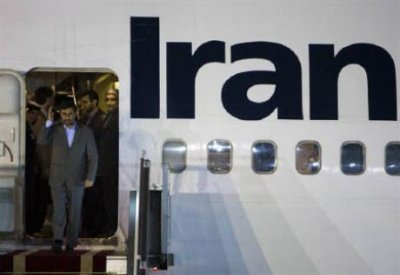
Iranian President Mahmoud Ahmadinejad is seen at International Mehrabad Airport, Tehran, in September 2009. On 5 July 2010, an Iranian official said the country’s aircraft had been denied fuel in Germany, Britain and the United Arab Emirates as a result of tighter U.S. sanctions. Credit: Reuters/Morteza Nikoubazl/Files
US President Barack Obama signed into law last Thursday Congressional legislation against Iran that has the potential to heighten tensions, not only with Tehran, but America’s European and Asia rivals.
The legislation broadly targets foreign banks and corporations doing business in Iran and sets out unilateral US penalties against those that do not fall into line. Companies could be denied access to the US Export-Import Bank, restricting their ability to sell into the US market, or denied US government contracts.
The Comprehensive Iran Sanctions, Accountability, and Divestment Act requires the US Treasury Department to bar access to the American financial system to any foreign bank conducting transactions with Iranian entities blacklisted by the UN or the US government. The list includes some major Iranian banks, the Iranian energy sector, and businesses associated with the Islamic Revolutionary Guard Corps (IRGC).
The legislation provocatively targets foreign companies selling refined petroleum products, such as gasoline and diesel, to Iran, including producers, insurers and those involved in transportation. While Iran has huge reserves of oil, its energy infrastructure and refining capacity are badly rundown due to a lack of investment, forcing the importation of gasoline.
Washington has accused Tehran of seeking to build nuclear weapons. Last month the US and its European allies pushed a fourth resolution through the UN Security Council, imposing new penalties on Tehran over its refusal to shut down its uranium enrichment facilities and halt the construction of a heavy water research reactor. Following the UN resolution, the European Union (EU) foreshadowed further tough sanctions against Iran, including a ban on investment in its energy sector.
The Iranian regime has repeatedly denied it has any plans to build nuclear weapons, and denounced the UN and US sanctions as illegal. Under the Nuclear Non-Proliferation Treaty (NPT), which Iran has signed, countries have the right to develop any aspect of the nuclear fuel cycle, including uranium enrichment and plutonium reprocessing, for peaceful purposes. Iranian nuclear facilities, including the Natanz uranium enrichment plant, are subject to regular International Atomic Energy Agency (IAEA) inspections, which include a stock take of enriched uranium to ensure it is not used for military purposes.
The US legislation goes far further than the proposed EU sanctions and the UN resolutions, to which Russia and China only reluctantly agreed under pressure from Washington. Any significant constriction of the sale of refined petroleum products to Iran could impact heavily on its economy. Although Tehran has been building up its strategic reserves and is cutting back on imports, Iran still buys an estimated 25-30 percent of its gasoline needs on the international market.
The ramifications of the laws are even wider. Democrat congressman Ron Klein told the Wall Street Journal: “Foreign companies are going to have to make a choice: Do they want to do business with us or with the Iranians?” By threatening to penalise foreign banks and companies for activities that are not banned under UN resolutions, the law will inevitably fuel international resentment and intensify frictions.
Total CEO Christophe de Margerie Last week the French oil company Total ended sales of gasoline to Iran and Spain’s Repsol pulled out of a development contract with Royal Dutch Shell for Iran’s South Pars gas field. Total CEO Christophe de Margerie told an economic forum: “We do not think an embargo on the delivery of petrol products is a good way to settle differences of a political nature.” He complained that “too many things are politicised these days”.
In the US, the National Foreign Trade Council and the US Engage alliance of companies and associations also raised concerns, particularly over possible penalties against US parent companies for violations by their foreign subsidiaries. In a press statement, council president Bill Reinsch warned: “We are deeply concerned about the timing of this legislation and its unintended consequences for legitimate global commerce.”
Total is just the latest company to pull out of gasoline sales to Iran. Over the past six months, Russia’s LUKOIL, India’s Reliance Industries, Malaysia’s Petronas, Royal Dutch Shell and the Swiss firm Glencore, each announced a halt to sales. At the same time, several major Chinese corporations, including the state-owned China National Petroleum Corp and China Petroleum & Chemical Corp, reportedly increased their sales to Iran earlier this year.
Under the legislation, the US administration can waive penalties on countries, such as China, that backed the UN resolution against Iran. If Obama took action against Chinese oil companies, tensions would escalate between Washington and Beijing, which only agreed to support the latest UN sanctions if Iran’s energy sector were excluded. China imports roughly 15 percent of its crude oil from Iran and has signed several major agreements to develop energy projects there.
The new US sanctions point to the motivations underlying Washington’s continuing threats and provocations against Iran. American banks and corporations will be largely unaffected, as Washington has effectively blockaded Iran economically for more than three decades following the overthrow of the Shah in 1979. But the penalties will impact on US rivals, including close US allies such as Germany and Japan, that have substantial economic interests in Iran.
The Wall Street Journal pointed out last Thursday: “Among those that could face legal challenges and fines are Japan’s Big Three Banks—Mitsubishi UFJ Financial Group Inc., Sumitomo Mitsui Financial Group and Mizuho Financial Group Inc—as well as European firms such as Commerzbank Bank AB and Deutsche Bank AG, all of whom have businesses inside Iran.” Japan’s oil and gas producer Inpex Corp also has significant interests, including a 10 percent stake in the Azadegan oil field in southwestern Iran.
Iran not only has huge oil and gas reserves but is strategically located between the key regions of the Middle East and Central Asia. The nuclear issue is simply a convenient pretext for Washington to apply pressure in a bid to fashion a regime in Tehran that is more conducive to US ambitions for regional domination. The Obama administration’s overt support for the oppositional Green movement inside Iran, following last year’s presidential poll, had the same aim.
There is a dangerous logic to US attempts to choke off gasoline supplies to Iran. As several articles in the US press have pointed out, even if major foreign corporations pull out of the gasoline trade with Iran, Tehran will still have access to refined petroleum products—at a price—through various black markets operating in the Persian Gulf. If financial penalties fail to stop gasoline supplies and bring the Iranian economy to its knees, a clamor in the US for a military blockade is certain to intensify.
Like his predecessor Bush, President Obama has repeatedly refused to rule out military action against Iran, including air strikes against its nuclear facilities. Any attempt to enforce an economic blockade of Iran through military force—regarded internationally as an act of war—would create an explosive situation in the Persian Gulf.
For further information see "US, Israel Warships in Suez May Be Prelude to Faceoff with Iran"HERE...
Editor's NOTE:
It is pure insanity to start a war with Iran a country which represents absolutely no existential threat to the United States whatsoever! Even Fidel Castro can see that to start a war in the Persian Gulf is to once again (as in 1962) risk a global nuclear conflagration. Once again it is Zionist control of US government foreign policy vis a vis Iran that is responsible for the latest push to war.
Please e-mail, phone, send post cards to your representative, senators and the Obama administration in protest. The latest bellicose moves against Iran are blatantly immoral and extremely dangerous.
--Dr. J. P. Hubert
Monday, July 12, 2010
Gulf Oil Update: Day 85
Gulf Oil Spill - Gutsy Solution Restores Environment in Just Six Weeks!!!
The Texas Land Office and Texas Water Commission successfully used 'oil eating' microbes to clean up large oil spills in just weeks. Microbes hunt down and eat the toxic oil and leave only a biodegradable waste that is non-toxic to humans and marine life. Marshland and beaches were pristine again in just weeks---not years like the Exxon Valdez spill. This is the answer to save the seafood industry and all the precious creatures we are about to kill. Watch this YouTube Video and see how effective Microbes work!
Editor's NOTE:
The "oil-eating" microbe idea would seem to provide great promise if the results reported in the above video are true and can be repeated by scientists. The Obama administration should immediately conduct appropriate scientific tests and begin employing microbes ASAP if the tests are successful--whether BP is in agreement or not.
If the latest reports are true that BP has managed to place a new cap on the riser pipe which can all but completely stop the flow of oil until the relief wells are finished, the microbe technology would seem to offer the quickest and most efficient way of clearing the millions of barrels of oil which have already spilled into the Gulf of Mexico. The government should order BP to cease using toxic disbursants (prarticularly Corexit) the use of which make it more difficult for microbes to clear oil throughout the entire water column.
All readers are encouraged to spread the word far and wide to media, Congress, the Obama administration and any other interested parties.
--Dr. J. P. Hubert
____________
BP prepares to test new cap installed on oil leak

AP – In this image taken from video provided by BP PLC at 18:23 CDT, a new containment cap, top, is lowered …
By COLLEEN LONG and HARRY R. WEBER, Associated Press Writers Colleen Long And Harry R. Weber, Associated Press Writers
NEW ORLEANS – After securing a new, tight-fitting cap on top of the leaking well in the Gulf of Mexico, BP prepared Tuesday to begin tests to see if it will hold and stop fresh oil from polluting the waters for the first time in nearly three months.
The oil giant expects to know within 48 hours if the new cap, which landed Monday after almost three days of painstaking, around-the-clock work a mile below the Gulf's surface, can stanch the flow. The solution is only temporary, but it offers the best hope yet for cutting off the gush of billowing brown oil.
The cap's installation was good news to weary Gulf Coast residents who have warily waited for BP to make good on its promise to clean up the mess. Still, they warned that even if the oil is stopped, the consequences are far from over.
"I think we're going to see oil out in the Gulf of Mexico, roaming around, taking shots at us, for the next year, maybe two," Billy Nungesser, president of Louisiana's oil-stained Plaquemines Parish, said Monday. "If you told me today no more oil was coming ashore, we've still got a massive cleanup ahead."
Starting Tuesday, the cap will be tested and monitored to see if it can withstand pressure from the gushing oil and gas. The tests could last anywhere between six to 48 hours, according to National Incident Commander Thad Allen.
The cap will be tested by closing off three separate valves that fit together snugly, choking off the oil from entering the Gulf. BP expects no oil will be released into the ocean during the tests, but remained cautious about the success of the system.
"This will not however be an indication that flow from the wellbore has been permanently stopped," the company said in a statement. "The sealing cap system never before has been deployed at these depths or under these conditions, and its efficiency and ability to contain the oil and gas cannot be assured."
BP will be watching pressure readings. High pressure is good, because it would mean the leak has been contained inside the wellhead machinery. But if readings are lower than expected, that could mean there is another leak elsewhere in the well.
Even if the cap works, the blown-out well must still be plugged. A permanent fix will have to wait until one of two relief wells being drilled reaches the broken well, which will then be plugged up with drilling mud and cement. That may not happen until mid-August.
Even if the flow of oil is choked off while BP works on a permanent fix, the spill has already damaged everything from beach tourism to the fishing industry.
Tony Wood, director of the National Spill Control School at Texas A&M-Corpus Christi said the sloppiest of the oil — mousse-like brown stuff that has not yet broken down — will keep washing ashore for several months, with the volume slowly decreasing over time.
He added that hardened tar balls could keep hitting beaches and marshes each time a major storm rolls through for a year or more. Those tar balls are likely trapped for now in the surf zone, gathering behind sand bars just like sea shells.
"It will still be getting on people's feet on the beaches probably a year or two from now," Wood said.
But on Monday, the region absorbed a rare piece of good news in the placement of the 150,000-pound cap on top of the gushing leak responsible for so much misery.
Around 6:30 p.m. CDT, live video streams trained on the wellhead showed the cap being slowly lowered into place. BP officials said the device was attached around 7 p.m.
"I'm very hopeful that this cap works and we wake up in the morning and they're catching all the oil. I would be the happiest person around here," said Mitch Jurisich, a third generation oysterman from Empire, La., who has been out of work for weeks.
Residents skeptical BP can deliver on its promise to control the spill greeted the news cautiously.
"There's no telling what those crazy suckers are going to do now," Ronnie Kenniar said when he heard the cap was placed on the well. The 49-year-old fishermen is now working for BP in the Vessel of Opportunity program, a BP-run operation employing boat owners for odd jobs.
James Pelas, 41, a shrimper who took a break from working on his boat at a marina in Venice, La., said he didn't think the crisis would be over for a long time.
"I ain't excited about it until it's closed off completely," he said. "Oil's scattered all over the place."
Meanwhile, the Obama administration issued a revised moratorium on deep-water offshore drilling Monday to replace the one that was struck down by the courts as heavy-handed. The new ban, in effect until Nov. 30, does not appear to deviate much from the original moratorium, as it still targets deep-water drilling operators while defining them in a different way.
As of Monday, the 83rd day of the disaster, between 89 million and 176 million gallons of oil had poured into the Gulf, according to government estimates. The spill started April 20 when the Deepwater Horizon rig, leased by BP from Transocean Ltd, exploded and burned, killing 11 workers. It sank two days later.
__________
NYT: Yes, BP Could Go Into Bankruptcy
By: David Dayen
Sunday July 11, 2010 6:30 am
Firedoglake.com
At almost every step of the way, BP’s efforts to cap the well spewing oil into the Gulf have wound up making things worse. Let’s hope this doesn’t continue, but for now, we have an uncapped well putting at least 35,000 barrels and maybe as much as 100,000 into the water today (I don’t know why WaPo is foregrounding the 15,000 barrels the last containment dome was catching, implying that no more oil would flow). You can read BP’s entire plan for the next several weeks, both the new cap and the timeline for the relief wells, in this letter to Thad Allen.
While BP claims that the project is moving on schedule, they’ve said that before, and yet previous top hats, top kills and junk shots wound up failing or capturing an inadequate amount of oil to stop the leak. And if the well cannot be fully capped, the risk of an increased flow into the Gulf exists. Remember that every barrel of oil carries with it not only a human cost in pollution, but a hard financial cost in per-barrel fines and penalties. I’ve been saying for a month that BP stands at risk of bankruptcy, and the New York Times picks it up today:
With pockets as deep as BP’s — its assets are worth more than $260 billion — the possibility that it might be forced to seek bankruptcy protection because of the Gulf of Mexico oil spill is considered remote by many industry experts.
But what if the company’s plan to contain the spill in the next several days does not work, and other efforts to stop the gushing oil also fail? If that were to occur, the worst-case projections of some experts, if they came to pass, would strain the ability of any company to pay, said Robin K. Craig, associate dean for environmental programs at the Florida State University College of Law.
Professor Craig said that if the oil hit the Gulf Stream and was carried by currents to East Coast states, Cuba and other Caribbean nations, and possibly even Britain, lawsuits could quickly mount to levels even BP could not handle.
“My bet is that BP will finally go bankrupt from the tort liability and the environmental liability,” she said. “Hypothetically, a bluefin tuna farmer in the Mediterranean could end up with a claim against BP.”
This becomes particularly true if Eric Holder does pursue legitimate criminal charges. Holder has said that his wide-ranging investigation would cover more companies than BP, but obviously they would be at the center of any investigation. And those other companies have already begun to stiff BP, which will result in additional legal proceedings (Anadarko may even have a case that BP holds all the negligence in this case).
I know that BP has $260 billion in assets, and makes enough in a day to cover the entire $75 million liability cap (which doesn’t include criminal penalties). But this possibility is real. A lot of things would have to go wrong, but a lot have already. And while the executives at BP would probably emerge from bankruptcy without much trouble, you cannot say the same for the federal government, which would then be on the hook for much of the cleanup and damage awards.
Still, you’d have to sell off a LOT of assets before we get to that point.
The Texas Land Office and Texas Water Commission successfully used 'oil eating' microbes to clean up large oil spills in just weeks. Microbes hunt down and eat the toxic oil and leave only a biodegradable waste that is non-toxic to humans and marine life. Marshland and beaches were pristine again in just weeks---not years like the Exxon Valdez spill. This is the answer to save the seafood industry and all the precious creatures we are about to kill. Watch this YouTube Video and see how effective Microbes work!
Editor's NOTE:
The "oil-eating" microbe idea would seem to provide great promise if the results reported in the above video are true and can be repeated by scientists. The Obama administration should immediately conduct appropriate scientific tests and begin employing microbes ASAP if the tests are successful--whether BP is in agreement or not.
If the latest reports are true that BP has managed to place a new cap on the riser pipe which can all but completely stop the flow of oil until the relief wells are finished, the microbe technology would seem to offer the quickest and most efficient way of clearing the millions of barrels of oil which have already spilled into the Gulf of Mexico. The government should order BP to cease using toxic disbursants (prarticularly Corexit) the use of which make it more difficult for microbes to clear oil throughout the entire water column.
All readers are encouraged to spread the word far and wide to media, Congress, the Obama administration and any other interested parties.
--Dr. J. P. Hubert
____________
BP prepares to test new cap installed on oil leak

AP – In this image taken from video provided by BP PLC at 18:23 CDT, a new containment cap, top, is lowered …
By COLLEEN LONG and HARRY R. WEBER, Associated Press Writers Colleen Long And Harry R. Weber, Associated Press Writers
NEW ORLEANS – After securing a new, tight-fitting cap on top of the leaking well in the Gulf of Mexico, BP prepared Tuesday to begin tests to see if it will hold and stop fresh oil from polluting the waters for the first time in nearly three months.
The oil giant expects to know within 48 hours if the new cap, which landed Monday after almost three days of painstaking, around-the-clock work a mile below the Gulf's surface, can stanch the flow. The solution is only temporary, but it offers the best hope yet for cutting off the gush of billowing brown oil.
The cap's installation was good news to weary Gulf Coast residents who have warily waited for BP to make good on its promise to clean up the mess. Still, they warned that even if the oil is stopped, the consequences are far from over.
"I think we're going to see oil out in the Gulf of Mexico, roaming around, taking shots at us, for the next year, maybe two," Billy Nungesser, president of Louisiana's oil-stained Plaquemines Parish, said Monday. "If you told me today no more oil was coming ashore, we've still got a massive cleanup ahead."
Starting Tuesday, the cap will be tested and monitored to see if it can withstand pressure from the gushing oil and gas. The tests could last anywhere between six to 48 hours, according to National Incident Commander Thad Allen.
The cap will be tested by closing off three separate valves that fit together snugly, choking off the oil from entering the Gulf. BP expects no oil will be released into the ocean during the tests, but remained cautious about the success of the system.
"This will not however be an indication that flow from the wellbore has been permanently stopped," the company said in a statement. "The sealing cap system never before has been deployed at these depths or under these conditions, and its efficiency and ability to contain the oil and gas cannot be assured."
BP will be watching pressure readings. High pressure is good, because it would mean the leak has been contained inside the wellhead machinery. But if readings are lower than expected, that could mean there is another leak elsewhere in the well.
Even if the cap works, the blown-out well must still be plugged. A permanent fix will have to wait until one of two relief wells being drilled reaches the broken well, which will then be plugged up with drilling mud and cement. That may not happen until mid-August.
Even if the flow of oil is choked off while BP works on a permanent fix, the spill has already damaged everything from beach tourism to the fishing industry.
Tony Wood, director of the National Spill Control School at Texas A&M-Corpus Christi said the sloppiest of the oil — mousse-like brown stuff that has not yet broken down — will keep washing ashore for several months, with the volume slowly decreasing over time.
He added that hardened tar balls could keep hitting beaches and marshes each time a major storm rolls through for a year or more. Those tar balls are likely trapped for now in the surf zone, gathering behind sand bars just like sea shells.
"It will still be getting on people's feet on the beaches probably a year or two from now," Wood said.
But on Monday, the region absorbed a rare piece of good news in the placement of the 150,000-pound cap on top of the gushing leak responsible for so much misery.
Around 6:30 p.m. CDT, live video streams trained on the wellhead showed the cap being slowly lowered into place. BP officials said the device was attached around 7 p.m.
"I'm very hopeful that this cap works and we wake up in the morning and they're catching all the oil. I would be the happiest person around here," said Mitch Jurisich, a third generation oysterman from Empire, La., who has been out of work for weeks.
Residents skeptical BP can deliver on its promise to control the spill greeted the news cautiously.
"There's no telling what those crazy suckers are going to do now," Ronnie Kenniar said when he heard the cap was placed on the well. The 49-year-old fishermen is now working for BP in the Vessel of Opportunity program, a BP-run operation employing boat owners for odd jobs.
James Pelas, 41, a shrimper who took a break from working on his boat at a marina in Venice, La., said he didn't think the crisis would be over for a long time.
"I ain't excited about it until it's closed off completely," he said. "Oil's scattered all over the place."
Meanwhile, the Obama administration issued a revised moratorium on deep-water offshore drilling Monday to replace the one that was struck down by the courts as heavy-handed. The new ban, in effect until Nov. 30, does not appear to deviate much from the original moratorium, as it still targets deep-water drilling operators while defining them in a different way.
As of Monday, the 83rd day of the disaster, between 89 million and 176 million gallons of oil had poured into the Gulf, according to government estimates. The spill started April 20 when the Deepwater Horizon rig, leased by BP from Transocean Ltd, exploded and burned, killing 11 workers. It sank two days later.
__________
NYT: Yes, BP Could Go Into Bankruptcy
By: David Dayen
Sunday July 11, 2010 6:30 am
Firedoglake.com
At almost every step of the way, BP’s efforts to cap the well spewing oil into the Gulf have wound up making things worse. Let’s hope this doesn’t continue, but for now, we have an uncapped well putting at least 35,000 barrels and maybe as much as 100,000 into the water today (I don’t know why WaPo is foregrounding the 15,000 barrels the last containment dome was catching, implying that no more oil would flow). You can read BP’s entire plan for the next several weeks, both the new cap and the timeline for the relief wells, in this letter to Thad Allen.
While BP claims that the project is moving on schedule, they’ve said that before, and yet previous top hats, top kills and junk shots wound up failing or capturing an inadequate amount of oil to stop the leak. And if the well cannot be fully capped, the risk of an increased flow into the Gulf exists. Remember that every barrel of oil carries with it not only a human cost in pollution, but a hard financial cost in per-barrel fines and penalties. I’ve been saying for a month that BP stands at risk of bankruptcy, and the New York Times picks it up today:
With pockets as deep as BP’s — its assets are worth more than $260 billion — the possibility that it might be forced to seek bankruptcy protection because of the Gulf of Mexico oil spill is considered remote by many industry experts.
But what if the company’s plan to contain the spill in the next several days does not work, and other efforts to stop the gushing oil also fail? If that were to occur, the worst-case projections of some experts, if they came to pass, would strain the ability of any company to pay, said Robin K. Craig, associate dean for environmental programs at the Florida State University College of Law.
Professor Craig said that if the oil hit the Gulf Stream and was carried by currents to East Coast states, Cuba and other Caribbean nations, and possibly even Britain, lawsuits could quickly mount to levels even BP could not handle.
“My bet is that BP will finally go bankrupt from the tort liability and the environmental liability,” she said. “Hypothetically, a bluefin tuna farmer in the Mediterranean could end up with a claim against BP.”
This becomes particularly true if Eric Holder does pursue legitimate criminal charges. Holder has said that his wide-ranging investigation would cover more companies than BP, but obviously they would be at the center of any investigation. And those other companies have already begun to stiff BP, which will result in additional legal proceedings (Anadarko may even have a case that BP holds all the negligence in this case).
I know that BP has $260 billion in assets, and makes enough in a day to cover the entire $75 million liability cap (which doesn’t include criminal penalties). But this possibility is real. A lot of things would have to go wrong, but a lot have already. And while the executives at BP would probably emerge from bankruptcy without much trouble, you cannot say the same for the federal government, which would then be on the hook for much of the cleanup and damage awards.
Still, you’d have to sell off a LOT of assets before we get to that point.
Sunday, July 11, 2010
Gulf Oil Update: Day 83
Editor's NOTE:
As regular readers are aware, this site has devoted a great deal of coverage recently to the Gulf Oil "Spill." In the past week I have provided a daily update in which hopefully the most informative pieces have been posted. It has been challenging to walk just the right line between on the one hand being alarmist and the other inappropriately optimistic especially since BP and the Obama administration have begun to seriously limit media access and investigation by scientists and other interested parties.
Some of the claims made by certain author's who allegedly have obtained "inside" information have been difficult to independently verify. The information contained on the separate "Gulf Oil Catastrophe Documented Effects Update" page HERE...represents what I believe has been established as fact. I do not include theories, hypotheses or speculation there.
Clearly, the ongoing contamination of the Gulf of Mexico with oil and gas is at a minimum a horrendous problem and could if not stopped become one of monumental proportions.
I encourage readers to send me any comments and reactions to what has been offered here vis a vis the Gulf Oil "Spill" and ask that anyone who has other anecdotal information or actual data to report send me an e-mail as directed under the communication section located on the right hand side of the site.
The following article is an example of a theory which I have been unable to independently validate. Note that the author makes multiple claims but does not reference them in the body of his piece.
--Dr. J. P. Hubert
____________
How the ultimate BP Gulf disaster could kill millions
by Terrence Aym
Helium
Disturbing evidence is mounting that something frightening is happening deep under the waters of the Gulf of Mexico—something far worse than the BP oil gusher.
Warnings were raised as long as a year before the Deepwater Horizon disaster that the area of seabed chosen by the BP geologists might be unstable, or worse, inherently dangerous. (Editor--a reference citation should have been included here)
What makes the location that Transocean chose potentially far riskier than other potential oil deposits located at other regions of the Gulf? It can be summed up with two words: methane gas.
The same methane that makes coal mining operations hazardous and leads to horrendous mining accidents deep under the earth also can present a high level of danger to certain oil exploration ventures.
Location of Deepwater Horizon oil rig was criticized
More than 12 months ago some geologists rang the warning bell that the Deepwater Horizon exploratory rig might have been erected directly over a huge underground reservoir of methane. (Editor--this claim sorely needs a reference citation)
Documents from several years ago indicate that the subterranean geologic formation may contain the presence of a huge methane deposit. (Editor--ditto)
None other than the engineer (Editor--what is his name and where did he allegedly make the following claim?) who helped lead the team to snuff the Gulf oil fires set by Saddam Hussein to slow the advance of American troops has stated that a huge underground lake of methane gas—compressed by a pressure of 100,000 pounds per square inch (psi)—could be released by BP's drilling effort to obtain the oil deposit.
Current engineering technology cannot contain gas that is pressurized to 100,000 psi.
By some (Editor--Who?) geologists' estimates the methane could be a massive 15 to 20 mile toxic and explosive bubble trapped for eons under the Gulf sea floor. In their opinion, the explosive destruction of the Deepwater Horizon wellhead was an accident just waiting to happen.
Yet the disaster that followed the loss of the rig pales by comparison to the apocalyptic disaster that may come.
A cascading catastrophe
According to worried geologists (Editor--name them), the first signs that the methane may burst its way through the bottom of the ocean would be fissures or cracks appearing on the ocean floor near the damaged well head.
Evidence of fissures opening up on the seabed have been captured by the robotic submersibles working to repair and contain the ruptured well. (Editor--I have been unable to find a reference that documents this claim) Smaller, independent plumes have also appeared outside the nearby radius of the bore hole itself. (Editor--I believe this has been established as fact)
According to some (Editor--again, who?) geological experts, BP's operations set into motion a series of events that may be irreversible. Step-by-step the drilling team committed one error after another.
Congressmen Henry Waxman, D-CA, and Bart Stupak, D-MI, in a letter sent to BP CEO Tony Hayward, identified 5 missteps made by BP during the period culminating with the explosion.
Waxman, chair of the Congressional energy panel and Stupak, the head of the subcommittee on oversight and investigations, said, "The common feature of these five decisions is that they posed a trade-off between cost and well safety."
The two Representatives also stated in the 14-page letter to Hayward that "Time after time, it appears that BP made decisions that increased the risk of a blowout to save the company time or expense."
Called by some insiders investigating the ongoing disaster a "perfect storm of catastrophe," the wellhead blew on the sea floor catapulting a stream of mud, oil and gas upwards at the speed of sound.
In describing the events—that transpired in a matter of seconds—they (Editor--Who?) note that immediately following the rupture the borehole pipe's casing blew away exposing a straight line 8 miles deep for the pressurized gas to escape. The result was cavitation, an irregular pressure variance sometimes experience by deep diving vessels such as nuclear submarines. This cavitation created a supersonic bubble of explosive methane gas that resulted in a supersonic explosion killing 11 men and completely annihilating the drilling platform.
Death from the depths
With the emerging evidence of fissures, the quiet fear now is the methane bubble rupturing the seabed and exploding into the Gulf waters. If the bubble escapes, every ship, drilling rig and structure within the region of the bubble will instantaneously sink. (Editor--Apparently fact since ships on the surface of the water would lose their bouyancy if that scenario occured) All the workers, engineers, Coast Guard personnel and marine biologists measuring the oil plumes' advance will instantly perish.
As horrible as that is, what would follow is an event so potentially horrific that it equals in its fury the Indonesian tsunami that killed more than 600,000, or the destruction of Pompeii by Mt. Vesuvius.
The ultimate Gulf disaster, however, would make even those historical horrors pale by comparison. If the huge methane bubble breaches the seabed, it will erupt with an explosive fury similar to that experienced during the eruption of Mt. Saint Helens in the Pacific Northwest. A gas gusher will surge upwards through miles of ancient sedimentary rock—layer after layer—past the oil reservoir. It will explode upwards propelled by 50 tons psi, burst through the cracks and fissures of the compromised sea floor, and rupture miles of ocean bottom with one titanic explosion.
The burgeoning methane gas cloud will surface, killing everything it touches, and set off a supersonic tsunami with the wave traveling somewhere between 400 to 600 miles per hour. (Editor--Several writers have said this on the internet but I have been unable to find a geologist who will go on the record and defend this contention)
While the entire Gulf coastline is vulnerable, the state most exposed to the fury of a supersonic wave towering 150 to 200 feet or more is Florida. The Sunshine State only averages about 100 feet above sea level with much of the coastline and lowlands and swamps near zero elevation.
Elevation Map:

A supersonic tsunami would literally sweep away everything from Miami to the panhandle in a matter of minutes. Loss of human life would be virtually instantaneous and measured in the millions. Of course the states of Texas, Louisiana, Mississippi, Alabama and southern region of Georgia—a state with no Gulf coastline—would also experience tens of thousands, if not hundreds of thousands of casualties.
Loss of property is virtually incalculable and the days of the US position as the world's superpower would be literally gone in a flash...of detonating methane.
Report about the Late Paleocene Thermal Maximum (LPTM), which occurred around 55 million years ago and lasted about 100,000 years. Large undersea methane caused explosions and mass extinctions.
This explores the controversial paper published by Northwestern University's Gregory Ryskin. His thesis: the oceans periodically produce massive eruptions of explosive methane gas.
____________
George Noory Interview
Noory's guest argues that "independent geological scientists should be supplied with the Mocondo Well 'mud log data' in order to help predict what might transpire"
___________
Dying, dead marine wildlife paint dark, morbid picture of Gulf Coast following oil spill
BY Matthew Lysiak In Grand Isle, La. and Helen Kennedy
NEW YORK DAILY NEWS STAFF WRITERS
Originally Published:Wednesday, June 2nd 2010, 12:52 AM
Updated: Wednesday, June 2nd 2010, 5:44 PM

DelMundo for News Carcass of a decomposing dolphin on rocks at Queen Bess Island in Gulf of Mexico.

DelMundo for News A sign expressing hatred towards BP stands on the side of Highway 1 in Grand Isle.
Here's what President Obama didn't see when he visited the Gulf Coast: a dead dolphin rotting in the shore weeds.
"When we found this dolphin it was filled with oil. Oil was just pouring out of it. It was the saddest darn thing to look at," said a BP contract worker who took the Daily News on a surreptitious tour of the wildlife disaster unfolding in Louisiana.
His motive: simple outrage.
"There is a lot of coverup for BP. They specifically informed us that they don't want these pictures of the dead animals. They know the ocean will wipe away most of the evidence. It's important to me that people know the truth about what's going on here," the contractor said.
"The things I've seen: They just aren't right. All the life out here is just full of oil. I'm going to show you what BP never showed the President."
The day was 85 degrees, the blue sky almost white with sunshine, the air fresh with salt tang.
After checking that he was unobserved, he motored out to Queen Bess barrier island, known to the locals as Bird Island.
The grasses by the shore were littered with tarred marine life, some dead and others struggling under a thick coating of crude.
"When you see some of the things I've seen, it would make you sick," the contractor said. "No living creature should endure that kind of suffering."
Queen Bess Island was the first place where fledglings were born when the beloved, endangered Louisiana brown pelicans were reintroduced in the 1970s. Their population rebounded and was finally declared stabilized in 2002.
Now their future is once again in doubt. In what had been such an important hatchery, hundreds of pelicans - their white heads stained black - stood sentinel. They seemed slow and lethargic.
"Those pelicans are supposed to have white heads. The black is from the oil. Most of them won't survive," the contractor said.
"They keep trying to clean themselves. They try and they try, but they can't do it."
The contractor has been attempting to save birds and turtles.
"I saw a pelican under water with only its wing sticking out," he said. "I grabbed it and lifted it out of the water. It was just covered in oil. It was struggling so hard to survive. We did what we could for it.
"Nature is cruel, but what's happening here is crueler."
The uninhabited barrier islands are surrounded by yellow floating booms, also stained black, that are supposed to keep the oil out. It's not working.
"That grass was green a few weeks ago," the contractor said. "Now look. ... This whole island is destroyed. How do you write a check for something like this?"
He said he recently found five turtles drowning in oil.
"Three turtles were dead. Two were dying and not dead yet. They will be," he said.
As the boat headed back amid the choppy waves, a pod of dolphins showed up to swim with the vessel and guide it to land.
"They know they are in trouble. We are all in trouble," the contractor said.
BP's central role in the disaster cleanup has apparently given the company a lot of latitude in keeping the press away from beaches where the oil is thickest.
On Monday, a Daily News team was escorted away from a public beach on Elmer's Island by cops who said they were taking orders from BP.
BP spokesman Toby Odone denied the company is trying to hide the environmental damage; he noted BP has organized press visits to the spill zone and said BP cannot tell cops what to do.
The contractor for BP said the public needs to see the truth." (Editor's bold emphasis)
BP is going to say the deaths of these animals wasn't oil-related," he said. "We know the truth. I hope these pictures get to the right people - to someone who can do something."
As regular readers are aware, this site has devoted a great deal of coverage recently to the Gulf Oil "Spill." In the past week I have provided a daily update in which hopefully the most informative pieces have been posted. It has been challenging to walk just the right line between on the one hand being alarmist and the other inappropriately optimistic especially since BP and the Obama administration have begun to seriously limit media access and investigation by scientists and other interested parties.
Some of the claims made by certain author's who allegedly have obtained "inside" information have been difficult to independently verify. The information contained on the separate "Gulf Oil Catastrophe Documented Effects Update" page HERE...represents what I believe has been established as fact. I do not include theories, hypotheses or speculation there.
Clearly, the ongoing contamination of the Gulf of Mexico with oil and gas is at a minimum a horrendous problem and could if not stopped become one of monumental proportions.
I encourage readers to send me any comments and reactions to what has been offered here vis a vis the Gulf Oil "Spill" and ask that anyone who has other anecdotal information or actual data to report send me an e-mail as directed under the communication section located on the right hand side of the site.
The following article is an example of a theory which I have been unable to independently validate. Note that the author makes multiple claims but does not reference them in the body of his piece.
--Dr. J. P. Hubert
____________
How the ultimate BP Gulf disaster could kill millions
by Terrence Aym
Helium
Disturbing evidence is mounting that something frightening is happening deep under the waters of the Gulf of Mexico—something far worse than the BP oil gusher.
Warnings were raised as long as a year before the Deepwater Horizon disaster that the area of seabed chosen by the BP geologists might be unstable, or worse, inherently dangerous. (Editor--a reference citation should have been included here)
What makes the location that Transocean chose potentially far riskier than other potential oil deposits located at other regions of the Gulf? It can be summed up with two words: methane gas.
The same methane that makes coal mining operations hazardous and leads to horrendous mining accidents deep under the earth also can present a high level of danger to certain oil exploration ventures.
Location of Deepwater Horizon oil rig was criticized
More than 12 months ago some geologists rang the warning bell that the Deepwater Horizon exploratory rig might have been erected directly over a huge underground reservoir of methane. (Editor--this claim sorely needs a reference citation)
Documents from several years ago indicate that the subterranean geologic formation may contain the presence of a huge methane deposit. (Editor--ditto)
None other than the engineer (Editor--what is his name and where did he allegedly make the following claim?) who helped lead the team to snuff the Gulf oil fires set by Saddam Hussein to slow the advance of American troops has stated that a huge underground lake of methane gas—compressed by a pressure of 100,000 pounds per square inch (psi)—could be released by BP's drilling effort to obtain the oil deposit.
Current engineering technology cannot contain gas that is pressurized to 100,000 psi.
By some (Editor--Who?) geologists' estimates the methane could be a massive 15 to 20 mile toxic and explosive bubble trapped for eons under the Gulf sea floor. In their opinion, the explosive destruction of the Deepwater Horizon wellhead was an accident just waiting to happen.
Yet the disaster that followed the loss of the rig pales by comparison to the apocalyptic disaster that may come.
A cascading catastrophe
According to worried geologists (Editor--name them), the first signs that the methane may burst its way through the bottom of the ocean would be fissures or cracks appearing on the ocean floor near the damaged well head.
Evidence of fissures opening up on the seabed have been captured by the robotic submersibles working to repair and contain the ruptured well. (Editor--I have been unable to find a reference that documents this claim) Smaller, independent plumes have also appeared outside the nearby radius of the bore hole itself. (Editor--I believe this has been established as fact)
According to some (Editor--again, who?) geological experts, BP's operations set into motion a series of events that may be irreversible. Step-by-step the drilling team committed one error after another.
Congressmen Henry Waxman, D-CA, and Bart Stupak, D-MI, in a letter sent to BP CEO Tony Hayward, identified 5 missteps made by BP during the period culminating with the explosion.
Waxman, chair of the Congressional energy panel and Stupak, the head of the subcommittee on oversight and investigations, said, "The common feature of these five decisions is that they posed a trade-off between cost and well safety."
The two Representatives also stated in the 14-page letter to Hayward that "Time after time, it appears that BP made decisions that increased the risk of a blowout to save the company time or expense."
Called by some insiders investigating the ongoing disaster a "perfect storm of catastrophe," the wellhead blew on the sea floor catapulting a stream of mud, oil and gas upwards at the speed of sound.
In describing the events—that transpired in a matter of seconds—they (Editor--Who?) note that immediately following the rupture the borehole pipe's casing blew away exposing a straight line 8 miles deep for the pressurized gas to escape. The result was cavitation, an irregular pressure variance sometimes experience by deep diving vessels such as nuclear submarines. This cavitation created a supersonic bubble of explosive methane gas that resulted in a supersonic explosion killing 11 men and completely annihilating the drilling platform.
Death from the depths
With the emerging evidence of fissures, the quiet fear now is the methane bubble rupturing the seabed and exploding into the Gulf waters. If the bubble escapes, every ship, drilling rig and structure within the region of the bubble will instantaneously sink. (Editor--Apparently fact since ships on the surface of the water would lose their bouyancy if that scenario occured) All the workers, engineers, Coast Guard personnel and marine biologists measuring the oil plumes' advance will instantly perish.
As horrible as that is, what would follow is an event so potentially horrific that it equals in its fury the Indonesian tsunami that killed more than 600,000, or the destruction of Pompeii by Mt. Vesuvius.
The ultimate Gulf disaster, however, would make even those historical horrors pale by comparison. If the huge methane bubble breaches the seabed, it will erupt with an explosive fury similar to that experienced during the eruption of Mt. Saint Helens in the Pacific Northwest. A gas gusher will surge upwards through miles of ancient sedimentary rock—layer after layer—past the oil reservoir. It will explode upwards propelled by 50 tons psi, burst through the cracks and fissures of the compromised sea floor, and rupture miles of ocean bottom with one titanic explosion.
The burgeoning methane gas cloud will surface, killing everything it touches, and set off a supersonic tsunami with the wave traveling somewhere between 400 to 600 miles per hour. (Editor--Several writers have said this on the internet but I have been unable to find a geologist who will go on the record and defend this contention)
While the entire Gulf coastline is vulnerable, the state most exposed to the fury of a supersonic wave towering 150 to 200 feet or more is Florida. The Sunshine State only averages about 100 feet above sea level with much of the coastline and lowlands and swamps near zero elevation.
Elevation Map:

A supersonic tsunami would literally sweep away everything from Miami to the panhandle in a matter of minutes. Loss of human life would be virtually instantaneous and measured in the millions. Of course the states of Texas, Louisiana, Mississippi, Alabama and southern region of Georgia—a state with no Gulf coastline—would also experience tens of thousands, if not hundreds of thousands of casualties.
Loss of property is virtually incalculable and the days of the US position as the world's superpower would be literally gone in a flash...of detonating methane.
Report about the Late Paleocene Thermal Maximum (LPTM), which occurred around 55 million years ago and lasted about 100,000 years. Large undersea methane caused explosions and mass extinctions.
This explores the controversial paper published by Northwestern University's Gregory Ryskin. His thesis: the oceans periodically produce massive eruptions of explosive methane gas.
____________
George Noory Interview
Noory's guest argues that "independent geological scientists should be supplied with the Mocondo Well 'mud log data' in order to help predict what might transpire"
___________
Dying, dead marine wildlife paint dark, morbid picture of Gulf Coast following oil spill
BY Matthew Lysiak In Grand Isle, La. and Helen Kennedy
NEW YORK DAILY NEWS STAFF WRITERS
Originally Published:Wednesday, June 2nd 2010, 12:52 AM
Updated: Wednesday, June 2nd 2010, 5:44 PM

DelMundo for News Carcass of a decomposing dolphin on rocks at Queen Bess Island in Gulf of Mexico.

DelMundo for News A sign expressing hatred towards BP stands on the side of Highway 1 in Grand Isle.
Here's what President Obama didn't see when he visited the Gulf Coast: a dead dolphin rotting in the shore weeds.
"When we found this dolphin it was filled with oil. Oil was just pouring out of it. It was the saddest darn thing to look at," said a BP contract worker who took the Daily News on a surreptitious tour of the wildlife disaster unfolding in Louisiana.
His motive: simple outrage.
"There is a lot of coverup for BP. They specifically informed us that they don't want these pictures of the dead animals. They know the ocean will wipe away most of the evidence. It's important to me that people know the truth about what's going on here," the contractor said.
"The things I've seen: They just aren't right. All the life out here is just full of oil. I'm going to show you what BP never showed the President."
The day was 85 degrees, the blue sky almost white with sunshine, the air fresh with salt tang.
After checking that he was unobserved, he motored out to Queen Bess barrier island, known to the locals as Bird Island.
The grasses by the shore were littered with tarred marine life, some dead and others struggling under a thick coating of crude.
"When you see some of the things I've seen, it would make you sick," the contractor said. "No living creature should endure that kind of suffering."
Queen Bess Island was the first place where fledglings were born when the beloved, endangered Louisiana brown pelicans were reintroduced in the 1970s. Their population rebounded and was finally declared stabilized in 2002.
Now their future is once again in doubt. In what had been such an important hatchery, hundreds of pelicans - their white heads stained black - stood sentinel. They seemed slow and lethargic.
"Those pelicans are supposed to have white heads. The black is from the oil. Most of them won't survive," the contractor said.
"They keep trying to clean themselves. They try and they try, but they can't do it."
The contractor has been attempting to save birds and turtles.
"I saw a pelican under water with only its wing sticking out," he said. "I grabbed it and lifted it out of the water. It was just covered in oil. It was struggling so hard to survive. We did what we could for it.
"Nature is cruel, but what's happening here is crueler."
The uninhabited barrier islands are surrounded by yellow floating booms, also stained black, that are supposed to keep the oil out. It's not working.
"That grass was green a few weeks ago," the contractor said. "Now look. ... This whole island is destroyed. How do you write a check for something like this?"
He said he recently found five turtles drowning in oil.
"Three turtles were dead. Two were dying and not dead yet. They will be," he said.
As the boat headed back amid the choppy waves, a pod of dolphins showed up to swim with the vessel and guide it to land.
"They know they are in trouble. We are all in trouble," the contractor said.
BP's central role in the disaster cleanup has apparently given the company a lot of latitude in keeping the press away from beaches where the oil is thickest.
On Monday, a Daily News team was escorted away from a public beach on Elmer's Island by cops who said they were taking orders from BP.
BP spokesman Toby Odone denied the company is trying to hide the environmental damage; he noted BP has organized press visits to the spill zone and said BP cannot tell cops what to do.
The contractor for BP said the public needs to see the truth." (Editor's bold emphasis)
BP is going to say the deaths of these animals wasn't oil-related," he said. "We know the truth. I hope these pictures get to the right people - to someone who can do something."
Subscribe to:
Posts (Atom)