by: Kourosh Ziabari
October 15, 2010 "Information Clearing House" -- Philip Giraldi is a former counter-terrorism specialist and military intelligence officer of the United States Central Intelligence Agency. Now, he chairs the Council for the National Interest as the Executive Director. CNI is a nonprofit organization that advocates for the transformation of United States' Middle East policy.
As a CIA officer, Giraldi served in different countries including Turkey, Italy, Germany and Spain. He is now a Francis Walsingham Fellow at The American Conservative Defense Alliance. He has appeared on several radio and TV programs including Good Morning America, MSNBC, NPR, Fox News, BBC, Al-Jazeera and 60 Minutes.
Giraldi works with the American Conservative magazine as a contributing editor and writes a regular column for the Antiwar website. He is an outspoken critic of the hawkish policies of the United States and has publicly decried Washington's unconditional support for the state of Israel.
Philip Giraldi joined me in an exclusive interview to discuss the latest developments of the Middle East, the prospect of Israeli-Palestinian conflict, the possibility of a peaceful compromise between Iran and the United States and the impact of Israeli lobby on the long-term policies of the White House.
Kourosh Ziabari: Why is the Israeli lobby so powerful, influential and authoritative? Almost all of the major media conglomerates in the United States own to well-off Jews who are committed to maintaining the interests of the state of Israel in the U.S. Some experts say that Israel is the representative of the United States in the Middle East region, but some others suggest that it's Israel which determines the future of political developments in the United States. What's your take on that?
Philip Giraldi: The Israel Lobby is so powerful because it deliberately set out to establish control over key elements in the United States. It has demonstrated a number of times that politicians who are perceived as being unfriendly to Israel will face serious problems in being reelected because the Lobby mobilizes to provide money and media support to opponents. This means that congress is afraid to oppose anything that Israel and its Lobby wants. The same holds true for the presidency. Every presidential candidate must be seen as friendly to Israel or he will be attacked in the media and denied millions of dollars in political contributions, making it a safer option to support Israel. Finally, pro-Israeli interests control much of the media and, more important, dominate the opinion and editorial pages, making the only narrative that most Americans hear about the Middle East highly favorable to Israel and highly critical of all Israel's enemies. As a result, Israel is able to control U.S. foreign policy as it relates to the Middle East and also much of the Muslim world.
KZ: The recent call by the Iranian President on framing a fact-finding group to probe into the 9/11 attacks sparked intense controversy around the United States. Is it because the United States considers 9/11 a red line which should not be crossed?
PG: Many Americans believe that 9/11 was never properly investigated. Some believe that the U.S. and, or Israeli governments were actually involved. The Federal government does not want the case to be reopened because a truly open investigation might reveal things that it would like to keep hidden. I do not know what exactly those things might be, but, at a minimum, there was a high level of incompetence within the government in the lead up to the attacks, both by Democrats and Republicans.
KZ: The former Italian President had once said that Mossad had played a role in the 9/11 attacks. Is there any convincing evidence that Israel was behind the 9/11 attacks? Can we rely on some implications including the five dancing Israelis who were seen cheering while the Twin Towers collapsed, or the closure of Zim Shipping Company's headquarters at the World Trade Center two week before the 9/11 attacks?
PG: Most intelligence officers believe that Israel, which was conducting a massive and illegal spy operation inside the U.S. aimed at Arabs living here, knew at least parts of the 9/11 conspiracy. It did not share that information and it is also clear that leading Israeli politicians welcomed the attacks because they made Washington a totally committed ally in full agreement with the Israeli view of Islamic terrorism. The Israel view, i.e. that anyone hostile to Israel is a terrorist, has done great damage to the United States because it has created enemies where no enemies previously existed.
KZ: What's your take on the exercise of double standards by the U.S. over Israel's nuclear issue?
PG: There is no justification for Washington's hypocrisy over Israel's nuclear weapons program. Israel should be held to the same standard as everyone else, but the action of the Israeli Lobby means that it will never be accountable for anything as long as Washington is in a position to protect it.
KZ: As someone who has closely worked with one of the most sensitive parts of the U.S. government, do you like the continuation of belligerence and hostility between Iran and the United States? Are these two nations fated to be at odds forever? Can you foresee promising horizons of reconciliation and friendship?
PG: I do not believe that Washington and Tehran are natural enemies. I believe that they have been turned into enemies by the media and the activity of the Israel Lobby. Unfortunately, that situation will not change until Washington completely overturns its policies in the Middle East, something that might not happen in our lifetimes. Many young Iranians, the bulk of the population, do not harbor any real hostility towards the United States and if the policies were to change I believe the two countries could again become friendly.
KZ: Is it plausible to be a former CIA officer at the same time as being an outspoken critic of the U.S. administration? You've been quite forthright in your criticism of the U.S. foreign policy, especially with regards to the 2003 invasion of Iraq. Haven't been any pressure on you to soften your tone or retreat from your stance?
PG: I have never been pressured to soften my criticism of the US government's foreign and security policies. There are many former intelligence officers who have also been highly critical of developments since 9/11. It is because intelligence officers quickly recognize lies when they hear them and are not very tolerant of a government that lies its way to war.
KZ: Iran marked the 20th anniversary of the conclusion of 8-year war with Iraq last month. Iranians well remember that it was the United States and its European allies, who persuaded, equipped, funded and aided Saddam Hussein in invading Iran. 20 years later, they came together to topple the very Saddam they had supported in war with Iran. Saddam killed more than 400,000 Iranians. My uncle was one of them. Can you put yourself in the place of an Iranian citizen who witnessed the war? What would be your feeling then?
PG: For the United States, the support of Saddam Hussein against Iran was a quid pro quo that goes back to the holding of the U.S. Embassy hostages in Tehran after the Islamic revolution. It was revenge pure and simple in hopes that Iraq would prove victorious and bring down the Iranian government. As an Iranian, you have a right to be outraged by what happened but the Embassy seizure was also outrageous. The U.S. response was, as it often is, disproportional and I am ashamed of my government's support of wars to fix political disputes.
KZ: and for the final question, how do you estimate the prospect of Israeli-Palestinian conflict?
PG: There is no hope for resolution of the Israel-Palestine conflict as long as the United States continues to permit the Israelis to expand and commit crimes against humanity directed towards the Palestinian people. Evil is evil no matter how you try to dress it up and the Israeli policies are manifestly evil. The Palestinians cannot ever accept a peace settlement that requires being held in a large outdoor prison camp by the Israelis supported by the United States.
Showing posts with label Preventive War with Iran. Show all posts
Showing posts with label Preventive War with Iran. Show all posts
Saturday, October 16, 2010
Monday, August 16, 2010
Another View on Possible War with Iran
Israeli Generals and Intel Officials Oppose Attack on Iran
Analysis by Gareth Porter
WASHINGTON, Aug 13, 2010 (IPS) - Pro-Israeli journalist Jeffrey Goldberg's article in "The Atlantic" magazine was evidently aimed at showing why the Barack Obama administration should worry that it risks an attack by the government of Prime Minister Benjamin Netanyahu on Iran in the coming months unless it takes a much more menacing line toward Iran's nuclear programme.
But the article provides new evidence that senior figures in the Israeli intelligence and military leadership oppose such a strike against Iran and believe that Netanyahu's apocalyptic rhetoric about an Iranian nuclear threat as an "existential threat" is unnecessary and self-defeating. Although not reported by Goldberg, Israeli military and intelligence figures began to express their opposition to such rhetoric on Iran in the early 1990s, and Netanyahu acted to end such talk when he became prime minister in 1996.
The Goldberg article also reveals extreme Israeli sensitivity to any move by Obama to publicly demand that Israel desist from such a strike, reflecting the reality that the Israeli government could not go ahead with any strike without being assured of U.S. direct involvement in the war with Iran.
Goldberg argues that a likely scenario some months in the future is that Israeli officials will call their U.S. counterparts to inform them that Israeli planes are already on their way to bomb Iranian nuclear sites.
The Israelis would explain that they had "no choice", he writes, because "a nuclear Iran poses the gravest threat since Hitler to the physical survival of the Jewish people."
He claims the "consensus" among present and past Israeli leaders is that the chances are better than 50/50 that Israel "will launch a strike by next July", based on interviews with 40 such Israeli decision-makers.
Goldberg is best known for hewing to the neoconservative line in his reporting on Iraq, particularly in his insistence that that Saddam Hussein had extensive ties with al Qaeda.
Goldberg quotes an Israeli official familiar with Netanyahu's thinking as saying, "In World War II, the Jews had no power to stop Hitler from annihilating us. Six million were slaughtered. Today, six million Jews live in Israel, and someone is threatening them with annihilation."
In his interview with Goldberg for this article, however, Netanyahu does not argue that Iran might use nuclear weapons against Israel. Instead he argues that Hezbollah and Hamas would be able to "fire rockets and engage in other terror activities while enjoying a nuclear umbrella".
But Israel relies on conventional forces - not nuclear deterrence - against Hezbollah and Hamas, making that argument entirely specious.
Goldberg reports that other Israeli leaders, including defence minister Ehud Barack, acknowledge the real problem with the possibility of a nuclear Iran is that it would gradually erode Israel's ability to retain its most talented people.
But that problem is mostly self-inflicted. Goldberg concedes that Israeli generals with whom he talked "worry that talk of an 'existential threat' is itself a kind of existential threat to the Zionist project, which was meant to preclude such threats against the Jewish people."
A number of sources told Goldberg, moreover, that Gabi Ashkenazi, the Israeli army chief of staff, doubts "the usefulness of an attack".
Top Israeli intelligence officials and others responsible for policy toward Iran have long argued, in fact, that the kind of apocalyptic rhetoric that Netanyahu has embraced in recent years is self-defeating.
Security correspondent Ronen Bergman reported in Yediot Ahronot, Israel's most popular newspaper, in July 2009 that former chief of military intelligence Major General Aharon Zeevi Farkash said the Israeli public perception of the Iranian nuclear threat had been "distorted".
Farkash and other military intelligence and Mossad officials believe Iran's main motive for seeking a nuclear weapons capability was not to threaten Israel but to "deter U.S. intervention and efforts at regime change", according to Bergman.
The use of blatantly distorted rhetoric about Iran as a threat to Israel - and Israeli intelligence officials' disagreement with it - goes back to the early 1990s, when the Labour Party government in Israel began a campaign to portray Iran's missile and nuclear programmes as an "existential threat" to Israel, as Trita Parsi revealed in his 2007 book "Treacherous Alliance".
An internal Israeli inter-ministerial committee formed in 1994 to make recommendations on dealing with Iran concluded that Israeli rhetoric had been "self-defeating", because it had actually made Iran more afraid of Israel, and more hostile toward it, Parsi writes.
Ironically, it was Netanyahu who decided to stop using such rhetoric after becoming prime minister the first time in mid-1996. Mossad director of intelligence Uzi Arad convinced him that Israel had a choice between making itself Iran's enemy or allowing Iran to focus on threats from other states.
Netanyahu even sought Kazakh and Russian mediation between Iran and Israel.
But he reversed that policy when he became convinced that Tehran was seeking a rapprochement with Washington, which Israeli leaders feared would result in reduced U.S. support for Israel, according to Parsi's account. As a result, Netanyahu reverted to the extreme rhetoric of his predecessors.
That episode suggests that Netanyahu is perfectly capable of grasping the intelligence community's more nuanced analysis of Iran, contrary to his public stance that the Iranian threat is the same as that from Hitler's Germany.
Netanyahu administration officials used Goldberg to convey the message to the Americans that they didn't believe Obama would launch an attack on Iran, and therefore Israel would have to do so.
But Israel clearly cannot afford to risk a war with Iran without the assurance that the United States being committed to participate in it. That is why the Israeli lobby in Washington and its allies argue that Obama should support an Israeli strike, which would mean that he would have to attack Iran with full force if it retaliates against such an Israeli strike.
The knowledge that Israel could not attack Iran without U.S. consent makes Israeli officials extremely sensitive about the possibility that Obama would explicitly reject an Israeli strike
Goldberg reports that "several Israeli officials" told him they were worried that U.S. intelligence might learn about Israeli plans to strike Iran "hours" before the scheduled launch.
The officials told Goldberg that if Obama were to say, "We know what you're doing. Stop immediately," Israel might have to back down.
Goldberg alludes only vaguely to the possibility that the threat of an attack on Iran is a strategy designed to manipulate both Iran and the United States. In a March 2009 article in The Atlantic online, however, he was more straightforward, conceding that the Netanyahu threat to strike Iran if the United States failed to stop the Iranian nuclear programme could be a "tremendous bluff".
Analysis by Gareth Porter
WASHINGTON, Aug 13, 2010 (IPS) - Pro-Israeli journalist Jeffrey Goldberg's article in "The Atlantic" magazine was evidently aimed at showing why the Barack Obama administration should worry that it risks an attack by the government of Prime Minister Benjamin Netanyahu on Iran in the coming months unless it takes a much more menacing line toward Iran's nuclear programme.
But the article provides new evidence that senior figures in the Israeli intelligence and military leadership oppose such a strike against Iran and believe that Netanyahu's apocalyptic rhetoric about an Iranian nuclear threat as an "existential threat" is unnecessary and self-defeating. Although not reported by Goldberg, Israeli military and intelligence figures began to express their opposition to such rhetoric on Iran in the early 1990s, and Netanyahu acted to end such talk when he became prime minister in 1996.
The Goldberg article also reveals extreme Israeli sensitivity to any move by Obama to publicly demand that Israel desist from such a strike, reflecting the reality that the Israeli government could not go ahead with any strike without being assured of U.S. direct involvement in the war with Iran.
Goldberg argues that a likely scenario some months in the future is that Israeli officials will call their U.S. counterparts to inform them that Israeli planes are already on their way to bomb Iranian nuclear sites.
The Israelis would explain that they had "no choice", he writes, because "a nuclear Iran poses the gravest threat since Hitler to the physical survival of the Jewish people."
He claims the "consensus" among present and past Israeli leaders is that the chances are better than 50/50 that Israel "will launch a strike by next July", based on interviews with 40 such Israeli decision-makers.
Goldberg is best known for hewing to the neoconservative line in his reporting on Iraq, particularly in his insistence that that Saddam Hussein had extensive ties with al Qaeda.
Goldberg quotes an Israeli official familiar with Netanyahu's thinking as saying, "In World War II, the Jews had no power to stop Hitler from annihilating us. Six million were slaughtered. Today, six million Jews live in Israel, and someone is threatening them with annihilation."
In his interview with Goldberg for this article, however, Netanyahu does not argue that Iran might use nuclear weapons against Israel. Instead he argues that Hezbollah and Hamas would be able to "fire rockets and engage in other terror activities while enjoying a nuclear umbrella".
But Israel relies on conventional forces - not nuclear deterrence - against Hezbollah and Hamas, making that argument entirely specious.
Goldberg reports that other Israeli leaders, including defence minister Ehud Barack, acknowledge the real problem with the possibility of a nuclear Iran is that it would gradually erode Israel's ability to retain its most talented people.
But that problem is mostly self-inflicted. Goldberg concedes that Israeli generals with whom he talked "worry that talk of an 'existential threat' is itself a kind of existential threat to the Zionist project, which was meant to preclude such threats against the Jewish people."
A number of sources told Goldberg, moreover, that Gabi Ashkenazi, the Israeli army chief of staff, doubts "the usefulness of an attack".
Top Israeli intelligence officials and others responsible for policy toward Iran have long argued, in fact, that the kind of apocalyptic rhetoric that Netanyahu has embraced in recent years is self-defeating.
Security correspondent Ronen Bergman reported in Yediot Ahronot, Israel's most popular newspaper, in July 2009 that former chief of military intelligence Major General Aharon Zeevi Farkash said the Israeli public perception of the Iranian nuclear threat had been "distorted".
Farkash and other military intelligence and Mossad officials believe Iran's main motive for seeking a nuclear weapons capability was not to threaten Israel but to "deter U.S. intervention and efforts at regime change", according to Bergman.
The use of blatantly distorted rhetoric about Iran as a threat to Israel - and Israeli intelligence officials' disagreement with it - goes back to the early 1990s, when the Labour Party government in Israel began a campaign to portray Iran's missile and nuclear programmes as an "existential threat" to Israel, as Trita Parsi revealed in his 2007 book "Treacherous Alliance".
An internal Israeli inter-ministerial committee formed in 1994 to make recommendations on dealing with Iran concluded that Israeli rhetoric had been "self-defeating", because it had actually made Iran more afraid of Israel, and more hostile toward it, Parsi writes.
Ironically, it was Netanyahu who decided to stop using such rhetoric after becoming prime minister the first time in mid-1996. Mossad director of intelligence Uzi Arad convinced him that Israel had a choice between making itself Iran's enemy or allowing Iran to focus on threats from other states.
Netanyahu even sought Kazakh and Russian mediation between Iran and Israel.
But he reversed that policy when he became convinced that Tehran was seeking a rapprochement with Washington, which Israeli leaders feared would result in reduced U.S. support for Israel, according to Parsi's account. As a result, Netanyahu reverted to the extreme rhetoric of his predecessors.
That episode suggests that Netanyahu is perfectly capable of grasping the intelligence community's more nuanced analysis of Iran, contrary to his public stance that the Iranian threat is the same as that from Hitler's Germany.
Netanyahu administration officials used Goldberg to convey the message to the Americans that they didn't believe Obama would launch an attack on Iran, and therefore Israel would have to do so.
But Israel clearly cannot afford to risk a war with Iran without the assurance that the United States being committed to participate in it. That is why the Israeli lobby in Washington and its allies argue that Obama should support an Israeli strike, which would mean that he would have to attack Iran with full force if it retaliates against such an Israeli strike.
The knowledge that Israel could not attack Iran without U.S. consent makes Israeli officials extremely sensitive about the possibility that Obama would explicitly reject an Israeli strike
Goldberg reports that "several Israeli officials" told him they were worried that U.S. intelligence might learn about Israeli plans to strike Iran "hours" before the scheduled launch.
The officials told Goldberg that if Obama were to say, "We know what you're doing. Stop immediately," Israel might have to back down.
Goldberg alludes only vaguely to the possibility that the threat of an attack on Iran is a strategy designed to manipulate both Iran and the United States. In a March 2009 article in The Atlantic online, however, he was more straightforward, conceding that the Netanyahu threat to strike Iran if the United States failed to stop the Iranian nuclear programme could be a "tremendous bluff".


Sunday, August 15, 2010
A Neocon Preps US for War with Iran
By Ray McGovern
August 13, 2010 "Information Clearing House" -- I guess I was naïve in thinking that The Atlantic and its American-Israeli writer Jeffrey Goldberg might shy away from arguing for yet another war — this one with Iran — while the cauldrons are still boiling in Afghanistan and Iraq.
It’s worth remembering how Goldberg helped to make the case for the U.S. invasion of Iraq. For instance, on Oct. 3, 2002, as America’s war fever was building, Goldberg wrote in Slate, the online magazine:
“The [Bush] administration is planning … to launch what many people would undoubtedly call a short-sighted and inexcusable act of aggression. In five years, however, I believe that the coming invasion of Iraq will be remembered as an act of profound morality.”
Looking back on Goldberg’s commentaries at the time, it’s also a reminder of how many U.S. publications that are considered centrist or even liberal were bending over backward to get in line with that coming invasion.
Even earlier, on March 25, 2002, Goldberg filled the pages of The New Yorker with a mammoth 17,000-word story hyping Iraqi leader Saddam Hussein’s ties to terrorism and glossing over the ambiguities regarding the gassing of civilians in the Kurdish city of Halabja during the Iran-Iraq war.
Goldberg’s magnum opus, entitled “The Great Terror,” earned him high marks from other neocons and essentially “made” Goldberg’s career. The story was also made to order, so to speak, for President George W. Bush and Vice President Dick Cheney.
Presenting Goldberg with an award for the article, the Overseas Press Club saw fit to note that former CIA director James Woolsey described the story as a “blockbuster.” Woolsey, the self-described "anchor of the Presbyterian wing of JINSA (The Jewish Institute for National Security Affairs),” has been a strong advocate for the use of force against any and all perceived enemies of Israel.
Woolsey also was the prime manufacturer and a key disseminator of bogus “intelligence” on the Saddam-al-Qaeda connection. In The New Yorker article, while exaggerating Iraq’s links to terrorism, Goldberg quotes Woolsey complaining about the CIA’s alleged aversion to learning about Saddam’s ties to al-Qaeda.
It is a safe bet that Goldberg’s prose under the subhead “The Al-Qaeda Link” was inspired by Woolsey. But it gets worse; the detail in that section came mostly from a drug dealer in a Kurdish prison, whom a British journalist, following upon Goldberg’s reporting, quickly determined to be a “liar.”
A Friendly Reception
Yet, not surprisingly, Goldberg emerged from his work prepping the PR ground for the U.S. invasion of Iraq as a well-respected "journalist," so much so that he was afforded deferential treatment when he made a tour of the cable TV news programs this week promoting his new case for a new war, this time with Iran.
Goldberg had just produced a new magnum opus for another prestige journal, The Atlantic, entitled “The Point of No Return,” explaining Israel’s case for bombing Iran and the reasons why the United States should join in.
On Wednesday, Goldberg swatted away softball questions from MSNBC anchor Andrea Mitchell, who joined in a friendly chat about whether the U.S. or Israel or both should opt for what Mitchell described as a “military response” to the “Iranian nuclear threat,” and when.
Goldberg claimed that Israeli Prime Minister Netanyahu sees the challenge from Iran as being on a par with the Holocaust, believing that Iran is bent on the destruction of Israel with its 6 million people.
“Are you persuaded that Israel would take action against Iran unilaterally?” asked Mitchell. “Yes, I am; I am,” Goldberg responded.
Goldberg added that he believes that President Barack Obama is not prepared to live with a nuclear Iran but that it remains an open question whether he would take military action to prevent that eventuality. Goldberg said Obama “probably” would not.
And that being the case, Goldberg thought Netanyahu would be inclined to unleash Israeli forces unilaterally and absorb any damage this might do to bilateral relations with Washington.
At the end of the Mitchell interview, she lofted what appeared to be a canned question and, in response, Goldberg seemed downright eager to share what he called a “secret,” as he put it.
Mitchell asked when Obama planned to visit Israel. Goldberg, however, expressed a concern: “The Israelis are worried about Obama coming; they don’t want him to be boo-ed wherever he goes; that’s the last thing they need. Obama is not popular in Israel in the way Bush and Clinton were.”
The unmistakable message: An Obama tour of Israel could be an ugly affair.
Chatting with Wolf
Goldberg walked through a similar discussion on the merits of war when he appeared on CNN, a guest of Wolf Blitzer’s “The Situation Room.”
Goldberg: “The question is what can the Obama administration do to stop the Iranians from pursuing the nuclear program … it seems unlikely to me at this point that Iran is simply going to say, because President Obama asks, you know, we’re going to end our nuclear program.”
Blitzer: “You have concluded that an Israeli air strike against Iran’s nuclear facilities is — in your word — a near certainty?”
Goldberg: “Well, it’s a near certainty, in the long term, but even in the next year I give it a 50 percent or better chance. Next year, meaning by next July.”
Not that it probably would have mattered, but someone probably should have told Andrea Mitchell and Wolf Blitzer that more skeptical observers have described Goldberg’s previous “journalism” in very unflattering terms.
One critic deemed Goldberg’s pre-Iraq War reporting for The New Yorker as “a journalism-school nightmare: bad sources, compromised sources, unacknowledged uncertainties … with alarmist rhetoric that is now either laughable or nauseating, depending on your mood.”
For instance, the fact that many civilians were gassed as Iraqi and Iranian forces clashed on March 16, 1988, in the area of Halabja, just barely inside Iraq’s border with Iran, is beyond dispute.
However, what is not clear is the blockbuster charge that it was the Iraqis, rather than the Iranians, who used the deadly chemical warfare agents. The U.S. government has pointed the finger in both directions, often depending on which side of the conflict Washington was tilting toward.
A joint CIA and Defense Intelligence assessment focused in on the “blood agents (cyanogen chloride) deemed responsible for most of the deaths in Halabja and determined that the Iraqis had no history of using those particular agents, but that the Iranians did.
That particular CIA-DIA report concluded that, despite the conventional wisdom, “the Iranians perpetrated this attack.”
Dr. Stephen Pelletiere, a senior CIA analyst on Iraq during its war with Iran, told Roger Trilling of the Village Voice that he is one among many who believe that Goldberg’s account of the killings at Halabja was wrong and that the issue was far from academic.
Pelletiere said: “We say Saddam is a monster, a maniac who gassed his own people, and the world shouldn’t tolerate him. But why? Because that’s the last argument the U.S. has for going to war with Iraq.”
It may well have been the most emotionally riveting argument, I suppose.
Debunking the Junk
But what about Iraq’s alleged WMDs and supposed ties between Iraq and al-Qaeda? Goldberg made an attempt to include those canards as well, focusing mostly on chemical and biological warfare agents. (He left to the New York Times’ Judith Miller, who was later fired, and Michael Gordon, who is still chief military correspondent, to do the heavy lifting for the lies about Iraq’s supposed nuclear weapons.)
A final story about Jeffrey Goldberg’s pre-Iraq-invasion stories: Just a week before Congress bowed to Bush’s request for war authorization against Iraq, Goldberg was writing in Slate about the dangers of “aflatoxin,” which he had cited 15 times in his New Yorker article.
“Aflatoxin does only one thing well,” Goldberg wrote. “It causes liver cancer. In fact, it induces it particularly well in children.”
However, Goldberg’s obsession with “aflatoxin” didn’t stand up too well after the U.S.-led invasion found no evidence that Iraq still had bio-weapons stockpiles. Regarding aflatoxin, Charles Duelfer, the Bush administration’s chief weapons inspector in Iraq, concluded that there was “no evidence to link those tests [of aflatoxin] with the development of biological weapons agents for military use.”
Ken Silverstein of Harper’s, among the more serious journalists who have had macabre fun critiquing Goldberg’s contribution to the Iraq War effort, wrote “Goldberg’s War,” one of the best critiques.
Silverstein wrote:
“Whatever Saddam’s regime intended to do with the aflatoxin … it did not involve wholescale tot-slaughter. But it seems to me that Goldberg was out to prove that Saddam was singularly evil — a man who would kill kids using cancer, no doubt cackling with glee as he watched them expire — because the American public might be less willing to support a war if he was merely an evil dictator, which are a dime a dozen.”
But who is Jeffrey Goldberg and how did he achieve such influence, helping to create the false conventional wisdom that sleep-walked the American people into war with Iraq and is now pointing toward a new war with Iran.
For a 44-year-old writer, Goldberg surely has been around. He left college to move to Israel where he served with the Israeli army as a prison guard at the Ketziot military prison camp during the First Intifada; he also wrote for The Jerusalem Post.
Upon his return to the U.S., he worked for the Jewish daily Forward and eventually got hired by The New Yorker. Now, he’s a star writer for The Atlantic.
Pitching for War
Goldberg’s mission this time? Pitching war with Iran.
This time, Goldberg and the Israelis want us to buy into a syllogism without a valid major premise. Their argument presupposes that Iran has made the decision to develop nuclear weapons and is hard at work on such a program, which is what they want Americans to believe whether there’s evidence or not.
The Fawning Corporate Media (FCM) and the neocons who brought us the war on Iraq, and occasionally the President himself, speak as though Iran has restarted work on the nuclear weapons part of their nuclear energy program.
This internal government debate (and the external propaganda) is a replay of three years ago, when the FCM succeeded in convincing most Americans that Iran either had nuclear weapons or was on the verge of getting them.
President Bush and Vice President Cheney were out in front hyping the danger, whipping the American people into another war frenzy -- when an honest National Intelligence Estimate stopped them in their tracks.
Two things saved the day: integrity and fear.
Integrity on the part of analysts who, after the corruption before the Iraq War, were able to revert to the tell-it-like-it-is-without-fear-or-favor ethos that obtained during my 27 years as a CIA analyst; and fear on the part of the senior U.S. military that Cheney and Bush were about to order them to commit U.S. forces to war with Iran.
The integrity played out during work on a congressionally mandated National Intelligence Estimate that it took almost all of 2007 to complete. Most of those intelligence officials who had “fixed” the intelligence on Iraq had been given the heave-ho.
New leadership was installed under the direction of a non-corruptible Director of the National Intelligence Council, Tom Fingar, from the State Department.
Under Fingar, intelligence analysts rose to the occasion on the delicate issue of Iran’s nuclear development program by performing a bottom-up assessment. There would be no “fixing” of intelligence around the policy. Main question: Had Iran decided to go for the bomb?
The NIE’s first sentence conveyed the unanimous conclusion of all 16 U.S. intelligence agencies: “We judge with high confidence that in fall 2003, Tehran halted its nuclear weapons program; we also assess with moderate-to-high confidence that Tehran at a minimum is keeping open the option to develop nuclear weapons.”
Fearing Another War
Fear now came into play and, for once, played a salutary role. Fear is simply a by-product of a sane appraisal of what war with Iran would mean. The senior U.S. military had enough good sense to be afraid and saw the NIE as an opportunity to stop the juggernaut toward war.
And so, they and those in Congress who had commissioned the NIE insisted that its key judgments be declassified and made public, despite reluctance on the part of the Director of National Intelligence to do so.
Joint Chiefs Chairman Adm. Mike Mullen and CENTCOM commander William “Fox” Fallon had been living in fear of a Cheney-inspired order to commit U.S. forces to war with Iran. Fallon actually had told retired Col. Patrick Lang, a few months before Fallon was cashiered, “We are not going to do Iran on my watch.”
Fear? Yes, fear — an altogether sensible reaction. No commander worth his salt looks with equanimity at the prospect of being on the receiving end of an order that could decimate his troops and lead to a wider war for which his forces would not be adequate.
On a more personal basis, no commander wants to be faced with a choice between having to resign on principle on the one hand and carrying out an order he knows to be fatefully misguided on the other.
Good sense prevailed, over Cheney’s strong objections and Bush sent Mullen to Israel in June 2008 with instructions to warn the Israelis in no uncertain terms not to provoke war with Iran with any expectation that the U.S. would pull their chestnuts out of the fire.
Fast forward to the present. Where is Iran now in its nuclear program?
When an important National Intelligence Estimate needs updating, the art form often chosen is what is called a “Memorandum to Holders” — in the case at hand, holders of the original NIE of November 2007.
Such a paper need not repeat the bottom-up research and analysis completed immediately prior to November 2007; it simply requires a close look at evidence acquired from the end of 2007 to the present to determine whether there is reason to change the key judgments of three years ago.
Pressure to Rewrite?
We hear nothing from our sources about any substantial change over the past three years. That is not what the Goldbergs and other neocons of this world want to hear, and this presumably is why the Memorandum to Holders has been held up for months and months. Not a good sign.
Authoritative statements for the record have been sparse but reassuring, inasmuch as they seem to confirm the 2007 NIE's key judgments. Congressional testimony in February by then-Director of National Intelligence Dennis Blair, and in April by the Defense Intelligence Agency and the Vice Chairman of the Joint Chiefs revealed no major developments.
Moreover, Blair consistently hewed to the 2007 judgment that Iran's eventual decision on whether or not to build a nuclear weapon can still be influenced by "the international community."
Scattered statements by other high officials, including President Obama, sometimes convey a sense that Iran is again working toward a nuclear weapon, and the FCM has been leaving hints left and right that this is the case.
Folks like Jeffrey Goldberg refer casually, but intentionally, to “Iran’s pursuit of nuclear weapons.”
The neocons seem to be as strong now as under George W. Bush, with their Real-Men-Go-to-Tehran-type macho undiminished.
Can integrity trump macho this time? Without a strong man at the helm in the intelligence community, it will be very difficult. And the administration let drop months ago that this time the key judgments of the Memorandum to Holders will not be made public.
Meanwhile, Goldberg and his neocon colleague flaks are trying to create as much pressure as they can on Obama to produce a scarier Estimate … or to delay the one in progress sine die.
The outlook would seem even bleaker were it not for the availability of WikiLeaks and other non-FCM news outlets that would be ready and willing to publish documents about what is actually going on behind the scenes.
It would seem a safe bet that there are enough folks with access to the Memorandum to Holders drafts to recognize swiftly any attempt to corrupt honest judgments.
Some government officials will probably be able to recognize their own conscience, their integrity and their oath to protect and defend the Constitution against all enemies, foreign and domestic, as values that properly supersede other promises — like the promise not to release classified information that is a condition of employment.
Those who are tempted to exaggerate the threat from Iran will, at least, have to take into account how relatively easy it has become to evade the FCM’s gatekeepers and expose government dishonesty to the people.
Editor's NOTE:
As Professor James Petras has frequently reminded us, the Zionist Power Configuration (ZPC) is alive and well among the elite broadcast media. Wolf Blitzer and Andrea Mitchell are both members. Goldberg is an avid Zionist who is in the mold of those charter members who signed the PNAC document including Bill Kristol, Donald Rumsfeld, Dick Cheney and others.
At the risk of being accused of the genetic fallacy, I would point out that anyone who either admits to being a Zionist or has Zionist sympathies should have any statements they make vis a vis war with Iran immediately discounted.
--Dr. J. P. Hubert
August 13, 2010 "Information Clearing House" -- I guess I was naïve in thinking that The Atlantic and its American-Israeli writer Jeffrey Goldberg might shy away from arguing for yet another war — this one with Iran — while the cauldrons are still boiling in Afghanistan and Iraq.
It’s worth remembering how Goldberg helped to make the case for the U.S. invasion of Iraq. For instance, on Oct. 3, 2002, as America’s war fever was building, Goldberg wrote in Slate, the online magazine:
“The [Bush] administration is planning … to launch what many people would undoubtedly call a short-sighted and inexcusable act of aggression. In five years, however, I believe that the coming invasion of Iraq will be remembered as an act of profound morality.”
Looking back on Goldberg’s commentaries at the time, it’s also a reminder of how many U.S. publications that are considered centrist or even liberal were bending over backward to get in line with that coming invasion.
Even earlier, on March 25, 2002, Goldberg filled the pages of The New Yorker with a mammoth 17,000-word story hyping Iraqi leader Saddam Hussein’s ties to terrorism and glossing over the ambiguities regarding the gassing of civilians in the Kurdish city of Halabja during the Iran-Iraq war.
Goldberg’s magnum opus, entitled “The Great Terror,” earned him high marks from other neocons and essentially “made” Goldberg’s career. The story was also made to order, so to speak, for President George W. Bush and Vice President Dick Cheney.
Presenting Goldberg with an award for the article, the Overseas Press Club saw fit to note that former CIA director James Woolsey described the story as a “blockbuster.” Woolsey, the self-described "anchor of the Presbyterian wing of JINSA (The Jewish Institute for National Security Affairs),” has been a strong advocate for the use of force against any and all perceived enemies of Israel.
Woolsey also was the prime manufacturer and a key disseminator of bogus “intelligence” on the Saddam-al-Qaeda connection. In The New Yorker article, while exaggerating Iraq’s links to terrorism, Goldberg quotes Woolsey complaining about the CIA’s alleged aversion to learning about Saddam’s ties to al-Qaeda.
It is a safe bet that Goldberg’s prose under the subhead “The Al-Qaeda Link” was inspired by Woolsey. But it gets worse; the detail in that section came mostly from a drug dealer in a Kurdish prison, whom a British journalist, following upon Goldberg’s reporting, quickly determined to be a “liar.”
A Friendly Reception
Yet, not surprisingly, Goldberg emerged from his work prepping the PR ground for the U.S. invasion of Iraq as a well-respected "journalist," so much so that he was afforded deferential treatment when he made a tour of the cable TV news programs this week promoting his new case for a new war, this time with Iran.
Goldberg had just produced a new magnum opus for another prestige journal, The Atlantic, entitled “The Point of No Return,” explaining Israel’s case for bombing Iran and the reasons why the United States should join in.
On Wednesday, Goldberg swatted away softball questions from MSNBC anchor Andrea Mitchell, who joined in a friendly chat about whether the U.S. or Israel or both should opt for what Mitchell described as a “military response” to the “Iranian nuclear threat,” and when.
Goldberg claimed that Israeli Prime Minister Netanyahu sees the challenge from Iran as being on a par with the Holocaust, believing that Iran is bent on the destruction of Israel with its 6 million people.
“Are you persuaded that Israel would take action against Iran unilaterally?” asked Mitchell. “Yes, I am; I am,” Goldberg responded.
Goldberg added that he believes that President Barack Obama is not prepared to live with a nuclear Iran but that it remains an open question whether he would take military action to prevent that eventuality. Goldberg said Obama “probably” would not.
And that being the case, Goldberg thought Netanyahu would be inclined to unleash Israeli forces unilaterally and absorb any damage this might do to bilateral relations with Washington.
At the end of the Mitchell interview, she lofted what appeared to be a canned question and, in response, Goldberg seemed downright eager to share what he called a “secret,” as he put it.
Mitchell asked when Obama planned to visit Israel. Goldberg, however, expressed a concern: “The Israelis are worried about Obama coming; they don’t want him to be boo-ed wherever he goes; that’s the last thing they need. Obama is not popular in Israel in the way Bush and Clinton were.”
The unmistakable message: An Obama tour of Israel could be an ugly affair.
Chatting with Wolf
Goldberg walked through a similar discussion on the merits of war when he appeared on CNN, a guest of Wolf Blitzer’s “The Situation Room.”
Goldberg: “The question is what can the Obama administration do to stop the Iranians from pursuing the nuclear program … it seems unlikely to me at this point that Iran is simply going to say, because President Obama asks, you know, we’re going to end our nuclear program.”
Blitzer: “You have concluded that an Israeli air strike against Iran’s nuclear facilities is — in your word — a near certainty?”
Goldberg: “Well, it’s a near certainty, in the long term, but even in the next year I give it a 50 percent or better chance. Next year, meaning by next July.”
Not that it probably would have mattered, but someone probably should have told Andrea Mitchell and Wolf Blitzer that more skeptical observers have described Goldberg’s previous “journalism” in very unflattering terms.
One critic deemed Goldberg’s pre-Iraq War reporting for The New Yorker as “a journalism-school nightmare: bad sources, compromised sources, unacknowledged uncertainties … with alarmist rhetoric that is now either laughable or nauseating, depending on your mood.”
For instance, the fact that many civilians were gassed as Iraqi and Iranian forces clashed on March 16, 1988, in the area of Halabja, just barely inside Iraq’s border with Iran, is beyond dispute.
However, what is not clear is the blockbuster charge that it was the Iraqis, rather than the Iranians, who used the deadly chemical warfare agents. The U.S. government has pointed the finger in both directions, often depending on which side of the conflict Washington was tilting toward.
A joint CIA and Defense Intelligence assessment focused in on the “blood agents (cyanogen chloride) deemed responsible for most of the deaths in Halabja and determined that the Iraqis had no history of using those particular agents, but that the Iranians did.
That particular CIA-DIA report concluded that, despite the conventional wisdom, “the Iranians perpetrated this attack.”
Dr. Stephen Pelletiere, a senior CIA analyst on Iraq during its war with Iran, told Roger Trilling of the Village Voice that he is one among many who believe that Goldberg’s account of the killings at Halabja was wrong and that the issue was far from academic.
Pelletiere said: “We say Saddam is a monster, a maniac who gassed his own people, and the world shouldn’t tolerate him. But why? Because that’s the last argument the U.S. has for going to war with Iraq.”
It may well have been the most emotionally riveting argument, I suppose.
Debunking the Junk
But what about Iraq’s alleged WMDs and supposed ties between Iraq and al-Qaeda? Goldberg made an attempt to include those canards as well, focusing mostly on chemical and biological warfare agents. (He left to the New York Times’ Judith Miller, who was later fired, and Michael Gordon, who is still chief military correspondent, to do the heavy lifting for the lies about Iraq’s supposed nuclear weapons.)
A final story about Jeffrey Goldberg’s pre-Iraq-invasion stories: Just a week before Congress bowed to Bush’s request for war authorization against Iraq, Goldberg was writing in Slate about the dangers of “aflatoxin,” which he had cited 15 times in his New Yorker article.
“Aflatoxin does only one thing well,” Goldberg wrote. “It causes liver cancer. In fact, it induces it particularly well in children.”
However, Goldberg’s obsession with “aflatoxin” didn’t stand up too well after the U.S.-led invasion found no evidence that Iraq still had bio-weapons stockpiles. Regarding aflatoxin, Charles Duelfer, the Bush administration’s chief weapons inspector in Iraq, concluded that there was “no evidence to link those tests [of aflatoxin] with the development of biological weapons agents for military use.”
Ken Silverstein of Harper’s, among the more serious journalists who have had macabre fun critiquing Goldberg’s contribution to the Iraq War effort, wrote “Goldberg’s War,” one of the best critiques.
Silverstein wrote:
“Whatever Saddam’s regime intended to do with the aflatoxin … it did not involve wholescale tot-slaughter. But it seems to me that Goldberg was out to prove that Saddam was singularly evil — a man who would kill kids using cancer, no doubt cackling with glee as he watched them expire — because the American public might be less willing to support a war if he was merely an evil dictator, which are a dime a dozen.”
But who is Jeffrey Goldberg and how did he achieve such influence, helping to create the false conventional wisdom that sleep-walked the American people into war with Iraq and is now pointing toward a new war with Iran.
For a 44-year-old writer, Goldberg surely has been around. He left college to move to Israel where he served with the Israeli army as a prison guard at the Ketziot military prison camp during the First Intifada; he also wrote for The Jerusalem Post.
Upon his return to the U.S., he worked for the Jewish daily Forward and eventually got hired by The New Yorker. Now, he’s a star writer for The Atlantic.
Pitching for War
Goldberg’s mission this time? Pitching war with Iran.
This time, Goldberg and the Israelis want us to buy into a syllogism without a valid major premise. Their argument presupposes that Iran has made the decision to develop nuclear weapons and is hard at work on such a program, which is what they want Americans to believe whether there’s evidence or not.
The Fawning Corporate Media (FCM) and the neocons who brought us the war on Iraq, and occasionally the President himself, speak as though Iran has restarted work on the nuclear weapons part of their nuclear energy program.
This internal government debate (and the external propaganda) is a replay of three years ago, when the FCM succeeded in convincing most Americans that Iran either had nuclear weapons or was on the verge of getting them.
President Bush and Vice President Cheney were out in front hyping the danger, whipping the American people into another war frenzy -- when an honest National Intelligence Estimate stopped them in their tracks.
Two things saved the day: integrity and fear.
Integrity on the part of analysts who, after the corruption before the Iraq War, were able to revert to the tell-it-like-it-is-without-fear-or-favor ethos that obtained during my 27 years as a CIA analyst; and fear on the part of the senior U.S. military that Cheney and Bush were about to order them to commit U.S. forces to war with Iran.
The integrity played out during work on a congressionally mandated National Intelligence Estimate that it took almost all of 2007 to complete. Most of those intelligence officials who had “fixed” the intelligence on Iraq had been given the heave-ho.
New leadership was installed under the direction of a non-corruptible Director of the National Intelligence Council, Tom Fingar, from the State Department.
Under Fingar, intelligence analysts rose to the occasion on the delicate issue of Iran’s nuclear development program by performing a bottom-up assessment. There would be no “fixing” of intelligence around the policy. Main question: Had Iran decided to go for the bomb?
The NIE’s first sentence conveyed the unanimous conclusion of all 16 U.S. intelligence agencies: “We judge with high confidence that in fall 2003, Tehran halted its nuclear weapons program; we also assess with moderate-to-high confidence that Tehran at a minimum is keeping open the option to develop nuclear weapons.”
Fearing Another War
Fear now came into play and, for once, played a salutary role. Fear is simply a by-product of a sane appraisal of what war with Iran would mean. The senior U.S. military had enough good sense to be afraid and saw the NIE as an opportunity to stop the juggernaut toward war.
And so, they and those in Congress who had commissioned the NIE insisted that its key judgments be declassified and made public, despite reluctance on the part of the Director of National Intelligence to do so.
Joint Chiefs Chairman Adm. Mike Mullen and CENTCOM commander William “Fox” Fallon had been living in fear of a Cheney-inspired order to commit U.S. forces to war with Iran. Fallon actually had told retired Col. Patrick Lang, a few months before Fallon was cashiered, “We are not going to do Iran on my watch.”
Fear? Yes, fear — an altogether sensible reaction. No commander worth his salt looks with equanimity at the prospect of being on the receiving end of an order that could decimate his troops and lead to a wider war for which his forces would not be adequate.
On a more personal basis, no commander wants to be faced with a choice between having to resign on principle on the one hand and carrying out an order he knows to be fatefully misguided on the other.
Good sense prevailed, over Cheney’s strong objections and Bush sent Mullen to Israel in June 2008 with instructions to warn the Israelis in no uncertain terms not to provoke war with Iran with any expectation that the U.S. would pull their chestnuts out of the fire.
Fast forward to the present. Where is Iran now in its nuclear program?
When an important National Intelligence Estimate needs updating, the art form often chosen is what is called a “Memorandum to Holders” — in the case at hand, holders of the original NIE of November 2007.
Such a paper need not repeat the bottom-up research and analysis completed immediately prior to November 2007; it simply requires a close look at evidence acquired from the end of 2007 to the present to determine whether there is reason to change the key judgments of three years ago.
Pressure to Rewrite?
We hear nothing from our sources about any substantial change over the past three years. That is not what the Goldbergs and other neocons of this world want to hear, and this presumably is why the Memorandum to Holders has been held up for months and months. Not a good sign.
Authoritative statements for the record have been sparse but reassuring, inasmuch as they seem to confirm the 2007 NIE's key judgments. Congressional testimony in February by then-Director of National Intelligence Dennis Blair, and in April by the Defense Intelligence Agency and the Vice Chairman of the Joint Chiefs revealed no major developments.
Moreover, Blair consistently hewed to the 2007 judgment that Iran's eventual decision on whether or not to build a nuclear weapon can still be influenced by "the international community."
Scattered statements by other high officials, including President Obama, sometimes convey a sense that Iran is again working toward a nuclear weapon, and the FCM has been leaving hints left and right that this is the case.
Folks like Jeffrey Goldberg refer casually, but intentionally, to “Iran’s pursuit of nuclear weapons.”
The neocons seem to be as strong now as under George W. Bush, with their Real-Men-Go-to-Tehran-type macho undiminished.
Can integrity trump macho this time? Without a strong man at the helm in the intelligence community, it will be very difficult. And the administration let drop months ago that this time the key judgments of the Memorandum to Holders will not be made public.
Meanwhile, Goldberg and his neocon colleague flaks are trying to create as much pressure as they can on Obama to produce a scarier Estimate … or to delay the one in progress sine die.
The outlook would seem even bleaker were it not for the availability of WikiLeaks and other non-FCM news outlets that would be ready and willing to publish documents about what is actually going on behind the scenes.
It would seem a safe bet that there are enough folks with access to the Memorandum to Holders drafts to recognize swiftly any attempt to corrupt honest judgments.
Some government officials will probably be able to recognize their own conscience, their integrity and their oath to protect and defend the Constitution against all enemies, foreign and domestic, as values that properly supersede other promises — like the promise not to release classified information that is a condition of employment.
Those who are tempted to exaggerate the threat from Iran will, at least, have to take into account how relatively easy it has become to evade the FCM’s gatekeepers and expose government dishonesty to the people.
Editor's NOTE:
As Professor James Petras has frequently reminded us, the Zionist Power Configuration (ZPC) is alive and well among the elite broadcast media. Wolf Blitzer and Andrea Mitchell are both members. Goldberg is an avid Zionist who is in the mold of those charter members who signed the PNAC document including Bill Kristol, Donald Rumsfeld, Dick Cheney and others.
At the risk of being accused of the genetic fallacy, I would point out that anyone who either admits to being a Zionist or has Zionist sympathies should have any statements they make vis a vis war with Iran immediately discounted.
--Dr. J. P. Hubert
Friday, August 6, 2010
Obama Warned: Israel May Bomb Iran
By Veteran Intelligence Professionals for Sanity
Consortiumnews.com
August 3, 2010
MEMORANDUM FOR: The President
FROM: Veteran Intelligence Professionals for Sanity (VIPS)
SUBJECT: War With Iran
We write to alert you to the likelihood that Israel will attack Iran as early as this month. This would likely lead to a wider war.
Israel’s leaders would calculate that once the battle is joined, it will be politically untenable for you to give anything less than unstinting support to Israel, no matter how the war started, and that U.S. troops and weaponry would flow freely. Wider war could eventually result in destruction of the state of Israel.
This can be stopped, but only if you move quickly to pre-empt an Israeli attack by publicly condemning such a move before it happens.
We believe that comments by senior American officials, you included, reflect misplaced trust in Israeli Prime Minister [Benjamin] Netanyahu.
Actually, the phrasing itself can be revealing, as when CIA Director Panetta implied cavalierly that Washington leaves it up to the Israelis to decide whether and when to attack Iran, and how much “room” to give to the diplomatic effort.
On June 27, Panetta casually told ABC’s Jake Tapper, “I think they are willing to give us the room to be able to try to change Iran diplomatically … as opposed to changing them militarily.”
Similarly, the tone you struck referring to Netanyahu and yourself in your July 7 interview with Israeli TV was distinctly out of tune with decades of unfortunate history with Israeli leaders.
“Neither of us try to surprise each other,” you said, “and that approach is one that I think Prime Minister Netanyahu is committed to.” You may wish to ask Vice President Biden to remind you of the kind of surprises he has encountered in Israel.
Blindsiding has long been an arrow in Israel’s quiver. During the emerging Middle East crisis in the spring of 1967, some of us witnessed closely a flood of Israeli surprises and deception, as Netanyahu’s predecessors feigned fear of an imminent Arab attack as justification for starting a war to seize and occupy Arab territories.
We had long since concluded that Israel had been exaggerating the Arab “threat” — well before 1982 when former Israeli Prime Minister Menachem Begin publicly confessed:
“In June 1967, we had a choice. The Egyptian army concentrations in the Sinai approaches do not prove that [Egyptian President] Nasser was really about to attack us. We must be honest with ourselves. We decided to attack him.”
Israel had, in fact, prepared well militarily and also mounted provocations against its neighbors, in order to provoke a response that could be used to justify expansion of its borders.
Given this record, one would be well advised to greet with appropriate skepticism any private assurances Netanyahu may have given you that Israel would not surprise you with an attack on Iran.
Netanyahu’s Calculations
Netanyahu believes he holds the high cards, largely because of the strong support he enjoys in our Congress and our strongly pro-Israel media. He reads your reluctance even to mention in controversial bilateral issues publicly during his recent visit as affirmation that he is in the catbird seat in the relationship.
During election years in the U.S. (including mid-terms), Israeli leaders are particularly confident of the power they and the Likud Lobby enjoy on the American political scene.
This prime minister learned well from Menachem Begin and Ariel Sharon.
Netanyahu’s attitude comes through in a video taped nine years ago and shown on Israeli TV, in which he bragged about how he deceived President Clinton into believing he (Netanyahu) was helping implement the Oslo accords when he was actually destroying them.
The tape displays a contemptuous attitude toward — and wonderment at — an America so easily influenced by Israel. Netanyahu says:
“America is something that can be easily moved. Moved in the right direction. … They won’t get in our way … Eighty percent of the Americans support us. It’s absurd.”
Israeli columnist Gideon Levy wrote that the video shows Netanyahu to be “a con artist … who thinks that Washington is in his pocket and that he can pull the wool over its eyes,” adding that such behavior “does not change over the years.”
As mentioned above, Netanyahu has had instructive role models.
None other than Gen. Brent Scowcroft told the Financial Times that former Israeli Prime Minister Ariel Sharon had George W. Bush “mesmerized;” that “Sharon just has him “wrapped around his little finger.”
(Scowcroft was promptly relieved of his duties as chair of the prestigious President’s Foreign Intelligence Advisory Board and told never again to darken the White House doorstep.)
If further proof of American political support for Netanyahu were needed, it was manifest when Senators McCain, Lieberman, and Graham visited Israel during the second week of July.
Lieberman asserted that there is wide support in Congress for using all means to keep Iran from becoming a nuclear power, including “through military actions if we must.” Graham was equally explicit: “The Congress has Israel’s back,” he said.
More recently, 47 House Republicans have signed onto H.R. 1553 declaring “support for Israel’s right to use all means necessary to confront and eliminate nuclear threats posed by Iran … including the use of military force.”
The power of the Likud Lobby, especially in an election year, facilitates Netanyahu’s attempts to convince those few of his colleagues who need convincing that there may never be a more auspicious time to bring about “regime change” in Tehran.
And, as we hope your advisers have told you, regime change, not Iranian nuclear weapons, is Israel’s primary concern.
If Israel’s professed fear that one or two nuclear weapons in Iran’s arsenal would be a game changer, one would have expected Israeli leaders to jump up and down with glee at the possibility of seeing half of Iran’s low enriched uranium shipped abroad.
Instead, they dismissed as a “trick” the tripartite deal, brokered by Turkey and Brazil with your personal encouragement, that would ship half of Iran’s low enriched uranium outside Tehran’s control.
The National Intelligence Estimate
The Israelis have been looking on intently as the U.S. intelligence community attempts to update, in a “Memorandum to Holders,” the NIE of November 2007 on Iran’s nuclear program. It is worth recalling a couple of that Estimate’s key judgments:
“We judge with high confidence that in fall of 2003 Tehran halted its nuclear weapons program. … We assess with moderate confidence Tehran has not restarted its nuclear program as of mid-2007, but we do not know whether it currently intends to develop nuclear weapons …”
Earlier this year, public congressional testimony by former Director of National Intelligence Dennis Blair (February 1 & 2) and Defense Intelligence Agency Director Gen. Ronald Burgess with Vice Chairman of the Joint Chiefs Gen. James Cartwright (April 14) did not alter those key judgments.
Blair and others continued to underscore the intelligence community’s agnosticism on one key point: as Blair put it earlier this year, “We do not know if Iran will eventually decide to build a nuclear weapon.”
The media have reported off-the-cuff comments by Panetta and by you, with a darker appraisal — with you telling Israeli TV “… all indicators are that they [the Iranians] are in fact pursuing a nuclear weapon;” and Panetta telling ABC, “I think they continue to work on designs in that area [of weaponization].”
Panetta hastened to add, though, that in Tehran, “There is a continuing debate right now as to whether or not they ought to proceed with the bomb.”
Israel probably believes it must give more weight to the official testimony of Blair, Burgess, and Cartwright, which dovetail with the earlier NIE, and the Israelis are afraid that the long-delayed Memorandum to Holders of the 2007 NIE will essentially affirm that Estimate’s key judgments.
Our sources tell us that an honest Memorandum to Holders is likely to do precisely that, and that they suspect that the several-months-long delay means intelligence judgments are being “fixed” around the policy — as was the case before the attack on Iraq.
One War Prevented
The key judgments of the November 2007 NIE shoved an iron rod into the wheel spokes of the Dick Cheney-led juggernaut rolling toward war on Iran. The NIE infuriated Israel leaders eager to attack before President Bush and Vice President Cheney left office. This time, Netanyahu fears that issuance of an honest Memorandum might have similar effect.
Bottom line: more incentive for Israel to pre-empt such an Estimate by striking Iran sooner rather than later.
Last week’s announcement that U.S. officials will meet next month with Iranian counterparts to resume talks on ways to arrange higher enrichment of Iranian low enriched uranium for Tehran’s medical research reactor was welcome news to all but the Israeli leaders.
In addition, Iran reportedly has said it would be prepared to halt enrichment to 20 percent (the level needed for the medical research reactor), and has made it clear that it looks forward to the resumption of talks.
Again, an agreement that would send a large portion of Iran’s LEU abroad would, at a minimum, hinder progress toward nuclear weapons, should Iran decide to develop them. But it would also greatly weaken Israel’s scariest rationale for an attack on Iran.
Bottom line: with the talks on what Israel’s leaders earlier labeled a “trick” now scheduled to resume in September, incentive builds in Tel Aviv for the Israelis to attack before any such agreement can be reached.
We’ll say it again: the objective is regime change. Creating synthetic fear of Iranian nuclear weapons is simply the best way to “justify” bringing about regime change. Worked well for Iraq, no?
Another War in Need of Prevention
A strong public statement by you, personally warning Israel not to attack Iran would most probably head off such an Israeli move. Follow-up might include dispatching Adm. Mullen to Tel Aviv with military-to-military instructions to Israel: Don’t Even Think of It.
In the wake of the 2007 NIE, President Bush overruled Vice President Cheney and sent Adm. Mullen to Israel to impart that hard message. A much-relieved Mullen arrived home that spring sure of step and grateful that he had dodged the likelihood of being on the end of a Cheney-inspired order for him to send U.S. forces into war with Iran.
This time around, Mullen returned with sweaty palms from a visit to Israel in February 2010. Ever since, he has been worrying aloud that Israel might mousetrap the U.S. into war with Iran, while adding the obligatory assurance that the Pentagon does have an attack plan for Iran, if needed.
In contrast to his experience in 2008, though, Mullen seemed troubled that Israel’s leaders did not take his warnings seriously.
While in Israel, Mullen insisted publicly that an attack on Iran would be “a big, big, big problem for all of us, and I worry a great deal about the unintended consequences.”
After his return, at a Pentagon press conference on Feb. 22 Mullen drove home the same point. After reciting the usual boilerplate about Iran being “on the path to achieve nuclear weaponization” and its “desire to dominate its neighbors,” he included the following in his prepared remarks:
“For now, the diplomatic and the economic levers of international power are and ought to be the levers first pulled. Indeed, I would hope they are always and consistently pulled. No strike, however effective, will be, in and of itself, decisive.”
Unlike younger generals — David Petraeus, for example — Adm. Mullen served in the Vietnam War. That experience is probably what prompts asides like this: “I would remind everyone of an essential truth: War is bloody and uneven. It’s messy and ugly and incredibly wasteful …”
Although the immediate context for that remark was Afghanistan, Mullen has underscored time and again that war with Iran would be a far larger disaster. Those with a modicum of familiarity with the military, strategic and economic equities at stake know he is right.
Other Steps
In 2008, after Mullen read the Israelis the riot act, they put their pre-emptive plans for Iran aside. With that mission accomplished, Mullen gave serious thought to ways to prevent any unintended (or, for that matter, deliberately provoked) incidents in the crowded Persian Gulf that could lead to wider hostilities.
Mullen sent up an interesting trial balloon at a July 2, 2008, press conference, when he indicated that military-to-military dialogue could “add to a better understanding” between the U.S. and Iran. But nothing more was heard of this overture, probably because Cheney ordered him to drop it.
It was a good idea — still is. The danger of a U.S.-Iranian confrontation in the crowded Persian Gulf has not been addressed, and should be. Establishment of a direct communications link between top military officials in Washington and Tehran would reduce the danger of an accident, miscalculation, or covert, false-flag attack.
In our view, that should be done immediately — particularly since recently introduced sanctions assert a right to inspect Iranian ships. The naval commander of the Iranian Revolutionary Guards reportedly has threatened “a response in the Persian Gulf and the Strait of Hormuz,” if anyone tries to inspect Iranian ships in international waters.
Another safety valve would result from successful negotiation of the kind of bilateral “incidents-at-sea” protocol that was concluded with the Russians in 1972 during a period of relatively high tension.
With only interim nobodies at the helm of the intelligence community, you may wish to consider knocking some heads together yourself and insisting that it finish an honest Memorandum to Holders of the 2007 NIE by mid-August — recording any dissents, as necessary.
Sadly, our former colleagues tell us that politicization of intelligence analysis did not end with the departure of Bush and Cheney…and that the problem is acute even at the State Department’s Bureau of Intelligence and Research, which in the past has done some of the best professional, objective, tell-it-like-it-is analysis.
Pundits, Think Tanks: Missing the Point
As you may have noticed, most of page one of Sunday’s Washington Post Outlook section was given to an article titled, “A Nuclear Iran: Would America Strike to Prevent It? — Imagining Obama’s Response to an Iranian Missile Crisis.”
Page five was dominated by the rest of the article, under the title “Who will blink first when Iran is on the brink?”
A page-wide photo of a missile rolling past Iranian dignitaries on a reviewing stand (reminiscent of the familiar parades on Red Square) is aimed at the centerfold of the Outlook section, as if poised to blow it to smithereens.
Typically, the authors address the Iranian “threat” as though it endangers the U.S., even though Secretary Clinton has stated publicly that this is not the case. They write that one option for the U.S. is “the lonely, unpopular path of taking military action lacking allied consensus.” O Tempora, O Mores!
In less than a decade, wars of aggression have become nothing more than lonely, unpopular paths.
What is perhaps most remarkable, though, is that the word Israel is nowhere to be found in this very long article. Similar think pieces, including some from relatively progressive think tanks, also address these issues as though they were simply bilateral U.S.-Iranian problems, with little or no attention to Israel.
Guns of August?
The stakes could hardly be higher. Letting slip the dogs of war would have immense repercussions. Again, we hope that Adm. Mullen and others have given you comprehensive briefings on them.
Netanyahu would be taking a fateful gamble by attacking Iran, with high risk to everyone involved. The worst, but conceivable case, has Netanyahu playing — unintentionally — Dr. Kevorkian to the state of Israel.
Even if the U.S. were to be sucked into a war provoked by Israel, there is absolutely no guarantee that the war would come out well.
Were the U.S. to suffer significant casualties, and were Americans to become aware that such losses came about because of exaggerated Israeli claims of a nuclear threat from Iran, Israel could lose much of its high standing in the United States.
There could even be an upsurge in anti-Semitism, as Americans conclude that officials with dual loyalties in Congress and the executive branch threw our troops into a war provoked, on false pretenses, by Likudniks for their own narrow purposes.
We do not have a sense that major players in Tel Aviv or in Washington are sufficiently sensitive to these critical factors.
You are in position to prevent this unfortunate, but likely chain reaction. We allow for the possibility that Israeli military action might not lead to a major regional war, but we consider the chances of that much less than even.
Footnote: VIPS Experience
We VIPS have found ourselves in this position before. We prepared our first Memorandum for the President on the afternoon of February 5, 2003 after Colin Powell’s speech at the UN.
We had been watching how our profession was being corrupted into serving up faux intelligence that was later criticized (correctly) as “uncorroborated, contradicted, and nonexistent” — adjectives used by former Senate Intelligence Committee chair Jay Rockefeller after a five-year investigation by his committee.
As Powell spoke, we decided collectively that the responsible thing to do was to try to warn the President before he acted on misguided advice to attack Iraq. Unlike Powell, we did not claim that our analysis was “irrefutable and undeniable.” We did conclude with this warning:
“After watching Secretary Powell today, we are convinced that you would be well served if you widened the discussion … beyond the circle of those advisers clearly bent on a war for which we see no compelling reason and from which we believe the unintended consequences are likely to be catastrophic.”
http://www.afterdowningstreet.org/downloads/vipstwelve.pdf
We take no satisfaction at having gotten it right on Iraq. Others with claim to more immediate expertise on Iraq were issuing similar warnings. But we were kept well away from the wagons circled by Bush and Cheney.
Sadly, your own Vice President, who was then chair of the Senate Foreign Affairs Committee, was among the most assiduous in blocking opportunities for dissenting voices to be heard. This is part of what brought on the worst foreign policy disaster in our nation’s history.
We now believe that we may also be right on (and right on the cusp of) another impending catastrophe of even wider scope — Iran — on which another President, you, are not getting good advice from your closed circle of advisers.
They are probably telling you that, since you have privately counseled Prime Minister Netanyahu against attacking Iran, he will not do it. This could simply be the familiar syndrome of telling the President what they believe he wants to hear.
Quiz them; tell them others believe them to be dead wrong on Netanyahu. The only positive here is that you — only you — can prevent an Israeli attack on Iran.
Steering Group, Veteran Intelligence Professionals for Sanity (VIPS)
Ray Close, Directorate of Operations, Near East Division, CIA (26 years)
Phil Giraldi, Directorate of Operations, CIA (20 years)
Larry Johnson, Directorate of Intelligence, CIA; Department of State, Department of Defense consultant (24 years)
W. Patrick Lang, Col., USA, Special Forces (ret.); Senior Executive Service: Defense Intelligence Officer for Middle East/South Asia, Director of HUMINT Collection, Defense Intelligence Agency (30 years)
Ray McGovern, US Army Intelligence Officer, Directorate of Intelligence, CIA (30 years)
Coleen Rowley, Special Agent and Minneapolis Division Counsel, FBI (24 years)
Ann Wright, Col., US Army Reserve (ret.), (29 years); Foreign Service Officer, Department of State (16 years)
Editor's NOTE:
Some readers may not yet be aware that Connecticut Senator Joe Lieberman is behaviorly a Zionist Israeli intelligence "cut-out" with more loyalty to the Jewish state than the United States. He has formed close friendships with Senators John McCain and Lindsey Graham both of whom are fellow Zionist sympathizer's. All three would have no problem with the US and Israel commencing a hot war with Iran which must be avoided as Iran presents absolutely no existential threat to the United States and an armed conflict with Iran could devestate the world economy if not result in a nuclear conflagration.
In many ways the Radical Zionist Terrorists (RZT) who currently advocate for war with Iran are the logical polar opposite of the so-called Radical Islamist Terrorists who they hold in such contempt. Both engage in morally illicit behavior in being willing to sacrifice innocent civilians in the pursuit of their political goals.
--Dr. J. P. Hubert
Consortiumnews.com
August 3, 2010
MEMORANDUM FOR: The President
FROM: Veteran Intelligence Professionals for Sanity (VIPS)
SUBJECT: War With Iran
We write to alert you to the likelihood that Israel will attack Iran as early as this month. This would likely lead to a wider war.
Israel’s leaders would calculate that once the battle is joined, it will be politically untenable for you to give anything less than unstinting support to Israel, no matter how the war started, and that U.S. troops and weaponry would flow freely. Wider war could eventually result in destruction of the state of Israel.
This can be stopped, but only if you move quickly to pre-empt an Israeli attack by publicly condemning such a move before it happens.
We believe that comments by senior American officials, you included, reflect misplaced trust in Israeli Prime Minister [Benjamin] Netanyahu.
Actually, the phrasing itself can be revealing, as when CIA Director Panetta implied cavalierly that Washington leaves it up to the Israelis to decide whether and when to attack Iran, and how much “room” to give to the diplomatic effort.
On June 27, Panetta casually told ABC’s Jake Tapper, “I think they are willing to give us the room to be able to try to change Iran diplomatically … as opposed to changing them militarily.”
Similarly, the tone you struck referring to Netanyahu and yourself in your July 7 interview with Israeli TV was distinctly out of tune with decades of unfortunate history with Israeli leaders.
“Neither of us try to surprise each other,” you said, “and that approach is one that I think Prime Minister Netanyahu is committed to.” You may wish to ask Vice President Biden to remind you of the kind of surprises he has encountered in Israel.
Blindsiding has long been an arrow in Israel’s quiver. During the emerging Middle East crisis in the spring of 1967, some of us witnessed closely a flood of Israeli surprises and deception, as Netanyahu’s predecessors feigned fear of an imminent Arab attack as justification for starting a war to seize and occupy Arab territories.
We had long since concluded that Israel had been exaggerating the Arab “threat” — well before 1982 when former Israeli Prime Minister Menachem Begin publicly confessed:
“In June 1967, we had a choice. The Egyptian army concentrations in the Sinai approaches do not prove that [Egyptian President] Nasser was really about to attack us. We must be honest with ourselves. We decided to attack him.”
Israel had, in fact, prepared well militarily and also mounted provocations against its neighbors, in order to provoke a response that could be used to justify expansion of its borders.
Given this record, one would be well advised to greet with appropriate skepticism any private assurances Netanyahu may have given you that Israel would not surprise you with an attack on Iran.
Netanyahu’s Calculations
Netanyahu believes he holds the high cards, largely because of the strong support he enjoys in our Congress and our strongly pro-Israel media. He reads your reluctance even to mention in controversial bilateral issues publicly during his recent visit as affirmation that he is in the catbird seat in the relationship.
During election years in the U.S. (including mid-terms), Israeli leaders are particularly confident of the power they and the Likud Lobby enjoy on the American political scene.
This prime minister learned well from Menachem Begin and Ariel Sharon.
Netanyahu’s attitude comes through in a video taped nine years ago and shown on Israeli TV, in which he bragged about how he deceived President Clinton into believing he (Netanyahu) was helping implement the Oslo accords when he was actually destroying them.
The tape displays a contemptuous attitude toward — and wonderment at — an America so easily influenced by Israel. Netanyahu says:
“America is something that can be easily moved. Moved in the right direction. … They won’t get in our way … Eighty percent of the Americans support us. It’s absurd.”
Israeli columnist Gideon Levy wrote that the video shows Netanyahu to be “a con artist … who thinks that Washington is in his pocket and that he can pull the wool over its eyes,” adding that such behavior “does not change over the years.”
As mentioned above, Netanyahu has had instructive role models.
None other than Gen. Brent Scowcroft told the Financial Times that former Israeli Prime Minister Ariel Sharon had George W. Bush “mesmerized;” that “Sharon just has him “wrapped around his little finger.”
(Scowcroft was promptly relieved of his duties as chair of the prestigious President’s Foreign Intelligence Advisory Board and told never again to darken the White House doorstep.)
If further proof of American political support for Netanyahu were needed, it was manifest when Senators McCain, Lieberman, and Graham visited Israel during the second week of July.
Lieberman asserted that there is wide support in Congress for using all means to keep Iran from becoming a nuclear power, including “through military actions if we must.” Graham was equally explicit: “The Congress has Israel’s back,” he said.
More recently, 47 House Republicans have signed onto H.R. 1553 declaring “support for Israel’s right to use all means necessary to confront and eliminate nuclear threats posed by Iran … including the use of military force.”
The power of the Likud Lobby, especially in an election year, facilitates Netanyahu’s attempts to convince those few of his colleagues who need convincing that there may never be a more auspicious time to bring about “regime change” in Tehran.
And, as we hope your advisers have told you, regime change, not Iranian nuclear weapons, is Israel’s primary concern.
If Israel’s professed fear that one or two nuclear weapons in Iran’s arsenal would be a game changer, one would have expected Israeli leaders to jump up and down with glee at the possibility of seeing half of Iran’s low enriched uranium shipped abroad.
Instead, they dismissed as a “trick” the tripartite deal, brokered by Turkey and Brazil with your personal encouragement, that would ship half of Iran’s low enriched uranium outside Tehran’s control.
The National Intelligence Estimate
The Israelis have been looking on intently as the U.S. intelligence community attempts to update, in a “Memorandum to Holders,” the NIE of November 2007 on Iran’s nuclear program. It is worth recalling a couple of that Estimate’s key judgments:
“We judge with high confidence that in fall of 2003 Tehran halted its nuclear weapons program. … We assess with moderate confidence Tehran has not restarted its nuclear program as of mid-2007, but we do not know whether it currently intends to develop nuclear weapons …”
Earlier this year, public congressional testimony by former Director of National Intelligence Dennis Blair (February 1 & 2) and Defense Intelligence Agency Director Gen. Ronald Burgess with Vice Chairman of the Joint Chiefs Gen. James Cartwright (April 14) did not alter those key judgments.
Blair and others continued to underscore the intelligence community’s agnosticism on one key point: as Blair put it earlier this year, “We do not know if Iran will eventually decide to build a nuclear weapon.”
The media have reported off-the-cuff comments by Panetta and by you, with a darker appraisal — with you telling Israeli TV “… all indicators are that they [the Iranians] are in fact pursuing a nuclear weapon;” and Panetta telling ABC, “I think they continue to work on designs in that area [of weaponization].”
Panetta hastened to add, though, that in Tehran, “There is a continuing debate right now as to whether or not they ought to proceed with the bomb.”
Israel probably believes it must give more weight to the official testimony of Blair, Burgess, and Cartwright, which dovetail with the earlier NIE, and the Israelis are afraid that the long-delayed Memorandum to Holders of the 2007 NIE will essentially affirm that Estimate’s key judgments.
Our sources tell us that an honest Memorandum to Holders is likely to do precisely that, and that they suspect that the several-months-long delay means intelligence judgments are being “fixed” around the policy — as was the case before the attack on Iraq.
One War Prevented
The key judgments of the November 2007 NIE shoved an iron rod into the wheel spokes of the Dick Cheney-led juggernaut rolling toward war on Iran. The NIE infuriated Israel leaders eager to attack before President Bush and Vice President Cheney left office. This time, Netanyahu fears that issuance of an honest Memorandum might have similar effect.
Bottom line: more incentive for Israel to pre-empt such an Estimate by striking Iran sooner rather than later.
Last week’s announcement that U.S. officials will meet next month with Iranian counterparts to resume talks on ways to arrange higher enrichment of Iranian low enriched uranium for Tehran’s medical research reactor was welcome news to all but the Israeli leaders.
In addition, Iran reportedly has said it would be prepared to halt enrichment to 20 percent (the level needed for the medical research reactor), and has made it clear that it looks forward to the resumption of talks.
Again, an agreement that would send a large portion of Iran’s LEU abroad would, at a minimum, hinder progress toward nuclear weapons, should Iran decide to develop them. But it would also greatly weaken Israel’s scariest rationale for an attack on Iran.
Bottom line: with the talks on what Israel’s leaders earlier labeled a “trick” now scheduled to resume in September, incentive builds in Tel Aviv for the Israelis to attack before any such agreement can be reached.
We’ll say it again: the objective is regime change. Creating synthetic fear of Iranian nuclear weapons is simply the best way to “justify” bringing about regime change. Worked well for Iraq, no?
Another War in Need of Prevention
A strong public statement by you, personally warning Israel not to attack Iran would most probably head off such an Israeli move. Follow-up might include dispatching Adm. Mullen to Tel Aviv with military-to-military instructions to Israel: Don’t Even Think of It.
In the wake of the 2007 NIE, President Bush overruled Vice President Cheney and sent Adm. Mullen to Israel to impart that hard message. A much-relieved Mullen arrived home that spring sure of step and grateful that he had dodged the likelihood of being on the end of a Cheney-inspired order for him to send U.S. forces into war with Iran.
This time around, Mullen returned with sweaty palms from a visit to Israel in February 2010. Ever since, he has been worrying aloud that Israel might mousetrap the U.S. into war with Iran, while adding the obligatory assurance that the Pentagon does have an attack plan for Iran, if needed.
In contrast to his experience in 2008, though, Mullen seemed troubled that Israel’s leaders did not take his warnings seriously.
While in Israel, Mullen insisted publicly that an attack on Iran would be “a big, big, big problem for all of us, and I worry a great deal about the unintended consequences.”
After his return, at a Pentagon press conference on Feb. 22 Mullen drove home the same point. After reciting the usual boilerplate about Iran being “on the path to achieve nuclear weaponization” and its “desire to dominate its neighbors,” he included the following in his prepared remarks:
“For now, the diplomatic and the economic levers of international power are and ought to be the levers first pulled. Indeed, I would hope they are always and consistently pulled. No strike, however effective, will be, in and of itself, decisive.”
Unlike younger generals — David Petraeus, for example — Adm. Mullen served in the Vietnam War. That experience is probably what prompts asides like this: “I would remind everyone of an essential truth: War is bloody and uneven. It’s messy and ugly and incredibly wasteful …”
Although the immediate context for that remark was Afghanistan, Mullen has underscored time and again that war with Iran would be a far larger disaster. Those with a modicum of familiarity with the military, strategic and economic equities at stake know he is right.
Other Steps
In 2008, after Mullen read the Israelis the riot act, they put their pre-emptive plans for Iran aside. With that mission accomplished, Mullen gave serious thought to ways to prevent any unintended (or, for that matter, deliberately provoked) incidents in the crowded Persian Gulf that could lead to wider hostilities.
Mullen sent up an interesting trial balloon at a July 2, 2008, press conference, when he indicated that military-to-military dialogue could “add to a better understanding” between the U.S. and Iran. But nothing more was heard of this overture, probably because Cheney ordered him to drop it.
It was a good idea — still is. The danger of a U.S.-Iranian confrontation in the crowded Persian Gulf has not been addressed, and should be. Establishment of a direct communications link between top military officials in Washington and Tehran would reduce the danger of an accident, miscalculation, or covert, false-flag attack.
In our view, that should be done immediately — particularly since recently introduced sanctions assert a right to inspect Iranian ships. The naval commander of the Iranian Revolutionary Guards reportedly has threatened “a response in the Persian Gulf and the Strait of Hormuz,” if anyone tries to inspect Iranian ships in international waters.
Another safety valve would result from successful negotiation of the kind of bilateral “incidents-at-sea” protocol that was concluded with the Russians in 1972 during a period of relatively high tension.
With only interim nobodies at the helm of the intelligence community, you may wish to consider knocking some heads together yourself and insisting that it finish an honest Memorandum to Holders of the 2007 NIE by mid-August — recording any dissents, as necessary.
Sadly, our former colleagues tell us that politicization of intelligence analysis did not end with the departure of Bush and Cheney…and that the problem is acute even at the State Department’s Bureau of Intelligence and Research, which in the past has done some of the best professional, objective, tell-it-like-it-is analysis.
Pundits, Think Tanks: Missing the Point
As you may have noticed, most of page one of Sunday’s Washington Post Outlook section was given to an article titled, “A Nuclear Iran: Would America Strike to Prevent It? — Imagining Obama’s Response to an Iranian Missile Crisis.”
Page five was dominated by the rest of the article, under the title “Who will blink first when Iran is on the brink?”
A page-wide photo of a missile rolling past Iranian dignitaries on a reviewing stand (reminiscent of the familiar parades on Red Square) is aimed at the centerfold of the Outlook section, as if poised to blow it to smithereens.
Typically, the authors address the Iranian “threat” as though it endangers the U.S., even though Secretary Clinton has stated publicly that this is not the case. They write that one option for the U.S. is “the lonely, unpopular path of taking military action lacking allied consensus.” O Tempora, O Mores!
In less than a decade, wars of aggression have become nothing more than lonely, unpopular paths.
What is perhaps most remarkable, though, is that the word Israel is nowhere to be found in this very long article. Similar think pieces, including some from relatively progressive think tanks, also address these issues as though they were simply bilateral U.S.-Iranian problems, with little or no attention to Israel.
Guns of August?
The stakes could hardly be higher. Letting slip the dogs of war would have immense repercussions. Again, we hope that Adm. Mullen and others have given you comprehensive briefings on them.
Netanyahu would be taking a fateful gamble by attacking Iran, with high risk to everyone involved. The worst, but conceivable case, has Netanyahu playing — unintentionally — Dr. Kevorkian to the state of Israel.
Even if the U.S. were to be sucked into a war provoked by Israel, there is absolutely no guarantee that the war would come out well.
Were the U.S. to suffer significant casualties, and were Americans to become aware that such losses came about because of exaggerated Israeli claims of a nuclear threat from Iran, Israel could lose much of its high standing in the United States.
There could even be an upsurge in anti-Semitism, as Americans conclude that officials with dual loyalties in Congress and the executive branch threw our troops into a war provoked, on false pretenses, by Likudniks for their own narrow purposes.
We do not have a sense that major players in Tel Aviv or in Washington are sufficiently sensitive to these critical factors.
You are in position to prevent this unfortunate, but likely chain reaction. We allow for the possibility that Israeli military action might not lead to a major regional war, but we consider the chances of that much less than even.
Footnote: VIPS Experience
We VIPS have found ourselves in this position before. We prepared our first Memorandum for the President on the afternoon of February 5, 2003 after Colin Powell’s speech at the UN.
We had been watching how our profession was being corrupted into serving up faux intelligence that was later criticized (correctly) as “uncorroborated, contradicted, and nonexistent” — adjectives used by former Senate Intelligence Committee chair Jay Rockefeller after a five-year investigation by his committee.
As Powell spoke, we decided collectively that the responsible thing to do was to try to warn the President before he acted on misguided advice to attack Iraq. Unlike Powell, we did not claim that our analysis was “irrefutable and undeniable.” We did conclude with this warning:
“After watching Secretary Powell today, we are convinced that you would be well served if you widened the discussion … beyond the circle of those advisers clearly bent on a war for which we see no compelling reason and from which we believe the unintended consequences are likely to be catastrophic.”
http://www.afterdowningstreet.org/downloads/vipstwelve.pdf
We take no satisfaction at having gotten it right on Iraq. Others with claim to more immediate expertise on Iraq were issuing similar warnings. But we were kept well away from the wagons circled by Bush and Cheney.
Sadly, your own Vice President, who was then chair of the Senate Foreign Affairs Committee, was among the most assiduous in blocking opportunities for dissenting voices to be heard. This is part of what brought on the worst foreign policy disaster in our nation’s history.
We now believe that we may also be right on (and right on the cusp of) another impending catastrophe of even wider scope — Iran — on which another President, you, are not getting good advice from your closed circle of advisers.
They are probably telling you that, since you have privately counseled Prime Minister Netanyahu against attacking Iran, he will not do it. This could simply be the familiar syndrome of telling the President what they believe he wants to hear.
Quiz them; tell them others believe them to be dead wrong on Netanyahu. The only positive here is that you — only you — can prevent an Israeli attack on Iran.
Steering Group, Veteran Intelligence Professionals for Sanity (VIPS)
Ray Close, Directorate of Operations, Near East Division, CIA (26 years)
Phil Giraldi, Directorate of Operations, CIA (20 years)
Larry Johnson, Directorate of Intelligence, CIA; Department of State, Department of Defense consultant (24 years)
W. Patrick Lang, Col., USA, Special Forces (ret.); Senior Executive Service: Defense Intelligence Officer for Middle East/South Asia, Director of HUMINT Collection, Defense Intelligence Agency (30 years)
Ray McGovern, US Army Intelligence Officer, Directorate of Intelligence, CIA (30 years)
Coleen Rowley, Special Agent and Minneapolis Division Counsel, FBI (24 years)
Ann Wright, Col., US Army Reserve (ret.), (29 years); Foreign Service Officer, Department of State (16 years)
Editor's NOTE:
Some readers may not yet be aware that Connecticut Senator Joe Lieberman is behaviorly a Zionist Israeli intelligence "cut-out" with more loyalty to the Jewish state than the United States. He has formed close friendships with Senators John McCain and Lindsey Graham both of whom are fellow Zionist sympathizer's. All three would have no problem with the US and Israel commencing a hot war with Iran which must be avoided as Iran presents absolutely no existential threat to the United States and an armed conflict with Iran could devestate the world economy if not result in a nuclear conflagration.
In many ways the Radical Zionist Terrorists (RZT) who currently advocate for war with Iran are the logical polar opposite of the so-called Radical Islamist Terrorists who they hold in such contempt. Both engage in morally illicit behavior in being willing to sacrifice innocent civilians in the pursuit of their political goals.
--Dr. J. P. Hubert
Sunday, August 1, 2010
More Saber Rattling on Iran: Zionist Lobby in Overdrive
The Real Aim of Israel’s Bomb Iran Campaign
By Gareth Porter
July 30, 2010 "Information Clearing House" -- Reuel Marc Gerecht's screed justifying an Israeli bombing attack on Iran coincides with the opening of the new Israel lobby campaign marked by the introduction of House Resolution 1553 expressing full support for such an Israeli attack.
What is important to understand about this campaign is that the aim of Gerecht and of the right-wing government of Benjamin Netanyahu is to support an attack by Israel so that the United States can be drawn into direct, full-scale war with Iran.
That has long been the Israeli strategy for Iran, because Israel cannot fight a war with Iran without full U.S. involvement. Israel needs to know that the United States will finish the war that Israel wants to start.
Gerecht openly expresses the hope that any Iranian response to the Israeli attack would trigger full-scale U.S. war against Iran. "If Khamenei has a death-wish, he'll let the Revolutionary Guards mine the strait, the entrance to the Persian Gulf," writes Gerecht. "It might be the only thing that would push President Obama to strike Iran militarily...." Gerecht suggest that the same logic would apply to any Iranian "terrorism against the United States after an Israeli strike," by which we really means any attack on a U.S. target in the Middle East. Gerecht writes that Obama might be "obliged" to threaten major retaliation "immediately after an Israeli surprise attack."
That's the key sentence in this very long Gerecht argument. Obama is not going to be "obliged" to join Israeli aggression against Iran unless he feels that domestic political pressures to do so are too strong to resist. That's why the Israelis are determined to line up a strong majority in Congress and public opinion for war to foreclose Obama's options.
In the absence of confidence that Obama would be ready to come into the war fully behind Israel, there cannot be an Israeli strike.
Gerecht's argument for war relies on a fanciful nightmare scenario of Iran doling out nuclear weapons to Islamic extremists all over the Middle East. But the real concern of the Israelis and their lobbyists, as Gerecht's past writing has explicitly stated, is to destroy Iran's Islamic regime in a paroxysm of U.S. military violence.
Gerecht first revealed this Israeli-neocon fantasy as early as 2000, before the Iranian nuclear program was even taken seriously, in an essay written for a book published by the Project for a New American Century. Gerecht argued that, if Iran could be caught in a "terrorist act," the U.S. Navy should "retaliate with fury". The purpose of such a military response, he wrote, should be to "strike with truly devastating effect against the ruling mullahs and the repressive institutions that maintain them."
And lest anyone fail to understand what he meant by that, Gerecht was more explicit: "That is, no cruise missiles at midnight to minimize the body count. The clerics will almost certainly strike back unless Washington uses overwhelming, paralyzing force."
In 2006-07, the Israeli war party had reason to believed that it could hijack U.S. policy long enough to get the war it wanted, because it had placed one of its most militant agents, David Wurmser, in a strategic position to influence that policy.
We now know that Wurmser, formerly a close adviser to Benjamin Netanyahu and during that period Vice President Dick Cheney's main adviser on the Middle East, urged a policy of overwhelming U.S. military force against Iran. After leaving the administration in 2007, Wurmser revealed that he had advocated a U.S. war on Iran, not to set back the nuclear program but to achieve regime change.
"Only if what we do is placed in the framework of a fundamental assault on the survival of the regime will it have a pick-up among ordinary Iranians," Wurmser told The Telegraph. The U.S. attack was not to be limited to nuclear targets but was to be quite thorough and massively destructive. "If we start shooting, we must be prepared to fire the last shot. Don't shoot a bear if you're not going to kill it."
Of course, that kind of war could not be launched out of the blue. It would have required a casus belli to justify a limited initial attack that would then allow a rapid escalation of U.S. military force. In 2007, Cheney acted on Wurmser's advice and tried to get Bush to provoke a war with Iran over Iraq, but it was foiled by the Pentagon.
As Wurmser was beginning to whisper that advice in Cheney's ear in 2006, Gerecht was making the same argument in The Weekly Standard:
Bombing the nuclear facilities once would mean we were declaring war on the clerical regime. We shouldn't have any illusions about that. We could not stand idly by and watch the mullahs build other sites. If the ruling mullahs were to go forward with rebuilding what they'd lost--and it would be surprising to discover the clerical regime knuckling after an initial bombing run--we'd have to strike until they stopped. And if we had any doubt about where their new facilities were (and it's a good bet the clerical regime would try to bury new sites deep under heavily populated areas), and we were reasonably suspicious they were building again, we'd have to consider, at a minimum, using special-operations forces to penetrate suspected sites.
The idea of waging a U.S. war of destruction against Iran is obvious lunacy, which is why U.S. military leaders have strongly resisted it both during the Bush and Obama administrations. But Gerecht makes it clear that Israel believes it can use its control of Congress to pound Obama into submission. Democrats in Congress, he boasts, "are mentally in a different galaxy than they were under President Bush." Even though Israel has increasingly been regarded around the world as a rogue state after its Gaza atrocities and the commando killings of unarmed civilians on board the Mavi Marmara, its grip on the U.S. Congress appears as strong as ever.
Moreover, polling data for 2010 show that a majority of Americans have already been manipulated into supporting war against Iran - in large part because more than two-thirds of those polled have gotten the impression that Iran already has nuclear weapons. The Israelis are apparently hoping to exploit that advantage. "If the Israelis bomb now, American public opinion will probably be with them," writes Gerecht. "Perhaps decisively so." Netanyahu must be feeling good about the prospects for pressuring Barack Obama to join an Israeli war of aggression against Iran. It was Netanyahu, after all, who declared in 2001, "I know what America is. America is a thing you can move very easily, move it in the right direction. They won't get in the way."
By Gareth Porter
July 30, 2010 "Information Clearing House" -- Reuel Marc Gerecht's screed justifying an Israeli bombing attack on Iran coincides with the opening of the new Israel lobby campaign marked by the introduction of House Resolution 1553 expressing full support for such an Israeli attack.
What is important to understand about this campaign is that the aim of Gerecht and of the right-wing government of Benjamin Netanyahu is to support an attack by Israel so that the United States can be drawn into direct, full-scale war with Iran.
That has long been the Israeli strategy for Iran, because Israel cannot fight a war with Iran without full U.S. involvement. Israel needs to know that the United States will finish the war that Israel wants to start.
Gerecht openly expresses the hope that any Iranian response to the Israeli attack would trigger full-scale U.S. war against Iran. "If Khamenei has a death-wish, he'll let the Revolutionary Guards mine the strait, the entrance to the Persian Gulf," writes Gerecht. "It might be the only thing that would push President Obama to strike Iran militarily...." Gerecht suggest that the same logic would apply to any Iranian "terrorism against the United States after an Israeli strike," by which we really means any attack on a U.S. target in the Middle East. Gerecht writes that Obama might be "obliged" to threaten major retaliation "immediately after an Israeli surprise attack."
That's the key sentence in this very long Gerecht argument. Obama is not going to be "obliged" to join Israeli aggression against Iran unless he feels that domestic political pressures to do so are too strong to resist. That's why the Israelis are determined to line up a strong majority in Congress and public opinion for war to foreclose Obama's options.
In the absence of confidence that Obama would be ready to come into the war fully behind Israel, there cannot be an Israeli strike.
Gerecht's argument for war relies on a fanciful nightmare scenario of Iran doling out nuclear weapons to Islamic extremists all over the Middle East. But the real concern of the Israelis and their lobbyists, as Gerecht's past writing has explicitly stated, is to destroy Iran's Islamic regime in a paroxysm of U.S. military violence.
Gerecht first revealed this Israeli-neocon fantasy as early as 2000, before the Iranian nuclear program was even taken seriously, in an essay written for a book published by the Project for a New American Century. Gerecht argued that, if Iran could be caught in a "terrorist act," the U.S. Navy should "retaliate with fury". The purpose of such a military response, he wrote, should be to "strike with truly devastating effect against the ruling mullahs and the repressive institutions that maintain them."
And lest anyone fail to understand what he meant by that, Gerecht was more explicit: "That is, no cruise missiles at midnight to minimize the body count. The clerics will almost certainly strike back unless Washington uses overwhelming, paralyzing force."
In 2006-07, the Israeli war party had reason to believed that it could hijack U.S. policy long enough to get the war it wanted, because it had placed one of its most militant agents, David Wurmser, in a strategic position to influence that policy.
We now know that Wurmser, formerly a close adviser to Benjamin Netanyahu and during that period Vice President Dick Cheney's main adviser on the Middle East, urged a policy of overwhelming U.S. military force against Iran. After leaving the administration in 2007, Wurmser revealed that he had advocated a U.S. war on Iran, not to set back the nuclear program but to achieve regime change.
"Only if what we do is placed in the framework of a fundamental assault on the survival of the regime will it have a pick-up among ordinary Iranians," Wurmser told The Telegraph. The U.S. attack was not to be limited to nuclear targets but was to be quite thorough and massively destructive. "If we start shooting, we must be prepared to fire the last shot. Don't shoot a bear if you're not going to kill it."
Of course, that kind of war could not be launched out of the blue. It would have required a casus belli to justify a limited initial attack that would then allow a rapid escalation of U.S. military force. In 2007, Cheney acted on Wurmser's advice and tried to get Bush to provoke a war with Iran over Iraq, but it was foiled by the Pentagon.
As Wurmser was beginning to whisper that advice in Cheney's ear in 2006, Gerecht was making the same argument in The Weekly Standard:
Bombing the nuclear facilities once would mean we were declaring war on the clerical regime. We shouldn't have any illusions about that. We could not stand idly by and watch the mullahs build other sites. If the ruling mullahs were to go forward with rebuilding what they'd lost--and it would be surprising to discover the clerical regime knuckling after an initial bombing run--we'd have to strike until they stopped. And if we had any doubt about where their new facilities were (and it's a good bet the clerical regime would try to bury new sites deep under heavily populated areas), and we were reasonably suspicious they were building again, we'd have to consider, at a minimum, using special-operations forces to penetrate suspected sites.
The idea of waging a U.S. war of destruction against Iran is obvious lunacy, which is why U.S. military leaders have strongly resisted it both during the Bush and Obama administrations. But Gerecht makes it clear that Israel believes it can use its control of Congress to pound Obama into submission. Democrats in Congress, he boasts, "are mentally in a different galaxy than they were under President Bush." Even though Israel has increasingly been regarded around the world as a rogue state after its Gaza atrocities and the commando killings of unarmed civilians on board the Mavi Marmara, its grip on the U.S. Congress appears as strong as ever.
Moreover, polling data for 2010 show that a majority of Americans have already been manipulated into supporting war against Iran - in large part because more than two-thirds of those polled have gotten the impression that Iran already has nuclear weapons. The Israelis are apparently hoping to exploit that advantage. "If the Israelis bomb now, American public opinion will probably be with them," writes Gerecht. "Perhaps decisively so." Netanyahu must be feeling good about the prospects for pressuring Barack Obama to join an Israeli war of aggression against Iran. It was Netanyahu, after all, who declared in 2001, "I know what America is. America is a thing you can move very easily, move it in the right direction. They won't get in the way."
Sunday, July 25, 2010
More Zionist Warmongering on Iran
Israel hiding behind the "Iranian threat"
Steven Zhou
The Canadian Charger
July 22, 2010
With the recent formation of The Emergency Committee for Israel, the neoconservative and Likudnik characters on the American right have stepped up their anti-Iranian lobbying efforts. Among other things, they have again brought up how a nuclear Iran would pose an "imminent threat" that would tear the region apart.
This renewed exaggeration of an Iranian threat to Israel comes at a time when Israel is clearly being shown to be a strategic liability to the U.S., a fact the Israel Lobby has so far concealed with great success.
Israel’s obsession with Iran, though, is two-sided. While some perceive a nuclear Iran to be a major existential threat, others on Israel’s far right cite pragmatic, if not cynical, reasons for this rancid rhetoric.
The government of Benjamin Netanyahu is undoubtedly using the threat of Iran to create a climate of fear that will distract world attention from The Gaza Massacre and the Flotilla incident, both of which have seriously undermined Israel’s standing in the world.
This tactic also reinforces the rhetoric about Israel’s “sacred bond” with the U.S. in the war against “Islamic Terrorism,” while not having to answer for its own nuclear arsenal
Since Israel’s American-backed arsenal of nuclear weapons does not receive nearly as much attention as does Iran’s attempts to acquire nuclear power, it might be useful to look at things from Iran’s perspective.
For its part, the U.S. has managed to have weak, but still damaging, sanctions imposed on Iran, while Israel, a genuine nuclear power, constantly shouts about bombing it.
Recently, the U.S. navy shipped missiles and more than 300 “bunker busters” to the island of Diego Garcia in the Indian Ocean, which is within striking distance of Iran. Furthermore, several of the countries that border Iran have U.S. troops.
Considering these factors, along with the fact that Israel is not a signatory to the Nuclear Proliferation Treaty, even hawkish analysts within the Israeli establishment have noted Iran’s need to have at least the option of a nuclear deterrent.
Israeli strategist Martin Van Creveld, for example, has noted that Iran’s president Mahmoud Ahmadinejad is “not crazy at all,” and that he would essentially do what Ahmadinejad is doing if he were in his position.
Furthermore, Iran can cite UN Security Council Resolution 1887, which states that threats of force are illegal when settling nuclear disputes. No amount of anti-Iranian hysteria, though, can hide the fact that Israel is at a crossroads.
Its only chance of preserving a Jewish state is through a two-state solution with the Palestinians, but settlement-building throughout the years has pretty much destroyed that option.
Israel’s unpopularity is also costing the U.S. all kinds of strategic leverage in the region and precipitating hatred toward both countries. Given its need for oil, a complete lack of U.S. allies in the Middle East would prove disastrous.
Confronted with an insoluble domestic problem and the possibility of having no friends in the world, we see why Israel is forced to hide behind the “Iranian threat” to prove its “strategic worth” to the U.S.
____________
The Canadian Charger--Alternative Media--(A must listen Video Announcment)
Announcement
The Canadian Charger Publishing Staff Says:
--->We encourage readers to write Op-Ed's and submit to The Canadian Charger.
--->Readers need the Canadian Charger (TCC) because the main-stream media controls the truth according to a corporate culture rather than the actual truth.
--->Print technology is a dying one.
--->One reason the corporate media is innaccurate and untrustworthy is because it is dependent for its survival on corporate advertising. TCC is different asking for direct support from our readers. Any size donation will be appreciated.
--->The TCC is on the side of social justice.
____________
Zionist Jews manufacture fear and teach hate
The Canadian Charger
July 7, 2010
Yoav Shamir's documentary Defamation has been added to The Canadian Charger's recommended summer book/movie list. The film is a must-see for anyone wanting to understand how Zionist Jews manufacture fear, and teach Israeli schoolchildren to hate.
In his review, Gilad Atzmon, an Israeli Jew who participated in the occupation of Lebanon in the 1980s, writes:
“The film is an astonishing exposure of the morbid conditions that entangle contemporary Jewish secular identity. It explores and ridicules the current notion of anti-Semitism and the lobbies that are engaged in disseminating such a fear. It also exposes those Jewish ethnic campaigners who, for some reason, insist on shaping their identity around the phantasmic idea of being ‘racially’ persecuted, defamed or hated.”
One of the ethnic Jewish campaigners that Shamir exposes is Abraham Foxman, director of the Anti-Defamation League.
Shamir, a young Israeli Jew, goes to New York to interview Foxman to get an answer to the following question: Could a Jew today lose his or her job just for being a Jew? If not, why is anti-Semitism still an important concern for the Anti-Defamation League.
Foxman says anti-Semitism comes from even “self-hating Jews,” who are critical of the Israeli government’s policies.
All anti-Zionist and pro-Palestinian Jews are targeted by ADL, including Dr. Norman Finkelstein, whom Shamir also interviews.
Finkelstein, you will remember, lost his job as a professor because of a concerted smear campaign and has been barred from entering Israel.
Shamir even joined Foxman on his mission to the Ukraine, and filmed the ADL director lecturing that country’s leaders on the lack of moral equivalence between Stalin’s genocidal starvation of 11 million Ukrainians, and the treatment of Jews during the Holocaust.
The highlight of Defamation, though, comes when Israeli high school students are taken on a tightly scripted and closely supervised indoctrination tour of Auschwitz before joining the army.
“I want to kill,” said one student afterwards. The lesson of the trip—the world is the enemy of the Jews—is accomplished.
That lesson was put on display following young Israeli soldiers killed nine civilians on the Gaza flotilla on May 31.
As described by Dr. Ilan Pappé in Scotland’s The Herald: “[There were] official parades celebrating the heroism of the commandos who stormed the ship and demonstrations by schoolchildren giving their unequivocal support for the government against the new wave of anti-Semitism.”
Steven Zhou
The Canadian Charger
July 22, 2010
With the recent formation of The Emergency Committee for Israel, the neoconservative and Likudnik characters on the American right have stepped up their anti-Iranian lobbying efforts. Among other things, they have again brought up how a nuclear Iran would pose an "imminent threat" that would tear the region apart.
This renewed exaggeration of an Iranian threat to Israel comes at a time when Israel is clearly being shown to be a strategic liability to the U.S., a fact the Israel Lobby has so far concealed with great success.
Israel’s obsession with Iran, though, is two-sided. While some perceive a nuclear Iran to be a major existential threat, others on Israel’s far right cite pragmatic, if not cynical, reasons for this rancid rhetoric.
The government of Benjamin Netanyahu is undoubtedly using the threat of Iran to create a climate of fear that will distract world attention from The Gaza Massacre and the Flotilla incident, both of which have seriously undermined Israel’s standing in the world.
This tactic also reinforces the rhetoric about Israel’s “sacred bond” with the U.S. in the war against “Islamic Terrorism,” while not having to answer for its own nuclear arsenal
Since Israel’s American-backed arsenal of nuclear weapons does not receive nearly as much attention as does Iran’s attempts to acquire nuclear power, it might be useful to look at things from Iran’s perspective.
For its part, the U.S. has managed to have weak, but still damaging, sanctions imposed on Iran, while Israel, a genuine nuclear power, constantly shouts about bombing it.
Recently, the U.S. navy shipped missiles and more than 300 “bunker busters” to the island of Diego Garcia in the Indian Ocean, which is within striking distance of Iran. Furthermore, several of the countries that border Iran have U.S. troops.
Considering these factors, along with the fact that Israel is not a signatory to the Nuclear Proliferation Treaty, even hawkish analysts within the Israeli establishment have noted Iran’s need to have at least the option of a nuclear deterrent.
Israeli strategist Martin Van Creveld, for example, has noted that Iran’s president Mahmoud Ahmadinejad is “not crazy at all,” and that he would essentially do what Ahmadinejad is doing if he were in his position.
Furthermore, Iran can cite UN Security Council Resolution 1887, which states that threats of force are illegal when settling nuclear disputes. No amount of anti-Iranian hysteria, though, can hide the fact that Israel is at a crossroads.
Its only chance of preserving a Jewish state is through a two-state solution with the Palestinians, but settlement-building throughout the years has pretty much destroyed that option.
Israel’s unpopularity is also costing the U.S. all kinds of strategic leverage in the region and precipitating hatred toward both countries. Given its need for oil, a complete lack of U.S. allies in the Middle East would prove disastrous.
Confronted with an insoluble domestic problem and the possibility of having no friends in the world, we see why Israel is forced to hide behind the “Iranian threat” to prove its “strategic worth” to the U.S.
____________
The Canadian Charger--Alternative Media--(A must listen Video Announcment)
Announcement
The Canadian Charger Publishing Staff Says:
--->We encourage readers to write Op-Ed's and submit to The Canadian Charger.
--->Readers need the Canadian Charger (TCC) because the main-stream media controls the truth according to a corporate culture rather than the actual truth.
--->Print technology is a dying one.
--->One reason the corporate media is innaccurate and untrustworthy is because it is dependent for its survival on corporate advertising. TCC is different asking for direct support from our readers. Any size donation will be appreciated.
--->The TCC is on the side of social justice.
____________
Zionist Jews manufacture fear and teach hate
The Canadian Charger
July 7, 2010
Yoav Shamir's documentary Defamation has been added to The Canadian Charger's recommended summer book/movie list. The film is a must-see for anyone wanting to understand how Zionist Jews manufacture fear, and teach Israeli schoolchildren to hate.
In his review, Gilad Atzmon, an Israeli Jew who participated in the occupation of Lebanon in the 1980s, writes:
“The film is an astonishing exposure of the morbid conditions that entangle contemporary Jewish secular identity. It explores and ridicules the current notion of anti-Semitism and the lobbies that are engaged in disseminating such a fear. It also exposes those Jewish ethnic campaigners who, for some reason, insist on shaping their identity around the phantasmic idea of being ‘racially’ persecuted, defamed or hated.”
One of the ethnic Jewish campaigners that Shamir exposes is Abraham Foxman, director of the Anti-Defamation League.
Shamir, a young Israeli Jew, goes to New York to interview Foxman to get an answer to the following question: Could a Jew today lose his or her job just for being a Jew? If not, why is anti-Semitism still an important concern for the Anti-Defamation League.
Foxman says anti-Semitism comes from even “self-hating Jews,” who are critical of the Israeli government’s policies.
All anti-Zionist and pro-Palestinian Jews are targeted by ADL, including Dr. Norman Finkelstein, whom Shamir also interviews.
Finkelstein, you will remember, lost his job as a professor because of a concerted smear campaign and has been barred from entering Israel.
Shamir even joined Foxman on his mission to the Ukraine, and filmed the ADL director lecturing that country’s leaders on the lack of moral equivalence between Stalin’s genocidal starvation of 11 million Ukrainians, and the treatment of Jews during the Holocaust.
The highlight of Defamation, though, comes when Israeli high school students are taken on a tightly scripted and closely supervised indoctrination tour of Auschwitz before joining the army.
“I want to kill,” said one student afterwards. The lesson of the trip—the world is the enemy of the Jews—is accomplished.
That lesson was put on display following young Israeli soldiers killed nine civilians on the Gaza flotilla on May 31.
As described by Dr. Ilan Pappé in Scotland’s The Herald: “[There were] official parades celebrating the heroism of the commandos who stormed the ship and demonstrations by schoolchildren giving their unequivocal support for the government against the new wave of anti-Semitism.”
Tuesday, July 13, 2010
Increasing Evidence of Coming War with Iran
Israel stations nuclear missile subs off Iran
By: Uzi Mahnaimi in Tel Aviv
The Sunday Times
May 30, 2010
Israel stations nuclear missile subs off IranUzi Mahnaimi in Tel Aviv
Three German-built Israeli submarines equipped with nuclear cruise missiles are to be deployed in the Gulf near the Iranian coastline.
The first has been sent in response to Israeli fears that ballistic missiles developed by Iran, Syria and Hezbollah, a political and military organisation in Lebanon, could hit sites in Israel, including air bases and missile launchers.
The submarines of Flotilla 7 — Dolphin, Tekuma and Leviathan — have visited the Gulf before. But the decision has now been taken to ensure a permanent presence of at least one of the vessels.
The flotilla’s commander, identified only as “Colonel O”, told an Israeli newspaper: “We are an underwater assault force. We’re operating deep and far, very far, from our borders.”
Each of the submarines has a crew of 35 to 50, commanded by a colonel capable of launching a nuclear cruise missile.
The vessels can remain at sea for about 50 days and stay submerged up to 1,150ft below the surface for at least a week. Some of the cruise missiles are equipped with the most advanced nuclear warheads in the Israeli arsenal.
The deployment is designed to act as a deterrent, gather intelligence and potentially to land Mossad agents. “We’re a solid base for collecting sensitive information, as we can stay for a long time in one place,” said a flotilla officer.
The submarines could be used if Iran continues its programme to produce a nuclear bomb. “The 1,500km range of the submarines’ cruise missiles can reach any target in Iran,” said a navy officer.
Apparently responding to the Israeli activity, an Iranian admiral said: “Anyone who wishes to do an evil act in the Persian Gulf will receive a forceful response from us.”
Israel’s urgent need to deter the Iran-Syria-Hezbollah alliance was demonstrated last month. Ehud Barak, the defence minister, was said to have shown President Barack Obama classified satellite images of a convoy of ballistic missiles leaving Syria on the way to Hezbollah in Lebanon.
Binyamin Netanyahu, the prime minister, will emphasise the danger to Obama in Washington this week.
Tel Aviv, Israel’s business and defence centre, remains the most threatened city in the world, said one expert. “There are more missiles per square foot targeting Tel Aviv than any other city,” he said.
____________
Transfer of ammunitions to Israel for a possible attack against Iran
by Manlio Dinucci
Non-Alligned Press Network
4 July 2010
Rome (Italy)
The White House hasn’t stopped heaping pressure on Iran to force it to cooperate in Afghanistan and in Iraq. While the State Department has triggered the start of an anti-Iranian blockade by way of resolution 1929, the Pentagon has been sending ammunitions to Israel and opening air corridors to provide Tsahal with the opportunity to strike the Iranian economy. Will Iran succumb to the threat?-
"Saudi Arabia would never allow Israeli bombers to cross its airspace in order to strike Iran’s nuclear sites", declared Prince Mohammed Bin Nawaf, sent from Riyadh to London, thus refuting what was reported in the Times. Has the alarm been turned off? Nothing could be less certain. No one in Washington has denied the information, emanating from the Pentagon, to the effect that an Israeli attack against Iran’s nuclear sites "has been planned in agreement with the U.S. State Department" and that another air corridor is contemplated, especially intended for an attack against Bushehr, going through Jordan, Iraq and Kuwait. But, over and above the words, it is the facts that indicate that preparations for a possible attack against Iran are building up.
During his Washington visit, Israeli Defence Minister Ehud Barak secured some large military equipment, in particular JDAM bombs manufactured by Boeing. These are high-potential bombs which, with the addition of a new GPS-guided tail section, acquire a range of more than 60 Km beyond their automatic target. Recently, they have also been equipped with a laser-guided system, further enhancing their precision. According to the Israeli newspaper Haaretz, they were employed in the second war against Lebanon in 2006 and in the Cast Lead onslaught against Gaza in 2008.
In addition, Barak called on Washington to increase by 50% the "emergency stockpiles" set up in Israel by the U.S. army last December following a decision by Obama’s Administration. As reported in Haaretz, these depots contain missiles, bombs, aircraft ammunition, armored vehicles and other weapons, which are categorized at the time of their arrival to ensure "quick and easy access" at the Israeli end. For sure, even if not said, part of the weapons sent to the "emergency stockpiles" come from the Camp Darby U.S. military and logistical base [Translator’s note: located in Italy, between Pisa - civilian and military airport, control tower manned by military staff only - and Leghorn, commercial harbor.]: according to Global Security, the 31st Air Base supply squadron has, for a long time, also been in charge of the arsenals located in Israel, a kind of Camp Darby outlet that supplied the Israeli forces for its attacks against Lebanon and Gaza.
The weapons provided to Israel by the United States include "heavy penetrating warheads", such as the 1-ton Blu-117, apt for an attack against Iranian bunkers. For months these same weapons have been amassed at the U.S. Diego García base in the Indian Ocean to where B-2 bombers with air defence penetration capabilities have been transferred.
According to Dan Plesh, Director of the Centre for International Studies and Diplomacy at the University of London, "U.S. bombers are already on stand-by to destroy 10 000 targets inside Iran in just a few hours". Concurrently, Saudi Arabia is upgrading its 150 F-15 fighter bombers supplied by Boeing, equipped with the most advanced technology to boost their effectiveness in night attacks and to make them fully inter-operational with U.S. forces.
____________
Act of war: Harsh new US penalties against Iran
If fully enforced, the new U.S. sanctions against Iran — signed into law by President Obama on July 1st — will potentially destroy the country’s economy. Killing several birds with one stone, the punitive measures will also impact some of Washington’s other rivals and are likely to pinch some of its allies as well. Whereas the Obama Administration calmly portrays economic sanctions as “peaceful” solutions to political problems, they are tantamount to an act of war ... an option which the U.S. has also been actively pursuing. Ultimately, the march to war begun by Bush is picking up momentum under Obama.
By: Peter Symonds
Non-Alligned Press Network
5 July 2010

Iranian President Mahmoud Ahmadinejad is seen at International Mehrabad Airport, Tehran, in September 2009. On 5 July 2010, an Iranian official said the country’s aircraft had been denied fuel in Germany, Britain and the United Arab Emirates as a result of tighter U.S. sanctions. Credit: Reuters/Morteza Nikoubazl/Files
US President Barack Obama signed into law last Thursday Congressional legislation against Iran that has the potential to heighten tensions, not only with Tehran, but America’s European and Asia rivals.
The legislation broadly targets foreign banks and corporations doing business in Iran and sets out unilateral US penalties against those that do not fall into line. Companies could be denied access to the US Export-Import Bank, restricting their ability to sell into the US market, or denied US government contracts.
The Comprehensive Iran Sanctions, Accountability, and Divestment Act requires the US Treasury Department to bar access to the American financial system to any foreign bank conducting transactions with Iranian entities blacklisted by the UN or the US government. The list includes some major Iranian banks, the Iranian energy sector, and businesses associated with the Islamic Revolutionary Guard Corps (IRGC).
The legislation provocatively targets foreign companies selling refined petroleum products, such as gasoline and diesel, to Iran, including producers, insurers and those involved in transportation. While Iran has huge reserves of oil, its energy infrastructure and refining capacity are badly rundown due to a lack of investment, forcing the importation of gasoline.
Washington has accused Tehran of seeking to build nuclear weapons. Last month the US and its European allies pushed a fourth resolution through the UN Security Council, imposing new penalties on Tehran over its refusal to shut down its uranium enrichment facilities and halt the construction of a heavy water research reactor. Following the UN resolution, the European Union (EU) foreshadowed further tough sanctions against Iran, including a ban on investment in its energy sector.
The Iranian regime has repeatedly denied it has any plans to build nuclear weapons, and denounced the UN and US sanctions as illegal. Under the Nuclear Non-Proliferation Treaty (NPT), which Iran has signed, countries have the right to develop any aspect of the nuclear fuel cycle, including uranium enrichment and plutonium reprocessing, for peaceful purposes. Iranian nuclear facilities, including the Natanz uranium enrichment plant, are subject to regular International Atomic Energy Agency (IAEA) inspections, which include a stock take of enriched uranium to ensure it is not used for military purposes.
The US legislation goes far further than the proposed EU sanctions and the UN resolutions, to which Russia and China only reluctantly agreed under pressure from Washington. Any significant constriction of the sale of refined petroleum products to Iran could impact heavily on its economy. Although Tehran has been building up its strategic reserves and is cutting back on imports, Iran still buys an estimated 25-30 percent of its gasoline needs on the international market.
The ramifications of the laws are even wider. Democrat congressman Ron Klein told the Wall Street Journal: “Foreign companies are going to have to make a choice: Do they want to do business with us or with the Iranians?” By threatening to penalise foreign banks and companies for activities that are not banned under UN resolutions, the law will inevitably fuel international resentment and intensify frictions.
Total CEO Christophe de Margerie Last week the French oil company Total ended sales of gasoline to Iran and Spain’s Repsol pulled out of a development contract with Royal Dutch Shell for Iran’s South Pars gas field. Total CEO Christophe de Margerie told an economic forum: “We do not think an embargo on the delivery of petrol products is a good way to settle differences of a political nature.” He complained that “too many things are politicised these days”.
In the US, the National Foreign Trade Council and the US Engage alliance of companies and associations also raised concerns, particularly over possible penalties against US parent companies for violations by their foreign subsidiaries. In a press statement, council president Bill Reinsch warned: “We are deeply concerned about the timing of this legislation and its unintended consequences for legitimate global commerce.”
Total is just the latest company to pull out of gasoline sales to Iran. Over the past six months, Russia’s LUKOIL, India’s Reliance Industries, Malaysia’s Petronas, Royal Dutch Shell and the Swiss firm Glencore, each announced a halt to sales. At the same time, several major Chinese corporations, including the state-owned China National Petroleum Corp and China Petroleum & Chemical Corp, reportedly increased their sales to Iran earlier this year.
Under the legislation, the US administration can waive penalties on countries, such as China, that backed the UN resolution against Iran. If Obama took action against Chinese oil companies, tensions would escalate between Washington and Beijing, which only agreed to support the latest UN sanctions if Iran’s energy sector were excluded. China imports roughly 15 percent of its crude oil from Iran and has signed several major agreements to develop energy projects there.
The new US sanctions point to the motivations underlying Washington’s continuing threats and provocations against Iran. American banks and corporations will be largely unaffected, as Washington has effectively blockaded Iran economically for more than three decades following the overthrow of the Shah in 1979. But the penalties will impact on US rivals, including close US allies such as Germany and Japan, that have substantial economic interests in Iran.
The Wall Street Journal pointed out last Thursday: “Among those that could face legal challenges and fines are Japan’s Big Three Banks—Mitsubishi UFJ Financial Group Inc., Sumitomo Mitsui Financial Group and Mizuho Financial Group Inc—as well as European firms such as Commerzbank Bank AB and Deutsche Bank AG, all of whom have businesses inside Iran.” Japan’s oil and gas producer Inpex Corp also has significant interests, including a 10 percent stake in the Azadegan oil field in southwestern Iran.
Iran not only has huge oil and gas reserves but is strategically located between the key regions of the Middle East and Central Asia. The nuclear issue is simply a convenient pretext for Washington to apply pressure in a bid to fashion a regime in Tehran that is more conducive to US ambitions for regional domination. The Obama administration’s overt support for the oppositional Green movement inside Iran, following last year’s presidential poll, had the same aim.
There is a dangerous logic to US attempts to choke off gasoline supplies to Iran. As several articles in the US press have pointed out, even if major foreign corporations pull out of the gasoline trade with Iran, Tehran will still have access to refined petroleum products—at a price—through various black markets operating in the Persian Gulf. If financial penalties fail to stop gasoline supplies and bring the Iranian economy to its knees, a clamor in the US for a military blockade is certain to intensify.
Like his predecessor Bush, President Obama has repeatedly refused to rule out military action against Iran, including air strikes against its nuclear facilities. Any attempt to enforce an economic blockade of Iran through military force—regarded internationally as an act of war—would create an explosive situation in the Persian Gulf.
For further information see "US, Israel Warships in Suez May Be Prelude to Faceoff with Iran"HERE...
Editor's NOTE:
It is pure insanity to start a war with Iran a country which represents absolutely no existential threat to the United States whatsoever! Even Fidel Castro can see that to start a war in the Persian Gulf is to once again (as in 1962) risk a global nuclear conflagration. Once again it is Zionist control of US government foreign policy vis a vis Iran that is responsible for the latest push to war.
Please e-mail, phone, send post cards to your representative, senators and the Obama administration in protest. The latest bellicose moves against Iran are blatantly immoral and extremely dangerous.
--Dr. J. P. Hubert
By: Uzi Mahnaimi in Tel Aviv
The Sunday Times
May 30, 2010
Israel stations nuclear missile subs off IranUzi Mahnaimi in Tel Aviv
Three German-built Israeli submarines equipped with nuclear cruise missiles are to be deployed in the Gulf near the Iranian coastline.
The first has been sent in response to Israeli fears that ballistic missiles developed by Iran, Syria and Hezbollah, a political and military organisation in Lebanon, could hit sites in Israel, including air bases and missile launchers.
The submarines of Flotilla 7 — Dolphin, Tekuma and Leviathan — have visited the Gulf before. But the decision has now been taken to ensure a permanent presence of at least one of the vessels.
The flotilla’s commander, identified only as “Colonel O”, told an Israeli newspaper: “We are an underwater assault force. We’re operating deep and far, very far, from our borders.”
Each of the submarines has a crew of 35 to 50, commanded by a colonel capable of launching a nuclear cruise missile.
The vessels can remain at sea for about 50 days and stay submerged up to 1,150ft below the surface for at least a week. Some of the cruise missiles are equipped with the most advanced nuclear warheads in the Israeli arsenal.
The deployment is designed to act as a deterrent, gather intelligence and potentially to land Mossad agents. “We’re a solid base for collecting sensitive information, as we can stay for a long time in one place,” said a flotilla officer.
The submarines could be used if Iran continues its programme to produce a nuclear bomb. “The 1,500km range of the submarines’ cruise missiles can reach any target in Iran,” said a navy officer.
Apparently responding to the Israeli activity, an Iranian admiral said: “Anyone who wishes to do an evil act in the Persian Gulf will receive a forceful response from us.”
Israel’s urgent need to deter the Iran-Syria-Hezbollah alliance was demonstrated last month. Ehud Barak, the defence minister, was said to have shown President Barack Obama classified satellite images of a convoy of ballistic missiles leaving Syria on the way to Hezbollah in Lebanon.
Binyamin Netanyahu, the prime minister, will emphasise the danger to Obama in Washington this week.
Tel Aviv, Israel’s business and defence centre, remains the most threatened city in the world, said one expert. “There are more missiles per square foot targeting Tel Aviv than any other city,” he said.
____________
Transfer of ammunitions to Israel for a possible attack against Iran
by Manlio Dinucci
Non-Alligned Press Network
4 July 2010
Rome (Italy)
The White House hasn’t stopped heaping pressure on Iran to force it to cooperate in Afghanistan and in Iraq. While the State Department has triggered the start of an anti-Iranian blockade by way of resolution 1929, the Pentagon has been sending ammunitions to Israel and opening air corridors to provide Tsahal with the opportunity to strike the Iranian economy. Will Iran succumb to the threat?-
"Saudi Arabia would never allow Israeli bombers to cross its airspace in order to strike Iran’s nuclear sites", declared Prince Mohammed Bin Nawaf, sent from Riyadh to London, thus refuting what was reported in the Times. Has the alarm been turned off? Nothing could be less certain. No one in Washington has denied the information, emanating from the Pentagon, to the effect that an Israeli attack against Iran’s nuclear sites "has been planned in agreement with the U.S. State Department" and that another air corridor is contemplated, especially intended for an attack against Bushehr, going through Jordan, Iraq and Kuwait. But, over and above the words, it is the facts that indicate that preparations for a possible attack against Iran are building up.
During his Washington visit, Israeli Defence Minister Ehud Barak secured some large military equipment, in particular JDAM bombs manufactured by Boeing. These are high-potential bombs which, with the addition of a new GPS-guided tail section, acquire a range of more than 60 Km beyond their automatic target. Recently, they have also been equipped with a laser-guided system, further enhancing their precision. According to the Israeli newspaper Haaretz, they were employed in the second war against Lebanon in 2006 and in the Cast Lead onslaught against Gaza in 2008.
In addition, Barak called on Washington to increase by 50% the "emergency stockpiles" set up in Israel by the U.S. army last December following a decision by Obama’s Administration. As reported in Haaretz, these depots contain missiles, bombs, aircraft ammunition, armored vehicles and other weapons, which are categorized at the time of their arrival to ensure "quick and easy access" at the Israeli end. For sure, even if not said, part of the weapons sent to the "emergency stockpiles" come from the Camp Darby U.S. military and logistical base [Translator’s note: located in Italy, between Pisa - civilian and military airport, control tower manned by military staff only - and Leghorn, commercial harbor.]: according to Global Security, the 31st Air Base supply squadron has, for a long time, also been in charge of the arsenals located in Israel, a kind of Camp Darby outlet that supplied the Israeli forces for its attacks against Lebanon and Gaza.
The weapons provided to Israel by the United States include "heavy penetrating warheads", such as the 1-ton Blu-117, apt for an attack against Iranian bunkers. For months these same weapons have been amassed at the U.S. Diego García base in the Indian Ocean to where B-2 bombers with air defence penetration capabilities have been transferred.
According to Dan Plesh, Director of the Centre for International Studies and Diplomacy at the University of London, "U.S. bombers are already on stand-by to destroy 10 000 targets inside Iran in just a few hours". Concurrently, Saudi Arabia is upgrading its 150 F-15 fighter bombers supplied by Boeing, equipped with the most advanced technology to boost their effectiveness in night attacks and to make them fully inter-operational with U.S. forces.
____________
Act of war: Harsh new US penalties against Iran
If fully enforced, the new U.S. sanctions against Iran — signed into law by President Obama on July 1st — will potentially destroy the country’s economy. Killing several birds with one stone, the punitive measures will also impact some of Washington’s other rivals and are likely to pinch some of its allies as well. Whereas the Obama Administration calmly portrays economic sanctions as “peaceful” solutions to political problems, they are tantamount to an act of war ... an option which the U.S. has also been actively pursuing. Ultimately, the march to war begun by Bush is picking up momentum under Obama.
By: Peter Symonds
Non-Alligned Press Network
5 July 2010
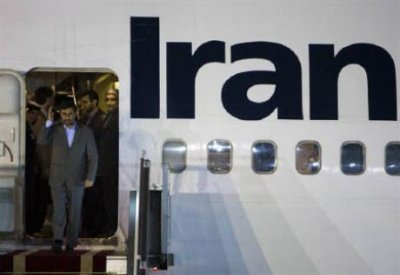
Iranian President Mahmoud Ahmadinejad is seen at International Mehrabad Airport, Tehran, in September 2009. On 5 July 2010, an Iranian official said the country’s aircraft had been denied fuel in Germany, Britain and the United Arab Emirates as a result of tighter U.S. sanctions. Credit: Reuters/Morteza Nikoubazl/Files
US President Barack Obama signed into law last Thursday Congressional legislation against Iran that has the potential to heighten tensions, not only with Tehran, but America’s European and Asia rivals.
The legislation broadly targets foreign banks and corporations doing business in Iran and sets out unilateral US penalties against those that do not fall into line. Companies could be denied access to the US Export-Import Bank, restricting their ability to sell into the US market, or denied US government contracts.
The Comprehensive Iran Sanctions, Accountability, and Divestment Act requires the US Treasury Department to bar access to the American financial system to any foreign bank conducting transactions with Iranian entities blacklisted by the UN or the US government. The list includes some major Iranian banks, the Iranian energy sector, and businesses associated with the Islamic Revolutionary Guard Corps (IRGC).
The legislation provocatively targets foreign companies selling refined petroleum products, such as gasoline and diesel, to Iran, including producers, insurers and those involved in transportation. While Iran has huge reserves of oil, its energy infrastructure and refining capacity are badly rundown due to a lack of investment, forcing the importation of gasoline.
Washington has accused Tehran of seeking to build nuclear weapons. Last month the US and its European allies pushed a fourth resolution through the UN Security Council, imposing new penalties on Tehran over its refusal to shut down its uranium enrichment facilities and halt the construction of a heavy water research reactor. Following the UN resolution, the European Union (EU) foreshadowed further tough sanctions against Iran, including a ban on investment in its energy sector.
The Iranian regime has repeatedly denied it has any plans to build nuclear weapons, and denounced the UN and US sanctions as illegal. Under the Nuclear Non-Proliferation Treaty (NPT), which Iran has signed, countries have the right to develop any aspect of the nuclear fuel cycle, including uranium enrichment and plutonium reprocessing, for peaceful purposes. Iranian nuclear facilities, including the Natanz uranium enrichment plant, are subject to regular International Atomic Energy Agency (IAEA) inspections, which include a stock take of enriched uranium to ensure it is not used for military purposes.
The US legislation goes far further than the proposed EU sanctions and the UN resolutions, to which Russia and China only reluctantly agreed under pressure from Washington. Any significant constriction of the sale of refined petroleum products to Iran could impact heavily on its economy. Although Tehran has been building up its strategic reserves and is cutting back on imports, Iran still buys an estimated 25-30 percent of its gasoline needs on the international market.
The ramifications of the laws are even wider. Democrat congressman Ron Klein told the Wall Street Journal: “Foreign companies are going to have to make a choice: Do they want to do business with us or with the Iranians?” By threatening to penalise foreign banks and companies for activities that are not banned under UN resolutions, the law will inevitably fuel international resentment and intensify frictions.
Total CEO Christophe de Margerie Last week the French oil company Total ended sales of gasoline to Iran and Spain’s Repsol pulled out of a development contract with Royal Dutch Shell for Iran’s South Pars gas field. Total CEO Christophe de Margerie told an economic forum: “We do not think an embargo on the delivery of petrol products is a good way to settle differences of a political nature.” He complained that “too many things are politicised these days”.
In the US, the National Foreign Trade Council and the US Engage alliance of companies and associations also raised concerns, particularly over possible penalties against US parent companies for violations by their foreign subsidiaries. In a press statement, council president Bill Reinsch warned: “We are deeply concerned about the timing of this legislation and its unintended consequences for legitimate global commerce.”
Total is just the latest company to pull out of gasoline sales to Iran. Over the past six months, Russia’s LUKOIL, India’s Reliance Industries, Malaysia’s Petronas, Royal Dutch Shell and the Swiss firm Glencore, each announced a halt to sales. At the same time, several major Chinese corporations, including the state-owned China National Petroleum Corp and China Petroleum & Chemical Corp, reportedly increased their sales to Iran earlier this year.
Under the legislation, the US administration can waive penalties on countries, such as China, that backed the UN resolution against Iran. If Obama took action against Chinese oil companies, tensions would escalate between Washington and Beijing, which only agreed to support the latest UN sanctions if Iran’s energy sector were excluded. China imports roughly 15 percent of its crude oil from Iran and has signed several major agreements to develop energy projects there.
The new US sanctions point to the motivations underlying Washington’s continuing threats and provocations against Iran. American banks and corporations will be largely unaffected, as Washington has effectively blockaded Iran economically for more than three decades following the overthrow of the Shah in 1979. But the penalties will impact on US rivals, including close US allies such as Germany and Japan, that have substantial economic interests in Iran.
The Wall Street Journal pointed out last Thursday: “Among those that could face legal challenges and fines are Japan’s Big Three Banks—Mitsubishi UFJ Financial Group Inc., Sumitomo Mitsui Financial Group and Mizuho Financial Group Inc—as well as European firms such as Commerzbank Bank AB and Deutsche Bank AG, all of whom have businesses inside Iran.” Japan’s oil and gas producer Inpex Corp also has significant interests, including a 10 percent stake in the Azadegan oil field in southwestern Iran.
Iran not only has huge oil and gas reserves but is strategically located between the key regions of the Middle East and Central Asia. The nuclear issue is simply a convenient pretext for Washington to apply pressure in a bid to fashion a regime in Tehran that is more conducive to US ambitions for regional domination. The Obama administration’s overt support for the oppositional Green movement inside Iran, following last year’s presidential poll, had the same aim.
There is a dangerous logic to US attempts to choke off gasoline supplies to Iran. As several articles in the US press have pointed out, even if major foreign corporations pull out of the gasoline trade with Iran, Tehran will still have access to refined petroleum products—at a price—through various black markets operating in the Persian Gulf. If financial penalties fail to stop gasoline supplies and bring the Iranian economy to its knees, a clamor in the US for a military blockade is certain to intensify.
Like his predecessor Bush, President Obama has repeatedly refused to rule out military action against Iran, including air strikes against its nuclear facilities. Any attempt to enforce an economic blockade of Iran through military force—regarded internationally as an act of war—would create an explosive situation in the Persian Gulf.
For further information see "US, Israel Warships in Suez May Be Prelude to Faceoff with Iran"HERE...
Editor's NOTE:
It is pure insanity to start a war with Iran a country which represents absolutely no existential threat to the United States whatsoever! Even Fidel Castro can see that to start a war in the Persian Gulf is to once again (as in 1962) risk a global nuclear conflagration. Once again it is Zionist control of US government foreign policy vis a vis Iran that is responsible for the latest push to war.
Please e-mail, phone, send post cards to your representative, senators and the Obama administration in protest. The latest bellicose moves against Iran are blatantly immoral and extremely dangerous.
--Dr. J. P. Hubert
Friday, July 9, 2010
Peace Movement: Activists In US Demand End to Empire
SPREAD THE WORD ... THE US MILITARY EMPIRE WILL CRUMBLE ... COME AND BE A PART OF HISTORY!
The only way to peace is through the people and obviously not through our corrupt and corporately controlled government.
Most of the rest of the world is aware that the US is a Military/Corporate Empire and that the spread of this Empire is harmful globally to peace, the environment, and economic health.
Part of POTA is to bring awareness to Americans about the profound cost to all of us from this Empire.
To these ends, Peace of the Action is holding Sizzlin' Summer Actions in Washington DC to question, oppose, and educate people about these US policies in particular:
Reliance on oil and the oil.
Increased use of unmanned aerial vehicles at home and abroad.
The lies military recruiters tell our children.
The US's support of Israel's illegal and immoral occupation of Palestine.
Every indicator for quality of life has plummeted in the last 18 months and instead of pretending like everything is okay, it's time to rekindle an anti-war movement to demand an end to the wars we are waging and the crass militarism that harms us all. We need as many people as possible who realize that time is running short for us to truly affect change by commitment and dedication to humanity through the end to the US Empire (and its subsidiaries).
Join us from July 4th to July 17th in Washington DC. MORE from Peace of the Action...
The only way to peace is through the people and obviously not through our corrupt and corporately controlled government.
Most of the rest of the world is aware that the US is a Military/Corporate Empire and that the spread of this Empire is harmful globally to peace, the environment, and economic health.
Part of POTA is to bring awareness to Americans about the profound cost to all of us from this Empire.
To these ends, Peace of the Action is holding Sizzlin' Summer Actions in Washington DC to question, oppose, and educate people about these US policies in particular:
Reliance on oil and the oil.
Increased use of unmanned aerial vehicles at home and abroad.
The lies military recruiters tell our children.
The US's support of Israel's illegal and immoral occupation of Palestine.
Every indicator for quality of life has plummeted in the last 18 months and instead of pretending like everything is okay, it's time to rekindle an anti-war movement to demand an end to the wars we are waging and the crass militarism that harms us all. We need as many people as possible who realize that time is running short for us to truly affect change by commitment and dedication to humanity through the end to the US Empire (and its subsidiaries).
Join us from July 4th to July 17th in Washington DC. MORE from Peace of the Action...
Sunday, June 20, 2010
Armada of U.S. and Israeli Warships Head for Iran
Kurt Nimmo
Infowars.com
June 19, 2010
More than twelve U.S. and Israeli warships, including an aircraft carrier, passed through the Suez Canal on Friday and are headed for the Red Sea. “According to eyewitnesses, the U.S. battleships were the largest to have crossed the Canal in many years,” reported the London-based newspaper al-Quds al-Arabi on Saturday.

The Israeli newspaper Haaretz reported Egyptian opposition HERE...members criticized the government for cooperating with the U.S. and Israeli forces and allowing the passage of the ships through Egyptian territorial waters. The Red Sea is the most direct route to the Persian Gulf from the Mediterranean.
Retired Egyptian General Amin Radi, chairman of the national security affairs committee, told the paper that “the decision to declare war on Iran is not easy, and Israel, due to its wild nature, may start a war just to remain the sole nuclear power in the region,” according to Yedioth Internet HERE..., an Israeli news site.
The passage of a warship armada through the Suez Canal and headed for the Persian Gulf and Iran is apparently not deemed important enough to be reported by the corporate media in the United States.
Egypt recently rejected an Israeli request to prevent Gaza aid ships from passing through the Suez Canal. According to a report by al-Jazeera, HERE... Israel appealed to Egyptians asking them to prevent the passage of Iranian ships through the Suez Canal. The Egyptians responded that due to international agreements on movement through the Suez Canal, Egypt cannot prevent ships from passing through the canal unless a ship belongs to a state that is at war with Egypt. Iran and Egypt are not at war.
The United States and Israel, the sole nuclear-armed power in the Middle East, have not ruled out a military strike to destroy Iran’s nuclear program.
A number of Israeli politicians and scholars have admitted Israel has used its nuclear weapons for “compellent purposes,” in short forcing others to accept Israeli political demands HERE....
Israel’s threats to use nuclear weapons have increased significantly since it was discovered in 2002 that Iran was building uranium enrichment facilities. Israel’s former Prime Minister Ariel Sharon “called on the international community to target Iran as soon as the imminent conflict with Iraq is complete,” the Sunday Times HERE...reported on November 5, 2002. The United States invaded Iraq on March 20, 2003.
Earlier this month Israel leaked to the press that they had permission from Saudi Arabia to use their air space to attack Iran. “In the week that the UN Security Council imposed a new round of sanctions on Tehran, defence sources in the Gulf say that Riyadh has agreed to allow Israel to use a narrow corridor of its airspace in the north of the country to shorten the distance for a bombing run on Iran,” the Sunday Times reported on June 12. On June 14, the ambassador of Saudi Arabia to UK Prince Mohammed bin Nawaf issued a categorical denial of the report.
On June 17, Iran’s parliament warned it will respond in kind to inspection of its ships under a fourth round of sanctions imposed on the country by the UN Security Council. “Even if one Iranian ship is stopped for security-check, we will act likewise and thoroughly inspect any (western) ship passing through the Persian Gulf and the Strait of Hormuz,” member of the Iranian parliament’s National Security and Foreign Policy Commission Hossein Ebrahimi said.
Also on Saturday, Iran accused the United States of “deception” and insisted its missile program is for self-defense after a top U.S. official claimed that Iran had the capacity to attack Europe. “The Islamic Republic’s missile capability has been designed and implemented to defend against any military aggression and it does not threaten any nation,” Defense Minister Ahmad Vahidi HERE...said in a statement carried by state media.
Vahidi announced on April 10 that Iran will use all available options to defend itself if the country comes under a military attack. “Americans have said they will use all options against Iran, we announce that we will use all options to defend ourselves,” Vahidi told the Tehran Times HERE....
Infowars.com
June 19, 2010
More than twelve U.S. and Israeli warships, including an aircraft carrier, passed through the Suez Canal on Friday and are headed for the Red Sea. “According to eyewitnesses, the U.S. battleships were the largest to have crossed the Canal in many years,” reported the London-based newspaper al-Quds al-Arabi on Saturday.

The Israeli newspaper Haaretz reported Egyptian opposition HERE...members criticized the government for cooperating with the U.S. and Israeli forces and allowing the passage of the ships through Egyptian territorial waters. The Red Sea is the most direct route to the Persian Gulf from the Mediterranean.
Retired Egyptian General Amin Radi, chairman of the national security affairs committee, told the paper that “the decision to declare war on Iran is not easy, and Israel, due to its wild nature, may start a war just to remain the sole nuclear power in the region,” according to Yedioth Internet HERE..., an Israeli news site.
The passage of a warship armada through the Suez Canal and headed for the Persian Gulf and Iran is apparently not deemed important enough to be reported by the corporate media in the United States.
Egypt recently rejected an Israeli request to prevent Gaza aid ships from passing through the Suez Canal. According to a report by al-Jazeera, HERE... Israel appealed to Egyptians asking them to prevent the passage of Iranian ships through the Suez Canal. The Egyptians responded that due to international agreements on movement through the Suez Canal, Egypt cannot prevent ships from passing through the canal unless a ship belongs to a state that is at war with Egypt. Iran and Egypt are not at war.
The United States and Israel, the sole nuclear-armed power in the Middle East, have not ruled out a military strike to destroy Iran’s nuclear program.
A number of Israeli politicians and scholars have admitted Israel has used its nuclear weapons for “compellent purposes,” in short forcing others to accept Israeli political demands HERE....
Israel’s threats to use nuclear weapons have increased significantly since it was discovered in 2002 that Iran was building uranium enrichment facilities. Israel’s former Prime Minister Ariel Sharon “called on the international community to target Iran as soon as the imminent conflict with Iraq is complete,” the Sunday Times HERE...reported on November 5, 2002. The United States invaded Iraq on March 20, 2003.
Earlier this month Israel leaked to the press that they had permission from Saudi Arabia to use their air space to attack Iran. “In the week that the UN Security Council imposed a new round of sanctions on Tehran, defence sources in the Gulf say that Riyadh has agreed to allow Israel to use a narrow corridor of its airspace in the north of the country to shorten the distance for a bombing run on Iran,” the Sunday Times reported on June 12. On June 14, the ambassador of Saudi Arabia to UK Prince Mohammed bin Nawaf issued a categorical denial of the report.
On June 17, Iran’s parliament warned it will respond in kind to inspection of its ships under a fourth round of sanctions imposed on the country by the UN Security Council. “Even if one Iranian ship is stopped for security-check, we will act likewise and thoroughly inspect any (western) ship passing through the Persian Gulf and the Strait of Hormuz,” member of the Iranian parliament’s National Security and Foreign Policy Commission Hossein Ebrahimi said.
Also on Saturday, Iran accused the United States of “deception” and insisted its missile program is for self-defense after a top U.S. official claimed that Iran had the capacity to attack Europe. “The Islamic Republic’s missile capability has been designed and implemented to defend against any military aggression and it does not threaten any nation,” Defense Minister Ahmad Vahidi HERE...said in a statement carried by state media.
Vahidi announced on April 10 that Iran will use all available options to defend itself if the country comes under a military attack. “Americans have said they will use all options against Iran, we announce that we will use all options to defend ourselves,” Vahidi told the Tehran Times HERE....
Sunday, May 23, 2010
Wesley Clark Warns that AIPAC is Pushing for War with Iran
Zionist Lobby Pursues American attack on Iran for "benefit" of Israel...
"Israel Told US to Bomb Iran or the Jewish State would do so..."
"Israel Told US to Bomb Iran or the Jewish State would do so..."
Subscribe to:
Posts (Atom)